
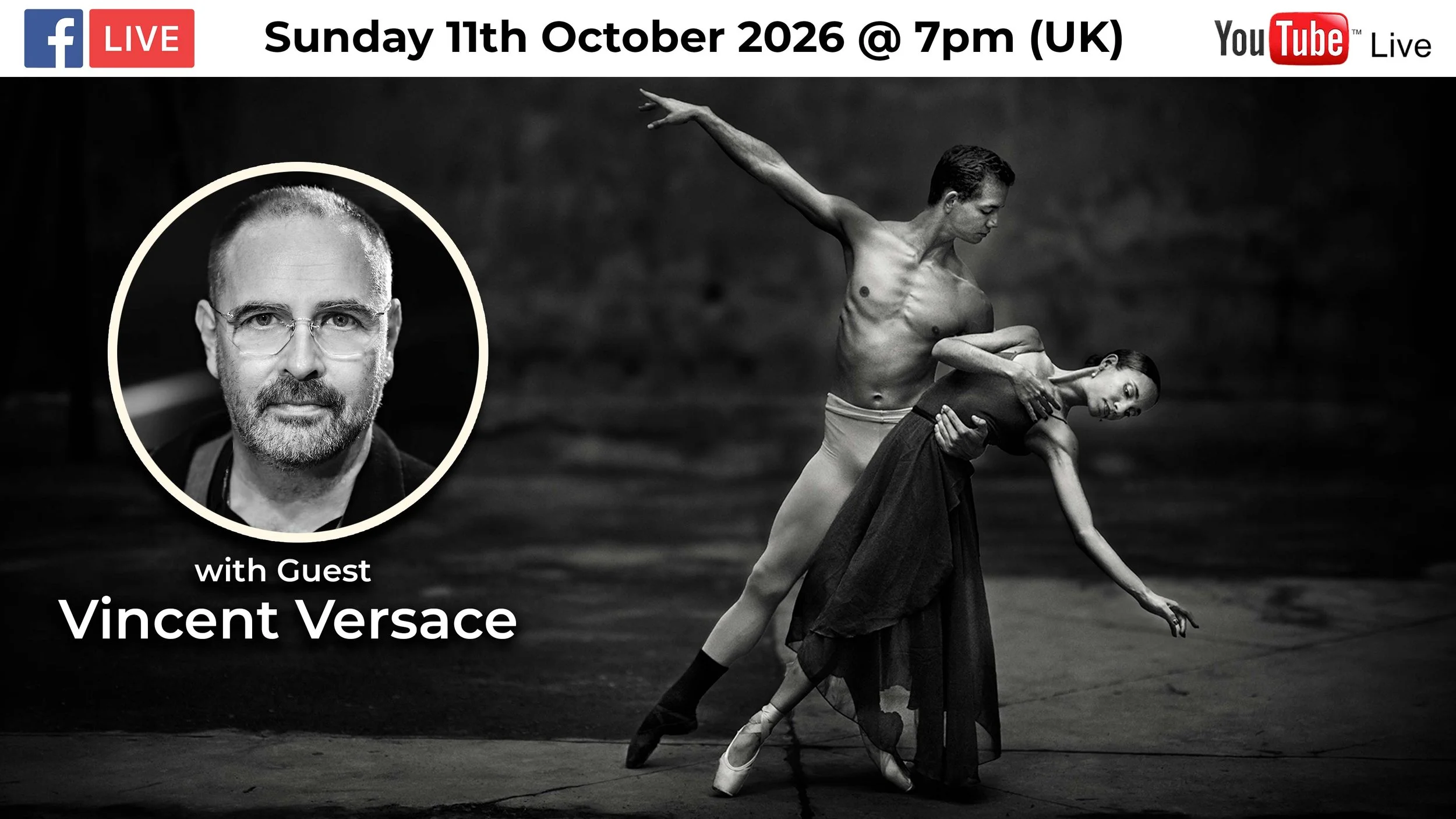
I was joined on Sunday Night Live by my friend Vincent Versace, and if you caught him the first time round you’ll know what to expect; it’s an open, honest conversation that ends up being incredibly motivating without either of us really trying. Plenty of you asked to have him back, so here’s the full chat along with some of the things that have stuck with me since.
Don’t pigeonhole yourself
I started by asking Vincent whether photographers should pick a niche, because looking through his work for the promo there’s portraits, wildlife, still life and everything in between. His answer was that if you want to master something you should master all of it, and he told a story about a friend from grad school who learned to play almost every instrument in the orchestra because he wanted to be a conductor, and the symphony was his instrument.
Vincent shoots his landscapes like portraits and his portraits like landscapes, and he puts it this way: if you only do one thing, that thing becomes a groove, then a rut, then a hole, then a grave, and then you’re wondering why nobody’s hiring you anymore.
That landed with me this week. I’ve gone full circle back to Canon, and I was out on Sunday morning with my friend Ben photographing birds for the very first time. I was like a kid in a sweet shop, and I genuinely felt like I was doing portraits of the birds. Vincent’s response was simple; a portrait shows the best of a person or a thing, so why should a bird or a flower be any different?
Just take the pictures
Vincent got hooked at seven, watching his uncle, a wedding photographer, print a picture in the darkroom. He sold his first photograph at nine and shot his first wedding at sixteen, and his rule hasn’t changed since: if it looks cool, take a picture of it.
He was teaching a workshop in Maine the week we spoke, and he told me he wasn’t going to tell his students that autumn colour is one of the hardest things to photograph, because if they don’t know it’s hard they won’t make it hard. He reckons he’s shot more bad photographs than my entire audience put together, but he just doesn’t show them, and that’s where his line “from fertiliser, flowers grow” comes from. You have to shoot an awful lot of rubbish to get to the gems.
The bit I keep coming back to is letting the picture take you rather than you taking the picture. If you’re busy working out what it is in the moment, the moment’s gone.
Let the camera do the work
On the technical side, Vincent believes every decision about a photograph happens at the moment of capture, and the more you understand about editing, the better those decisions get. However, the aim is for all that knowledge to sit in your unconscious mind so you’re not juggling it while you shoot. He knows how to focus manually and how to expose, but he hands all of it to the camera because it can track an eye faster than he ever could, which frees him up to pay attention to what’s happening in front of him.
He also made the point that the word amateur comes from the Latin for doing something simply for the love of it, and that’s where your head should be. He’d far rather be an amateur than an expert, and his childhood joke book definition of an expert had me laughing; “ex” is a has-been and a “spurt” is a drip under pressure.
Art, and making a picture
Vincent thinks photography is the only art form where owning the instrument makes you a practitioner; nobody buys a cello and calls themselves a cellist. He doesn’t call himself an artist either. To him, art is something other people accuse your work of being, and until then it’s expression, a postcard from the vacation of his life.
I’ve always struggled with calling myself an artist, so it was good to hear someone put it that way.
I also asked him about saying “make a picture” rather than “take a picture”, because when I first heard it years ago I thought it sounded pretentious, but my view’s changed. The way Vincent sees it, the lens is his brush, the sensor is the canvas, the file is the sheet music and the final image is the symphony. Pictures don’t come out of the camera finished, and as he put it, the boon of digital is that you have total control, and the bane of digital is that you have total control.
Remembering Jay Maisel
We lost Jay Maisel back in August. I was lucky enough to meet Jay a few times at the conferences Vincent and I were teaching at in the States, but the two of them were close friends for 37 years, ever since they ended up sitting next to each other on a panel.
Vincent described his most perfect day as a photographer, spent with Jay in New York. It started with cigars at half eight in the morning, and at one point Jay stood next to a rubbish bin, looking from the bin to Vincent and back again, while Vincent walked past it three times thinking it was just a bin. Back at Jay’s building, Jay showed him a frame of blurred colour, shadow and geometric shapes, and it was that bin.
Later, sitting in Jay’s kitchen on the sixth floor with the Empire State Building in the window at sunset, a white “I ♥ NY” bag floated up and hovered in the frame, moving from spot to spot as if it were asking where they wanted it. Both cameras were five floors down. They called it the cyber chrome that got away, a picture taken with your mind, and it was a running joke between them for 20 years.
When I asked what Jay saw that the rest of us don’t, Vincent said he was always childlike and had the ability to slow down to the speed of life. Jay trained as a painter under Josef Albers at Yale, and for him gesture came before everything. That’s also Vincent’s take on black and white; it works when the colour gets in the way of the gesture, rather than being about contrast for its own sake.
Jay’s mantras still come into Vincent’s head when he’s shooting. Be taken by the picture. Photography is unrequited love, and Jay’s own line was that he fell in love a thousand times a day, usually for 1/125th of a second. Fill the frame and own every millimetre of it; Jay never cropped. He treated light like a solid object that the subject interrupts, and he’d take a line of washing in beautiful light over the Taj Mahal in poor light every time.
About ten years ago Vincent was ready to walk away from photography altogether, and Jay told him that if he’d already shot that tree, he should shoot it again, because he’d see it differently. Vincent has photographed the Golden Gate Bridge for over 40 years, and while plenty of those pictures are clichés, plenty of them are completely unique because he kept going back. In his words, mastery is the variation of repetition over time.
Photography today
Asked whether he’d want to be starting out now, Vincent gave the same advice he’s given for 20 years: consider a career in plumbing. If you can’t do anything else, though, keep the love going, and if it stops making you happy, find the joy again or step away and come back when you can.
His biggest sorrow for people coming up today is that there are no heroes anymore, just influencers. He grew up studying the greats and living and breathing Jay’s work, whereas now we scroll past images so fast we never let any of them take us. For Vincent, the power of a still photograph is that it freezes the moment that took the photographer, and AI images feel sad to him because there’s no feeling in them.
I’d been thinking about the guy who vibe coded his own version of the Adobe apps, and it made me realise that the future isn’t really the editing software, because that will always change; it’s the craft. Vincent agreed, and he’s not anti-AI either. He uses the AI remove tools because they do a better job of cleaning up an image, and he’s used generative tools to rescue a couple of soft film scans, but he doesn’t make AI pictures. When I asked whether people writing prompts are photographers, he said no; he thinks they’re authors.