I've spent a fair bit of money over the years on lighting, cameras, and lenses. They're nice to have, don't get me wrong, but none of it means anything if the person in front of your camera isn't comfortable.
I learned this properly a few years ago, and it changed the way I work.
If someone isn't comfortable with you, it shows in the pictures straight away. They go stiff, they look posed, and no amount of expensive lighting or technical wizardry fixes that. Comfort comes first. The camera comes second. Always.
Here are seven things I've picked up through trial and error that genuinely improve your portraits. No complicated techniques, no expensive gear, just things that make a real difference.
1. Give yourself time before picking up the camera
I never go straight in with the camera. Before I even think about lighting or where someone's going to sit or stand, I spend time with them first, just talking. Sometimes that's ten or fifteen minutes, sometimes longer. Sometimes I'll meet someone for a coffee beforehand purely to get to know them.
This really clicked for me during my 39-45 Portraits Project. I was photographing people who'd lived through the most extraordinary times, and honestly, I just wanted to hear their stories. I'd talk with them for a good while before picking up the camera. There was no grand plan behind it, I was just genuinely interested. But when I looked back at the pictures afterwards, I noticed something: the more time I'd spent talking with someone, the better their portrait turned out. They actually looked like themselves, not a posed version. A great portrait starts with a real conversation, not with the camera.
2. Ask people about themselves
If you're meeting someone for the first time and you're not quite sure what to say, here's something that works well: ask them about their world. Their work, their family, their hobbies, what they get up to at weekends. People generally love talking about themselves, and when you're genuinely curious, the conversation just flows.
I've got a bit of a fascination with TV programmes about surgery. In a recent episode of Surgeons at the Edge of Life, I noticed something interesting. Just before a patient goes under anaesthetic, the anaesthetist doesn't start talking about the operation. They ask about the patient's family, their holidays, their life, and the patient drifts off completely calm. People feel far more at ease talking about themselves than almost anything else.
There's a little phrase I keep coming back to: MMFI, "Make Me Feel Important." It's not manipulative. It's just a reminder that people relax when someone shows a genuine interest in them.
3. Keep talking while you're actually shooting
This might sound a bit odd at first, but I never have a moment where everything goes quiet and still just before I take the portrait. There's no "ready" moment. That approach has never worked for me. The conversation just keeps going right through the shoot, even once the lighting's sorted and I'm ready to take the shot.
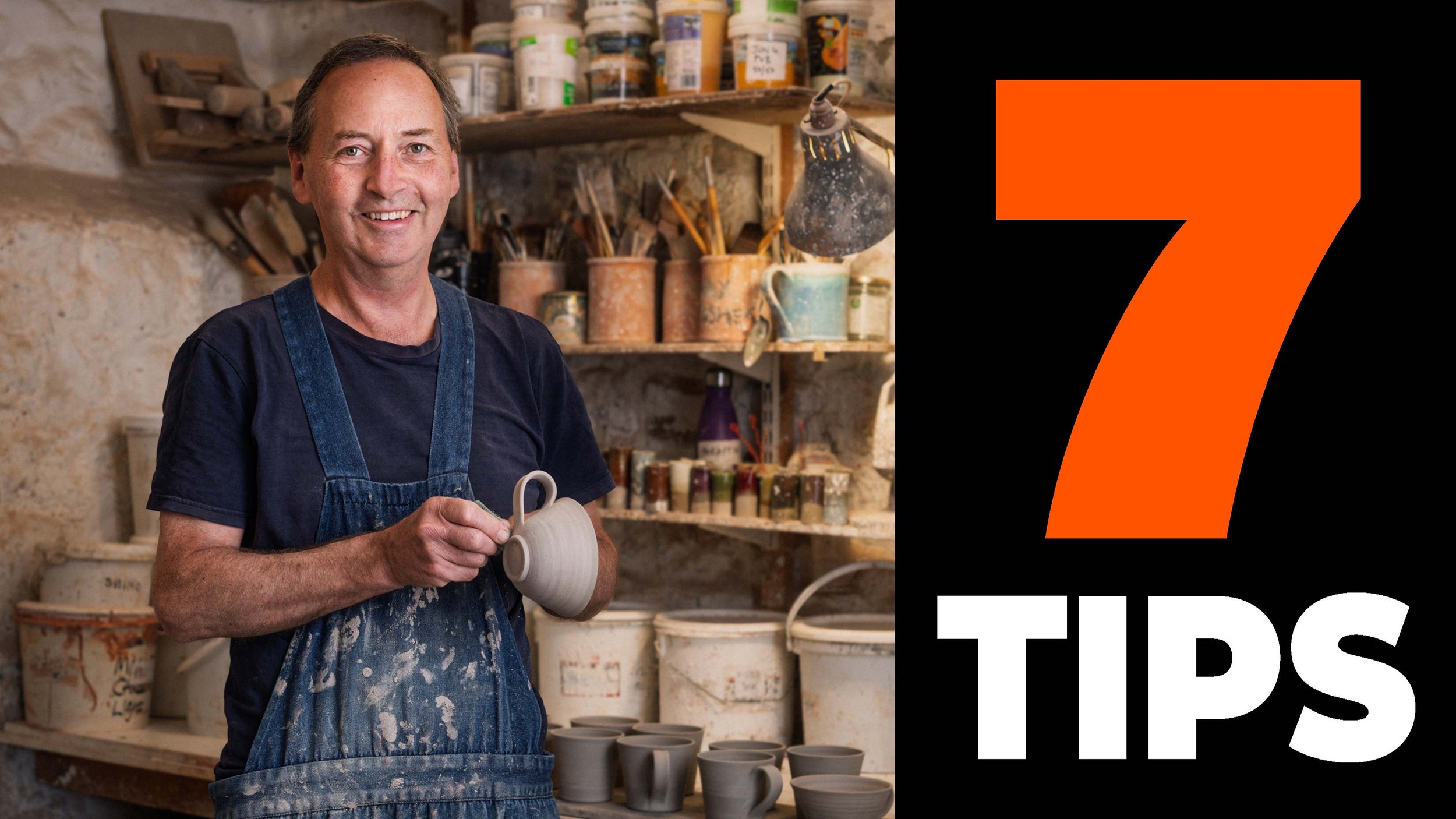
I did a shoot recently with Harry Anderson, a potter here in Lyme Regis. Instead of posing him for the camera, I simply asked him to carry on with what he was already doing, smoothing down a piece of pottery. I let him keep going, and every now and again I asked him to turn his gaze towards the camera, but we were chatting the whole time. That's when the best pictures happen. Not when everything's gone still and formal, but when someone's genuinely being themselves.
4. Try not to overdirect
Something I've noticed time and time again: the more you tell someone exactly what to do, the more uncomfortable they become. The moment you say "stand like this," "put your hands here," or the funniest of all, "look relaxed," someone who isn't used to being photographed will tense up almost immediately. You can watch it happen.
You might spend twenty minutes building up real comfort and ease, and one single instruction like that can undo the whole lot. Keep your directions to an absolute minimum and keep the conversation running instead. Let people find their own natural position and expression in their own time.
5. Be willing to adapt
I remember photographing a veteran who, day to day, always wore a shirt and a dicky bow. That was just how he dressed, that was him. When I turned up, sure enough, that's exactly what he had on. He mentioned to me almost in passing, "Do you want me to put my jacket and medals on?" But I could hear it in the way he said it, he didn't really want to. That wasn't him day to day. So I said, "No, we'll just photograph you as you are." And the pictures were so much better for it.
If I'd asked him to change into something that wasn't really him, he wouldn't have looked anywhere near as comfortable. Learn to properly listen and photograph people as they actually present themselves, not how you think a portrait of them is supposed to look. Read what the person in front of you actually needs, not what you'd planned on the way there.
6. Your own calm matters more than you think
Years ago I used to teach conflict management, and there's a model from that world called Betari's Box that's stuck with me ever since, because it applies just as much to a portrait shoot as it does to any difficult situation. It goes like this: my attitude affects my behaviour, my behaviour affects your attitude, which affects your behaviour, and round it goes again. It's a loop constantly feeding itself.
If you turn up stressed, that stress comes out in your behaviour whether you mean it to or not. The person you're photographing picks up on it, and it affects how they behave in front of you. Once that loop starts running in the wrong direction, you're on a loser from the start, and no amount of good lighting fixes it.
But it works the other way round too. If you show up calm, even if you're not feeling entirely calm inside, that calm comes out in your behaviour and feeds into their attitude. The way I get to that calm is by keeping things simple. Don't try to be clever with your lighting or overcomplicate your setup, especially not the first time you're photographing someone. Save the clever stuff for the second or third time, once you've got to know each other. A simple setup keeps you calm, and your calm is what the whole loop depends on.
7. Under-promise and over-deliver
When someone asks how long a shoot's going to take, I'll usually say around an hour and a half as an example, but I'll aim to be done and dusted after about an hour. Go before you're expected to go, rather than overstaying your welcome.
I heard some nightmare stories during the veterans project around this. Photographers would turn up at someone's house and stay for several hours without really reading the room. When I spoke to one of the veterans afterwards, he told me it had all gone on far too long and he'd been exhausted by the end of it. It clearly hadn't been a good experience, and the photographer concerned hadn't picked up on any of that. It all comes right back to people skills, reading the room, reading the person, and knowing when enough is enough. Under-promise on the time, over-deliver on the experience. Leave while they still want a bit more, rather than after they've had quite enough.
It's not about the kit
If you're a portrait photographer looking to improve, maybe the next thing worth reading isn't about photography at all. Maybe it's about people.
People skills are the most underrated, most forgotten skill in this whole craft. Over the years it's become all about the kit, but the kit really is secondary. People skills come first, and the portraits follow on naturally from there.
Check out the full video above for a deeper dive into these tips, and let me know in the comments which of these makes the biggest difference in your own work.
Cheers,
Glyn