I knew Sunday Night Live with Gary Williamson was going to be good, but I didn’t expect quite the kick up the backside that it turned out to be. Gary is a street and portrait photographer from Lancashire who has been blind for over 35 years, and as I said on the night, I can see and I can’t do what he does.
A big thank you to Lee Churchill for nudging me to get Gary on, and you can follow his work on Instagram at @swirly_magnolia. The full conversation is in the video above, but here’s an overview of what we talked about.
Why he says blind photographer
Before we got into anything else, I asked Gary how he’d like me to refer to his sight. He uses the terms blind photographer and blind person because, after years of working on disability issues around the country, he feels they carry political weight. He’s also keen for people to understand that blindness is a spectrum, and that it doesn’t mean everything is black.
He showed us what that looks like for him. Walking into a low sun is a complete whiteout, and anyone who’s backlit becomes a flat silhouette with no features at all, even from around six feet away. Turn that person towards the light, though, and as the contrast comes, features start to pop. There’s a pink haze over everything too, and his sight falls away so quickly with distance that, depending on the light, someone can be standing next to him without him knowing.
It’s a hereditary condition that damages the optic nerve, which is why glasses don’t really help.
Gibraltar, and one very long lift
I had no idea about this part of Gary’s story. At 18 he hitchhiked down to Gibraltar looking for work, sleeping rough, when he woke up one day and couldn’t read his book. Over the next few days his sight got worse every time he woke, until he looked in a mirror and couldn’t see his own face.
This was around 36 years ago, so there was no mobile phone to fall back on and Gary’s plan was simple; he’d got himself down there, so he’d get himself back. He sat waiting for a lift until an American lad pointed out that he was in the wrong place, as those were the Spanish wagons and the English ones came out a hundred metres to the left. Gary walked across, and before long a wagon pulled up with a Lancashire driver who offered him a lift as far as Bolton, which was one bus ride from his house.
I asked whether it had made him grow up quicker, and he told me he thinks it’s the best thing that could have happened to him, because being thrown in the deep end gave him the belief that he could rely on himself.
From the darkroom to a little Olympus
Gary had been to art college before all of this and loved the magic of the darkroom, watching an image float up in the chemicals. He kept shooting film after he lost his sight, but other people had to describe the pictures to him.
Digital brought him back in. Around 2006 he got a small Olympus Mju, and when he put the pictures on a computer and got his nose right up to the screen, he could see things again. He said it was almost like the darkroom, because he didn’t know what he had until he got home.
Watching the light
Gary told me that photography lets him explore the world he can hear going on around him. He’ll pass a sound or a pattern of light, then use the camera to find out what it was.
With portraits he gets very close and watches the light travel across someone’s face as they move, which he compares to watching waves in the sea. “I’m not looking at them, I’m looking at the light,” as he put it, and he thinks people can tell. That struck a chord with me, because when I shoot tethered I get a far better reaction from telling someone how good the light looks on them than from telling them they look amazing. Gary’s view is that people don’t really believe compliments anyway.
He also told a great story about photographing a group of young people having coffee. He got them posed, explained that he couldn’t see them once he stepped back, then let his white cane drop open to a chorus of “you what?”
Why sighted people are at a disadvantage
That’s the title of the TED Talk Gary wants to give. His point is that sighted people take in nearly everything through a window in front of them and have to turn round to see anything else, whereas his world is 360 degrees.
He described walking down a wet street in Manchester, hearing high heels behind him and the rain falling on a woman’s umbrella, smelling perfume from an open doorway and feeling a pane of glass that might give him a reflection shot. He knows she’s distracted because he can hear her on the phone, so he moves to the right to steer her into the light on his left. All of that happens in about five seconds, before he’s even looked at her. I told him his name must be Peter Parker.
The camera work happens the same way. In Naples he could hear a bike changing gear as it came towards a junction, so he knew it was about to slow down and could get his settings ready. He hears a piano from two blocks away and sets his aperture by touch as he walks towards it, and on a lens with an aperture ring, f/2.8 to f/8 is just nine clicks. He also talks to himself the whole time, as a checklist.
Competing with yesterday’s Gary
Gary stopped comparing himself with sighted photographers and now competes with who he was yesterday. If yesterday’s Gary was too slow on the shutter or lacked the confidence to ask someone for a picture, today’s needs to do better. He says he’s never had a nasty response from asking, just a conversation that sometimes goes in his favour.
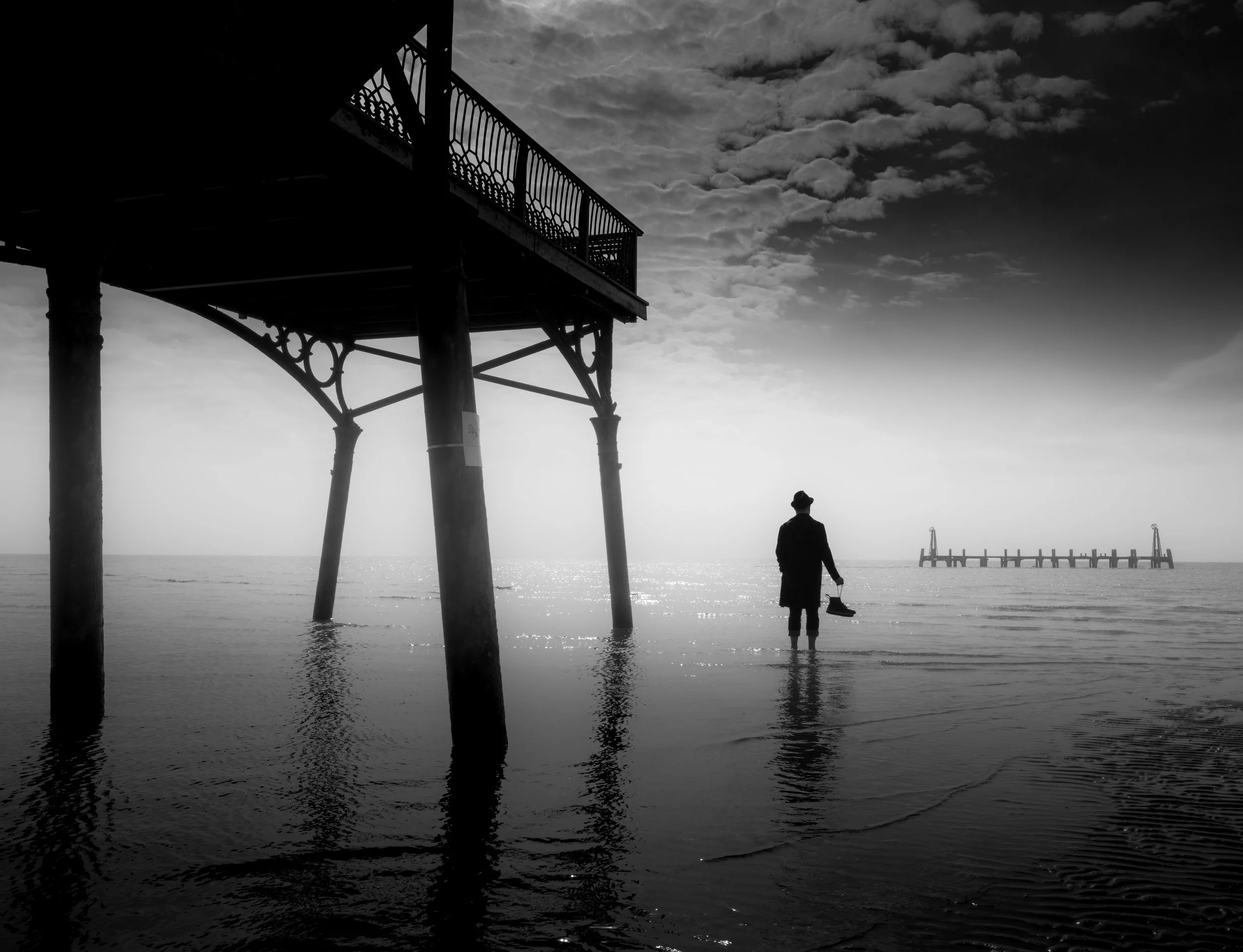
He only keeps a picture if it tells a story or leaves you with a question. One of his favourites came from a zebra crossing, when he was told a man was coming towards him. He dropped to one knee, stood his ground and shot, feeling someone else walk through behind him as he did. He saw none of it until afterwards, or as he put it, “look what the universe gave me”.
Editing in black and white on an iPad
Gary is colour blind, which is one reason he works in black and white, but he still uses the colour sliders to learn about a picture. If he moves the green slider and part of the image shifts, he knows that part’s green.
His pictures go into collections in Lightroom Classic, then he edits the smart previews on a 13-inch iPad using Lightroom on the iPad. He wrote off an iPad Pro by sitting on it, which he told us about with some pain. He converts to black and white and crops first, having shot slightly wider than he needs so he doesn’t cut anything important out. Then he pushes the exposure slider right up and back down to see what’s in there, and sometimes finds a person he had no idea was in the picture.
To see the detail, he uses pinch zoom, a three-finger zoom on the iPad and a 20x magnifier held in his eye, about a centimetre from the screen. Masks come early in his edit, and rather than worrying about whether something’s too black, he edits for the feeling and the story.
He admires the storytelling of Jack Vettriano and Gregory Crewdson, and he likes Alan Schaller’s work too, but he says his style grew out of what he needs, and I think that’s a big part of why it’s so recognisable.
A talking camera and glasses that describe the view
Gary’s Sony reads its menus out loud, and he has the voice set so fast that nobody else can follow it. What he values most is the confidence it gives him to be out there shooting, and it also gets people talking. He doesn’t want a camera telling him when there’s a picture, as that’s his job, but he’d love a beep for when it’s level, and for it to read out his settings when he looks back through his pictures.
His Meta glasses have been a game changer in everyday life, from shopping to reading things, but what he enjoys most is asking them to describe a scene in a sensory way. Hearing rolling green hills and light moving across the ground described to him warms his heart, as he put it, because he feels involved in the world around him. I’ll admit that made me look at that kind of technology differently.
Five minutes with your eyes closed
When I asked what he’d like people to take from the live, Gary said that anything’s possible, but he also gave us something to do. Next time you’re in a cafe or out in the woods, close your eyes for five minutes and listen.
You might hear a dog scratching under a table before it settles down, someone stirring their tea, the barista tapping three times and wet footsteps coming through the door with a cold breeze behind them. Then notice the smell of the coffee and how the seat feels underneath you. Gary’s suggestion is to keep doing that and bring it into your photography, and having heard what he picks up in five seconds on a wet street in Manchester, I think he’s right about how much the rest of us are missing.