
I was down on the beach at Lyme Regis at 7 yesterday morning for the next set of portraits for my “I am Lyme” project, this time with early morning sea swimmers, Mary and Christine; Mary runs the Axminster and Lyme Regis Cancer Support, and Christine, an artist and also the wife of Harry May, one of the fishermen I photographed a good few weeks back.
Waiting for them to come out
Low tide had been at around half four, and we were shooting at seven, so the sea was on its way back in but still a fair way out, so I waited until they'd had their swim and photographed the two of them together right on the water's edge, wet hair and robes.
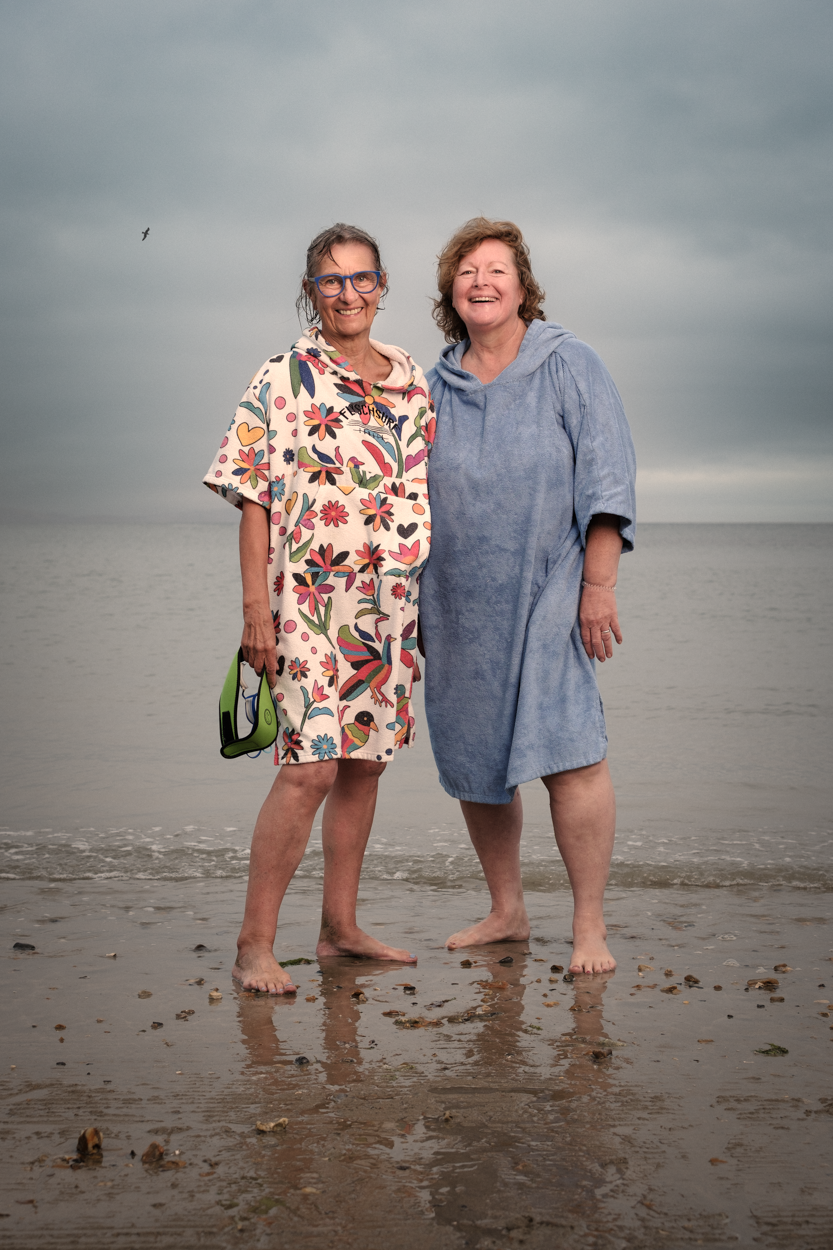
Christine and Mary
My dear friend Steve Healy came along to help out and did a top job holding the light, which meant I could spend the time talking to Mary and Christine rather than fiddling about with a stand.
And then Neptune turned up
This is the part I couldn't have planned.
While we were shooting, Mary and Christine spotted a chap they knew coming out of the sea and pointed him out to me; Nick, known affectionately as Neptune, another early morning sea swimmer that has done so pretty much his entire life of 83 years; yeah I know what you’re thinking “He’s 83??” Yep, looks amazing huh. I guess there’s something in this sea swimming.
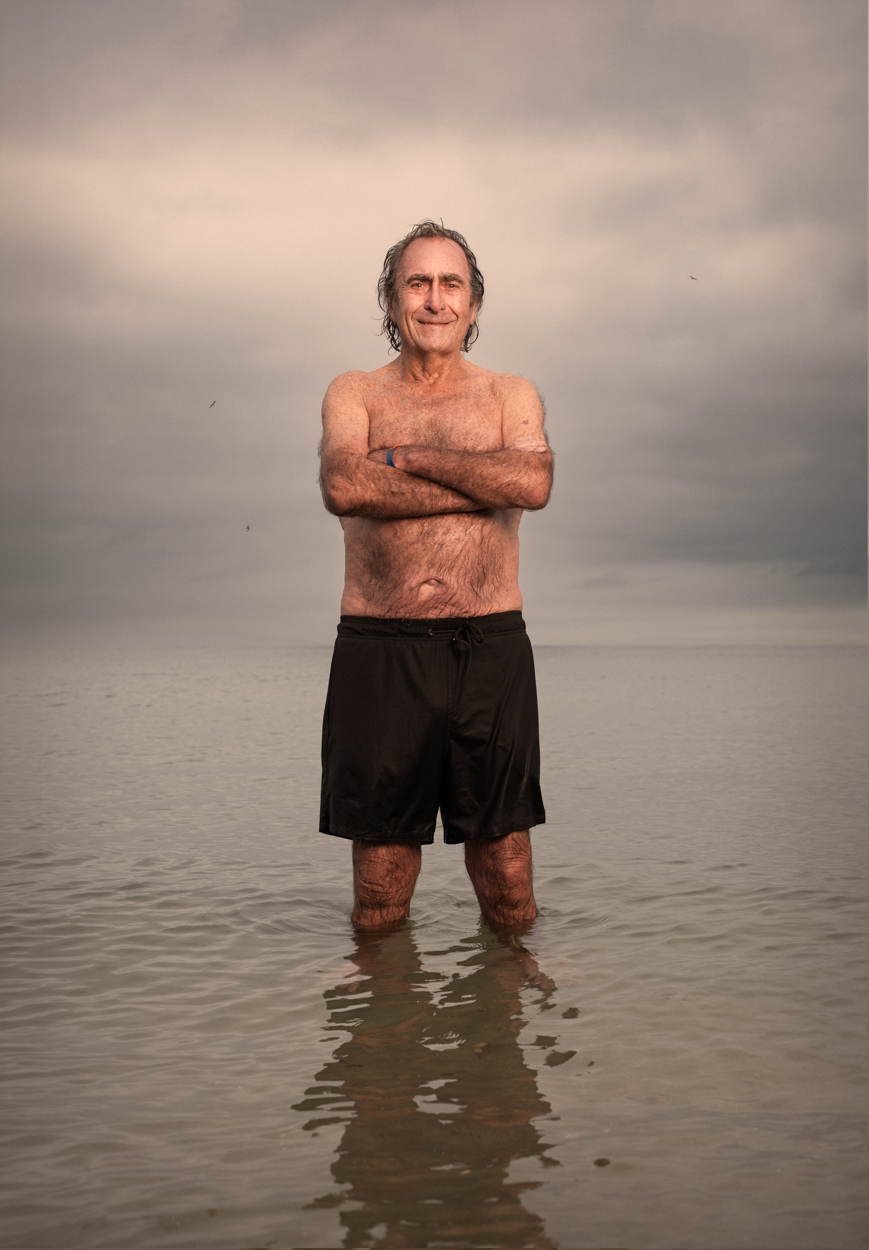
Nick aka Neptune
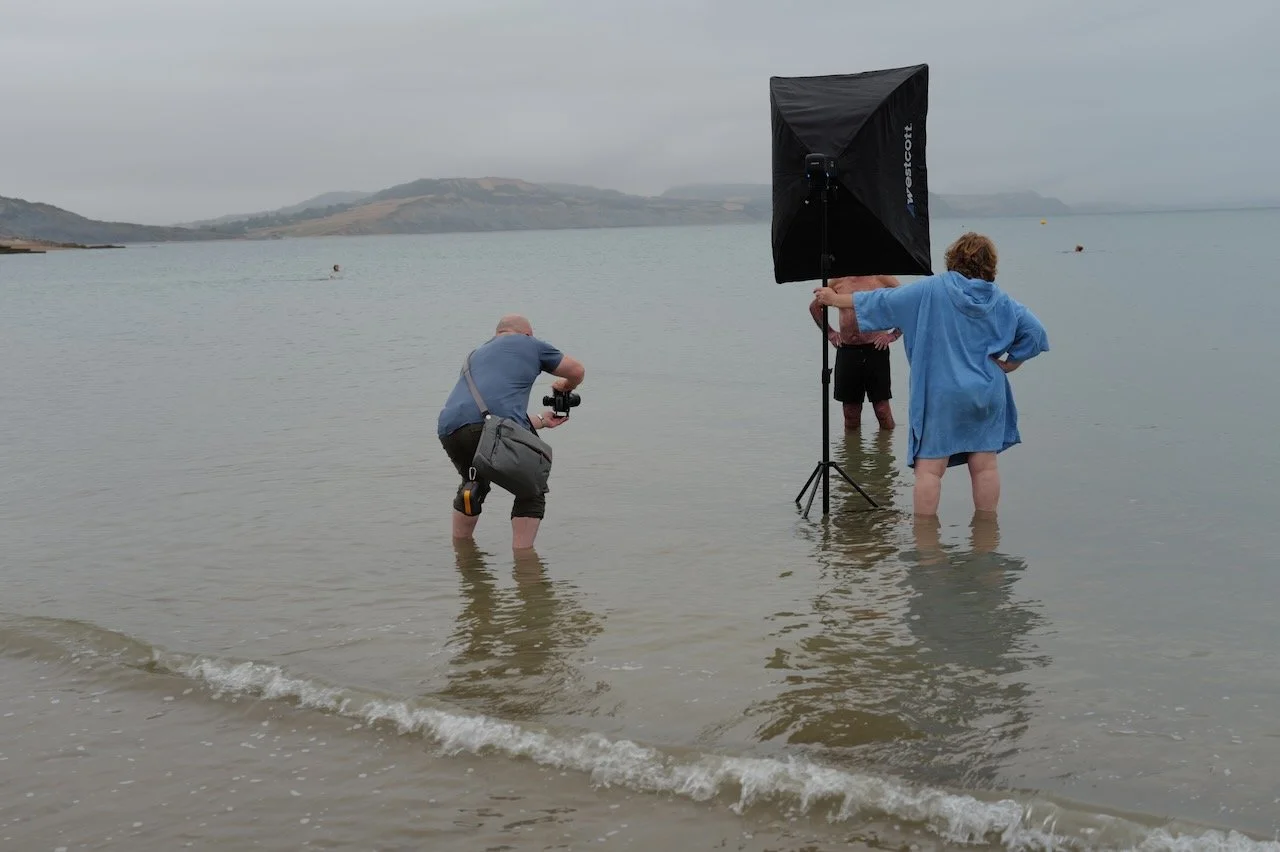
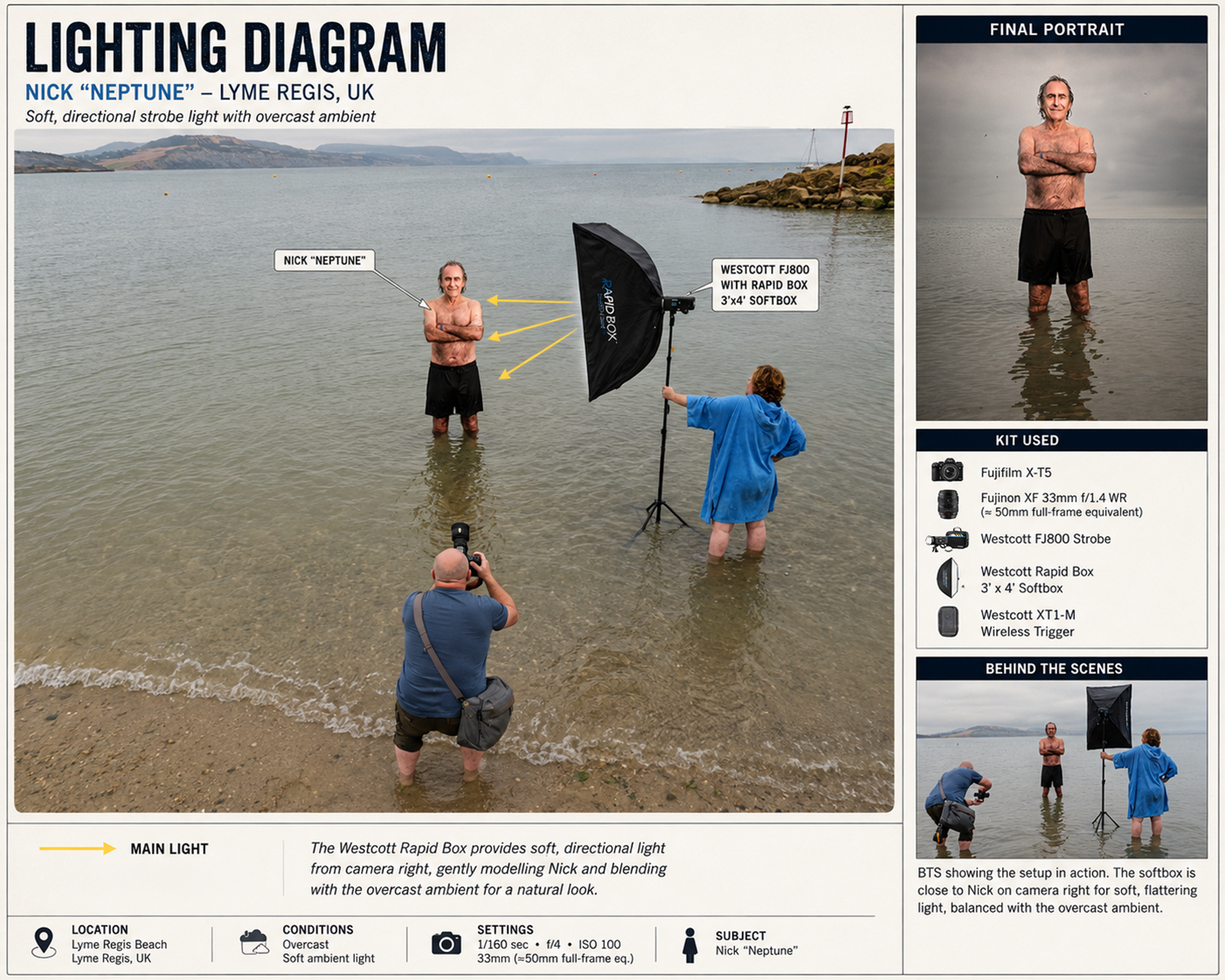
Anyway, they called him over and he was keen from the off, which always helps. For him though it had to be in the water, because anywhere else would have been wrong, so it was trainers off, trousers rolled up and in I went. Mary took over the light for that one, stood in the sea alongside me, and it was done in a handful of frames.
What I used
the Westcott FJ800 strobe
the Westcott Rapid Box, 3ft by 4ft softbox
the Fujifilm X-T5 with the 33mm f/1.4 WR lens
the Westcott XT1-M wireless trigger
That's the lot, and you'll notice there's no neutral density filter on that list.
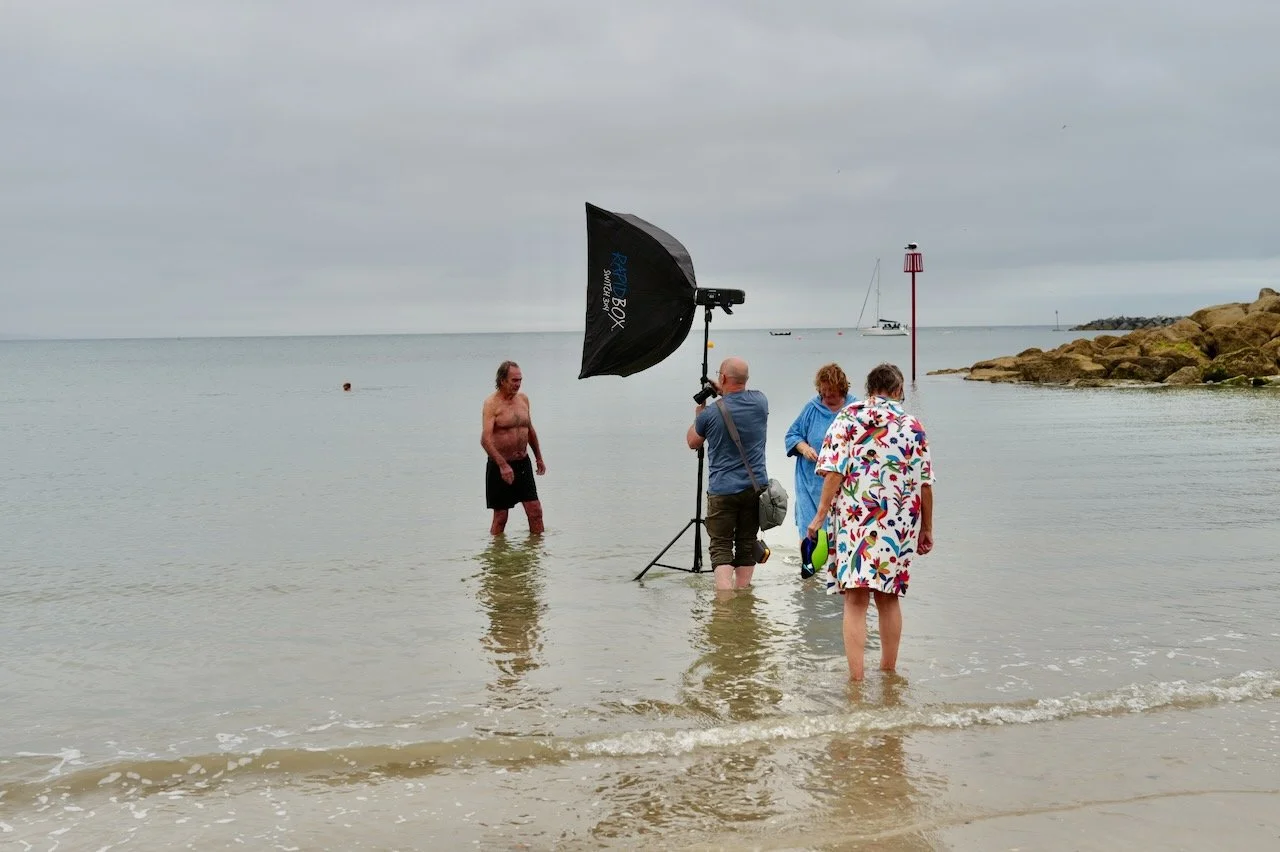
The settings, and why there's no ND filter
Normally on the seafront I'd have one on to keep the shutter speed within sync while I'm shooting wide open, and to hold on to the detail in the sky. This morning was properly overcast though, so the sky was doing nothing dramatic and there was nothing to rescue. The grey did the job for me.
My Fujifilm X-T5 was in Manual with the following settings used to “set the scene” …
1/160 sec, f/4, ISO 100, with the 33mm giving me roughly the 50mm equivalent on the X-T5.
For the flash, the FJ800 went into TTL first, purely to get the exposure right on the skin, and once it was there I locked it in using the TTL to manual function, which I keep banging on about. From that point on it fires exactly the same every single frame, so nothing shifts as I move around or recompose. It takes seconds to do, and on a morning when your subjects have just got out of the sea, seconds matter.
Matching the shadows, which is the bit most people miss
The softbox was in as close as I could physically get it, just out of frame, and that was a deliberate decision rather than habit.
When you're using flash outdoors, most of the attention goes on balancing the flash with the ambient, so the two brightnesses sit together and it doesn't look lit. That's only half of it. You also have to match the quality of the light, meaning the shadows your flash makes need to look like the shadows already in the scene, whether those are hard or soft.
Yesterday morning was flat and overcast, so the light on everything around us was very soft, with shadows that were barely there. If I'd lit Mary and Christine with something small, or with a big modifier pulled back a long way, I'd have put a harder shadow on their faces than anything else in the frame had. The eye picks that up straight away, even when the person looking can't tell you what's wrong with it. It's one of the biggest giveaways that a flash was used.
So a 3ft by 4ft box, in tight, giving light almost as soft as the morning itself. On a hard, bright day I'd want the opposite, something that puts a shadow on the face with an edge to it, because that's what the sun is doing to everything else.
It's worth paying as much attention to that as you do to which modifier you own. Same softbox, wrong distance, and the picture tells on you.
BIG Thanks to Steve for holding the light all morning, to Mary for taking over when I waded in, and to Christine and Nick for being so game about the whole thing.