behind the scenes

Up Early and Gifted with a Fabulous Sunrise

Headed out early yesterday morning to photograph sunrise on the coast, with the tail end of the recent storms still hanging around.

The plan was Charmouth, but when we got there not much was happening, so we carried on down to West Bay. Very glad we did.

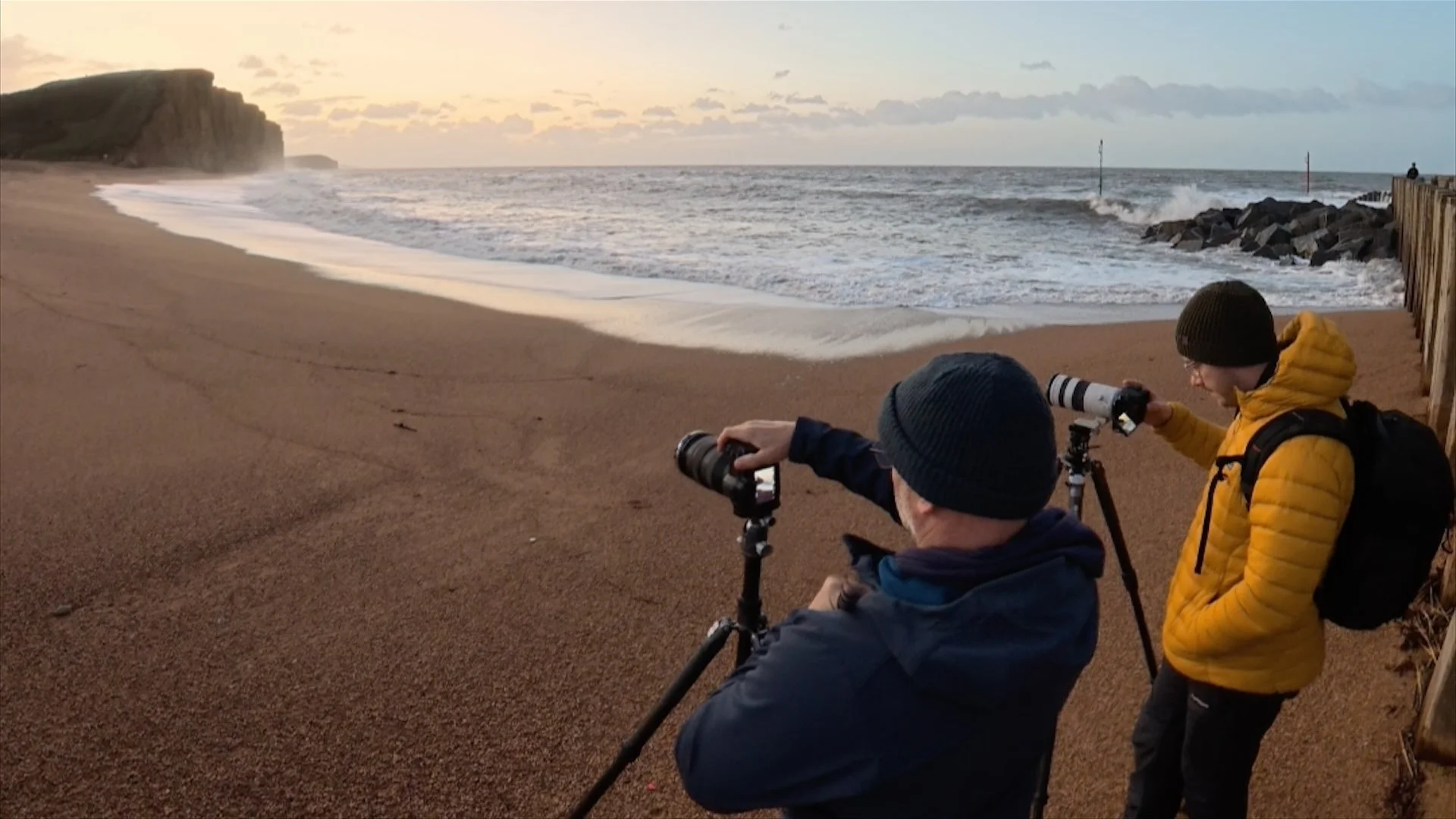
We (me and my friend Ben Kapur) got ourselves into position knowing where the sun would be coming up. It looked good, but the light was so flat. There were clouds, but the sky was just grey and featureless.

Two photographers with cameras on tripods on the beach at West Bay at sunrise

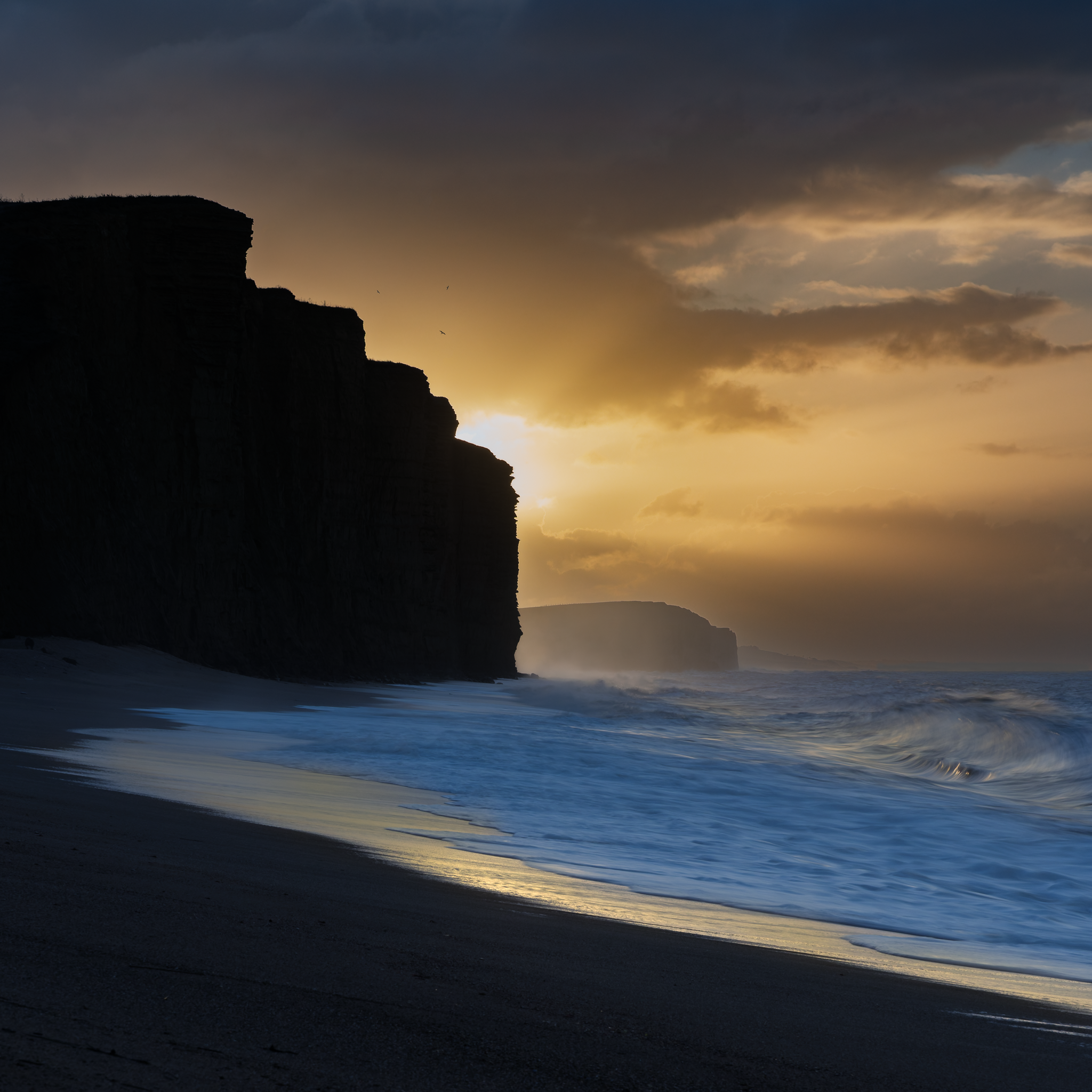
Then, all of a sudden, the sun broke through right at the turn of high tide. We had this amazing glow coming from behind the cliff face, which ws most definitely a reward for the early start 😍

Silhouetted cliff at West Bay with golden sunrise light over the sea

It just goes to show... don't give in, and don't pack your camera away too soon. You never know what's going to happen.

I shot this on the RF 28-70mm f/2. It's not really a landscape lens, but as I've only just changed over to Canon, it's what I had with me. Something like the 70-200mm Ben was using would have been great.

I'm now building up the lenses I need to cover my portraits, seascapes and my wildlife photography.

Next on the list is a 70-200, and I'll probably go for the f/2. I'm also likely to get the 14-35mm f/4 rather than the 15-35mm f/2.8. I'd only ever use it for landscapes, and I'll more than likely be at around f/8 anyway, so I wouldn't benefit from the f/2.8.

Anyway, a fantastic morning.

It felt so good to get out and see the start of the day.

Mornings are definitely my favourite part of the day, especially when a scene like this unfolds in front of you.

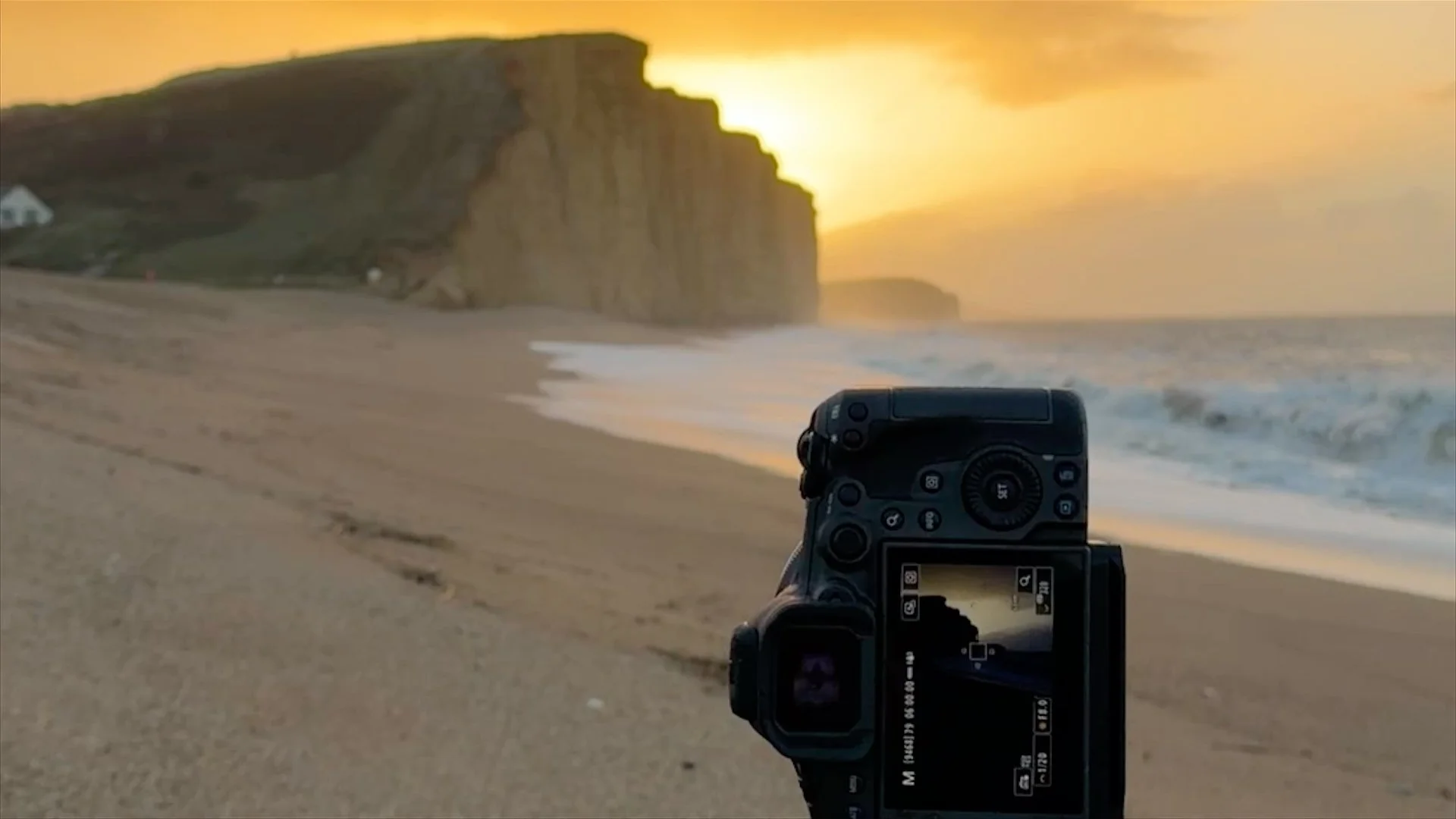
Camera on the beach facing the golden cliffs at West Bay at sunrise

Kit Used:
Canon R5 Mark II
Canon RF 28-70mm f/2
NiSi 5-Stop ND (JetMag Pro)

Printed on Fotospeed NST Bright White using my Canon Pro-1100.

📷 2nd Time Out Wildlife-ing ... Perfect Conditions But a No-Show/

I was out early this morning meeting up with my mate Ben Kapur for some more Wildlife Photography down at the local reservoir, and hopefully another chance at photographing the resident Kingfisher.

Conditions were incredible!

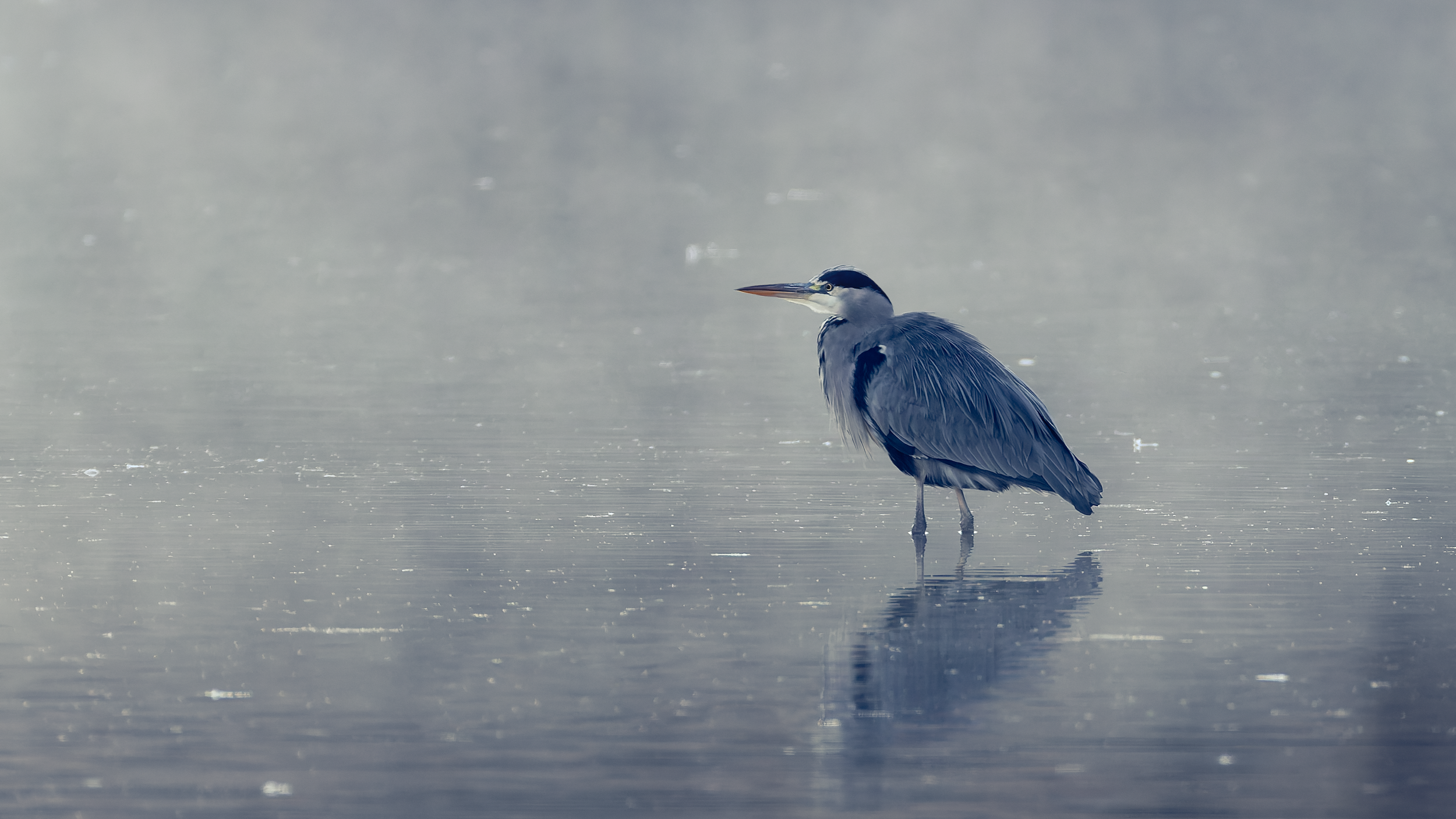
Grey heron standing in still, misty water

1/400 sec
f/4.0
ISO 2000

A cool start to the day (3 Degrees Celsius) brought with it the most amazing mist across the water surface, and the most amazing light as the sun crept above the horizon. Photography or not ... it was just a treat to be there.

Despite the perfect conditions, activity on the water was exceptionally quiet, and almost 2 hours in, it was no-show from the Kingfisher.

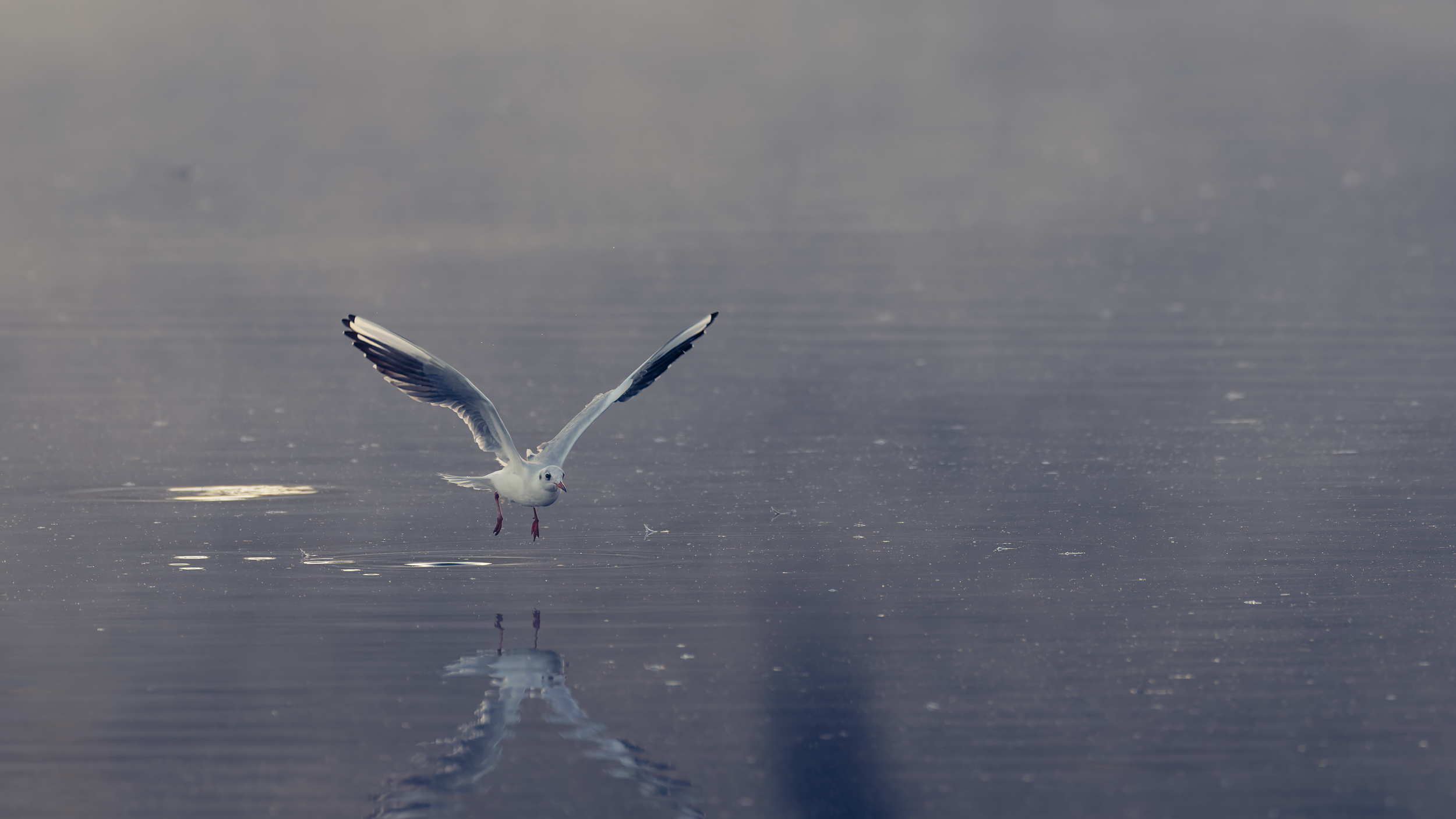
Gull landing on misty water with its wings raised

1/2500 sec
f/4.0
ISO 1000

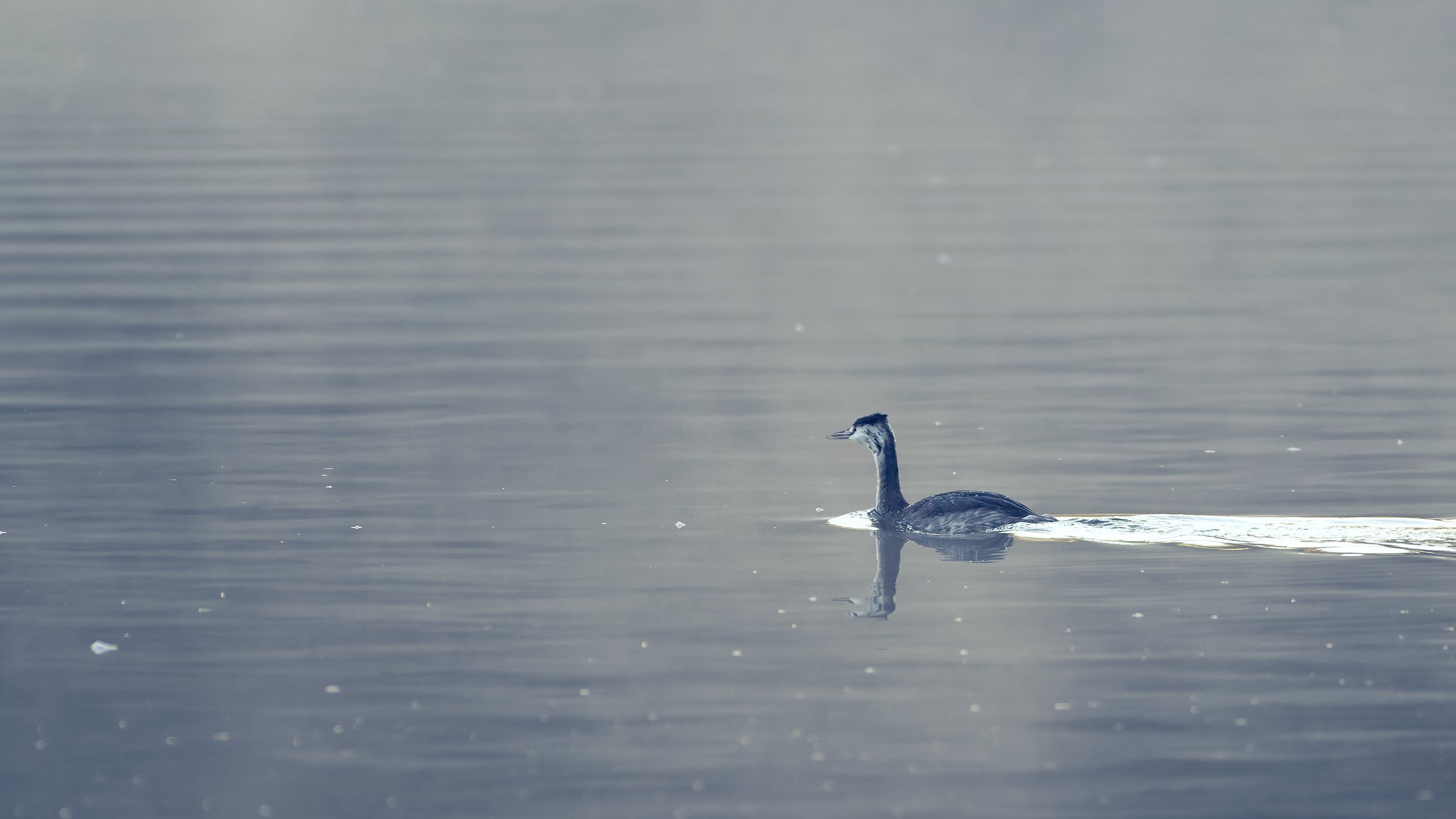
Still, with it being only my 2nd time out photographing wildlife, any time with the camera in hand is a good thing, and I did manage to capture some images I'm actually really with of a Heron, Great Crested Grebe and a Black-Headed Gull.

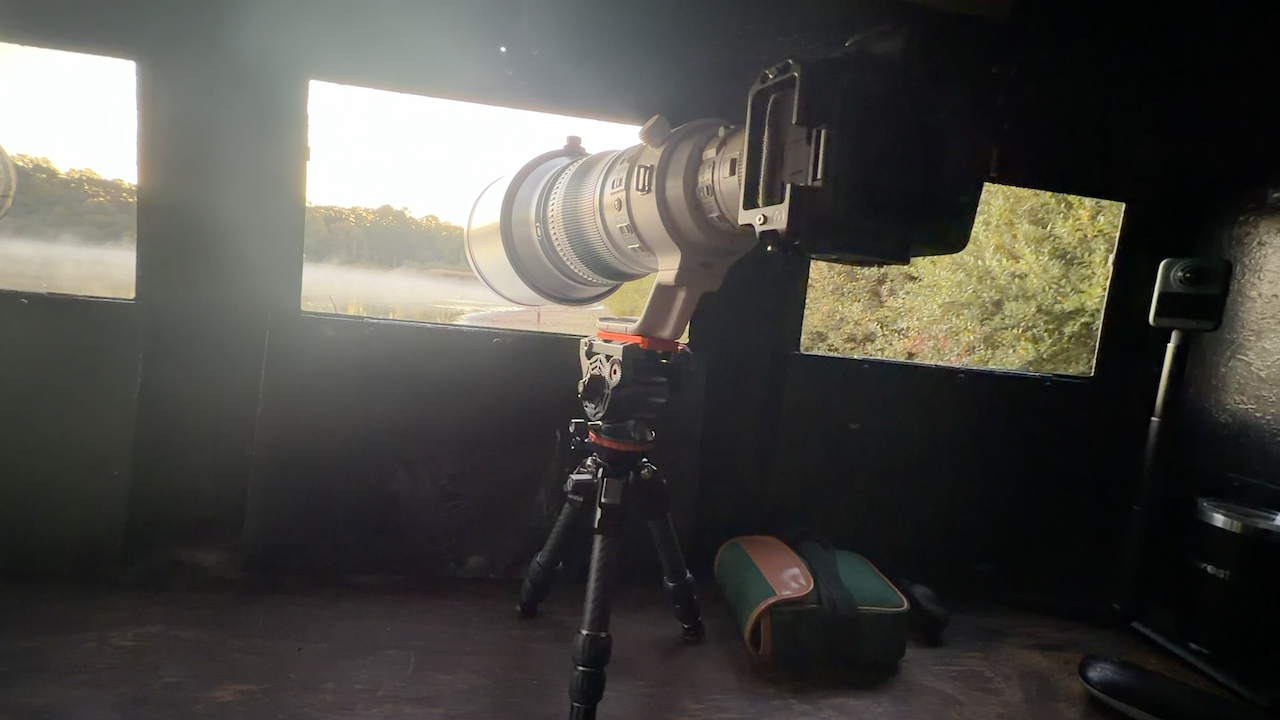
This time I was using a table top tripod fitted with one of my spare video heads (3 Legged Thing) which made a huge difference, working with the big lens (400mm f/2.8).

All taken with my Canon R5 Mark 2 and the Canon EF 400mm f/2.8 III and 1.4x Converter

Waterbird swimming across a misty reservoir

1/2000 sec
f/4.0
ISO 2500

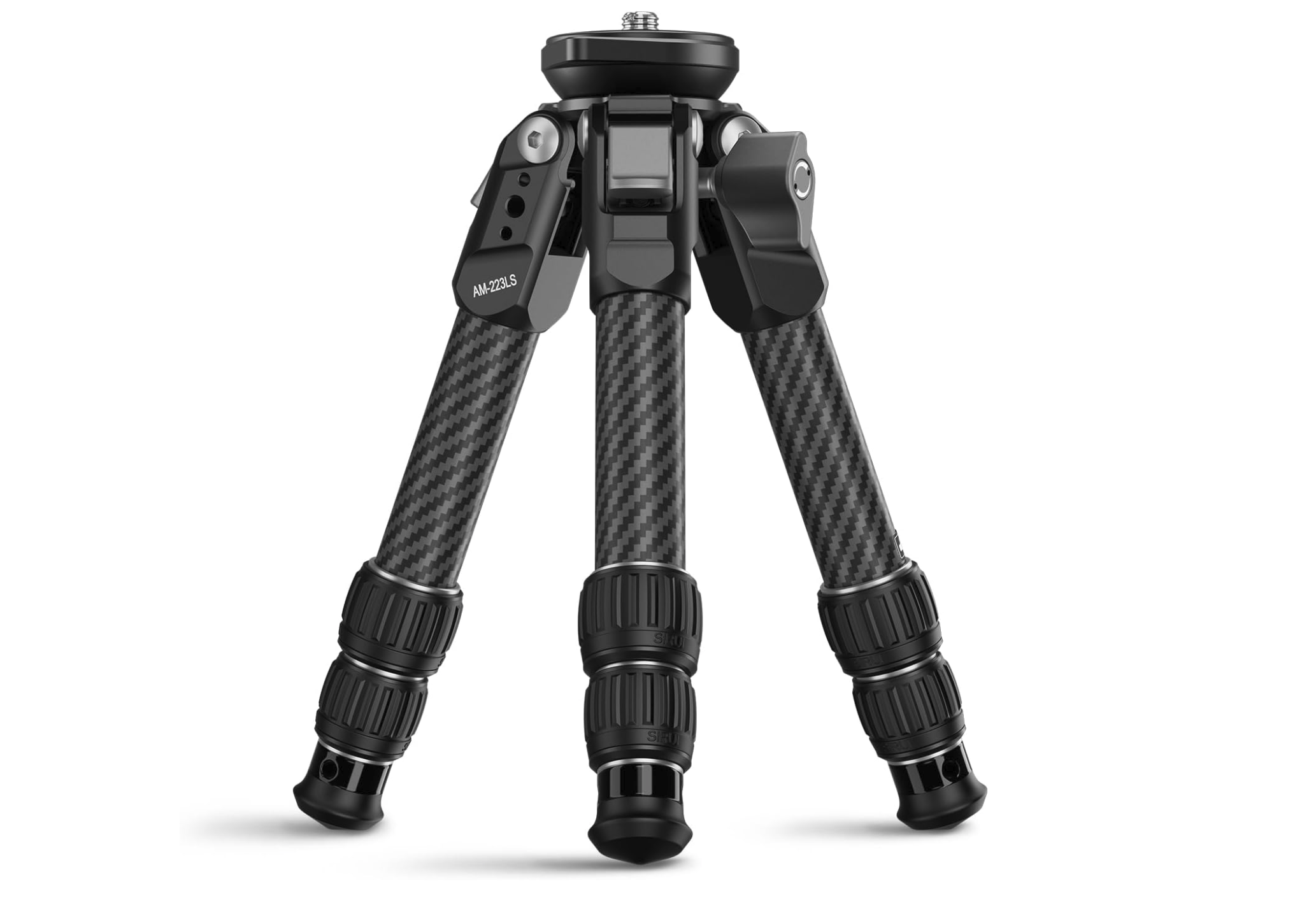
Here’s the table-top tripod set up I’m now using, which is

SIRUI AM-223LS Mini Tripod with Bowl Base for Camera,Carbon Fiber Traveler

Amazon

Capture to Print: One-Light Complete Portrait Workflow

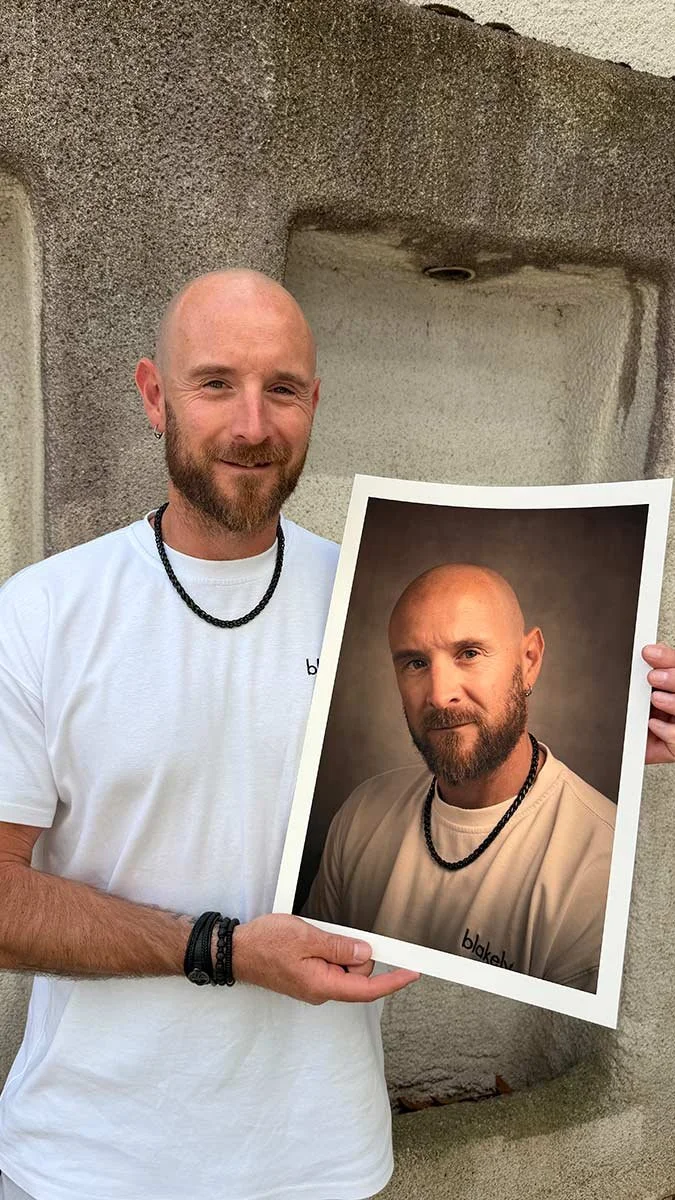
For the past three months I've been touring with Wex Photo Video around the UK on their Summer Roadshow, showing how I take portraits with minimal kit in limited space. I came away with portraits I'm really happy with from every date, but there was one look in particular I was asked about more than any other, so I asked my friend Michael if he'd sit for me and we went outside with one small flash to make it again.

The video above goes through the whole thing, from the shoot, through every step of the edit in Lightroom and Photoshop, to a finished print. Here's an overview of what's in it.

One small flash, outdoors

The idea is simple. Before the flash comes into it at all, I set the camera so that it doesn't see any ambient light; take a picture and you get a black screen. That way the only light in the final shot is the light I put there.

Outdoors in bright sun that takes a bit more doing than it does in a store. I ended up at f/16, which was as far as the lens would go, around ISO 125 and 1/250th of a second, keeping within the flash sync speed rather than reaching for high speed sync or ND filters. I did wonder whether a 100 watt second light could cope with sun that bright, but it wasn't a problem.

The kit was:

  • the Westcott FJ100 on power 9, so pretty much full power

  • a 15 inch octa with the grid fitted

  • a pistol grip handle to hold it steady

  • the camera on a tripod

  • a reflector just below chest level

The camera goes on a tripod so Michael has one fixed point to look at, rather than following me around as I move, and I trust the eye autofocus to nail the focus so I don't need to be right behind it.

How the light falls

I raise the light nice and high and get Michael to lean forward a little towards the camera. Because of the grid, the light doesn't go everywhere; it comes down and skips across the front of his face, and it doesn't spill onto the background, which I wanted to keep dark.

What I really like about it is that the light is so directional you get shadow either side of it, so it's almost like having a strip of light running down the front of the face. It's a look I definitely want to work more on.

The one thing that made the biggest difference was the reflector. Flat and horizontal, it did very little for the eyes. Lift the far end so it's angled up towards him and the light bounces back into his face, and suddenly there's plenty of detail in the eyes to work with.

The edit in Lightroom

Only one job happens in Lightroom, and that's the eyes. I use masking to select the iris and pupil, finesse the mask with the feather and edge sliders so it sits just inside the eyes, then lift the exposure slightly and add a little texture, clarity and a touch of dehaze. At 100% the difference with the mask on and off is night and day.

After that the image goes over to Photoshop, because that's where the heavy lifting gets done.

The heavy lifting in Photoshop

My rule of thumb here is to look at the image and fix whatever jumps out first. On this one it was the shine down the middle of Michael's nose, which I took out with the Remove Tool on a new layer, then lowered the opacity to around 50% to bring some of the natural shine back. After that I used the Spot Healing Brush on a blank layer to clean up the more obvious marks in the concrete wall behind him, which was sharper than I'd like because of shooting at f/16.

Most of the work is dodging and burning on a 50% grey layer set to Soft Light, with the Dodge Tool at 10% exposure and the Option key (Alt on Windows) held down to switch to the Burn Tool with the same settings. I brighten the highlights and darken the shadows either side of them, around the eyes, down the nose, the eyebrows and the mouth, and then the folds in his top. It sneaks up on you; you often don't see it until you turn the layer off. Working on a grey layer rather than the image itself also means that if you go too far, you can paint over it with 50% grey and it's gone.

From there it's a handful of smaller things:

  • a loose lasso round the teeth and a Hue/Saturation adjustment on the yellows, lifting the lightness slightly so they're cleaner without looking like he's had them done

  • my 2010 technique, two passes of Unsharp Mask on merged layers, amount and radius at 20 then 10 with the threshold at 0, each painted in through a black mask, the first over the middle of the face and the second over the eyes, nose and mouth

  • a skin texture effect using Reduce Noise at full strength with everything else at zero

  • a High Pass layer at a radius of 2, set to Hard Light and placed on top, to bring back the sharpness in the eyes, hair and skin detail that the texture effect softens

The 2010 technique is superb on close-up portraits; it makes the face look as if it's coming forward off the screen, and even more so in print.

Camera Raw and a finishing touch

In the Camera Raw filter I used Lens Blur to soften the concrete wall and give the picture a bit of fake depth of field, brushing blur in around the top of the head, the ears and the shoulders so it feels more like f/2.8 or f/4 than f/16. I still wanted to be able to just about see the wall, so it isn't blacked out completely.

A linear gradient with the exposure brought down takes the edge off the bright top he's wearing, which was pulling my eye, and a radial gradient in the middle of the face at +0.2 exposure adds a little light where it matters. I do that last one on pretty much every portrait.

The finishing touch is a warm colour grade from Optics by Boris FX, using the Titanic look in the Portrait colour section, brought down to 50% opacity.

Making the print

I print pretty much every image I'm happy with onto A4, and this one went onto Fotospeed Natural Soft Textured Bright White 315, a fine art matte paper and one I use most of the time, on the Canon PRO-300.

The steps are:

  • duplicate and flatten the image

  • resize to 10 inches on the long edge at 300ppi

  • soft proof with the paper profile, comparing relative and perceptual rendering intents

  • a slight brightening just for the print

  • save as a TIFF in Adobe RGB

  • print from Canon Professional Print & Layout, with Heavyweight Fine Art Paper as the media type, the paper's ICC profile, perceptual rendering intent and black point compensation on

For this picture perceptual was the clear choice. Relative blocked the blacks up quite a lot, whereas perceptual gave it more contrast, which suited it.

Straight out of the printer it was looking really good, and on a matte paper like this it only gets better once the ink has had time to dry and settle. You can just about see detail in the back wall, which is what I was after, and the 2010 technique does exactly what I hoped, bringing the face forward off the page.

Why I always print

Our screens are fantastic, but it's not until you have something physical in your hands that you can really study it and start noticing the things you missed while editing. I truly believe printing can help you get better as a photographer, and certainly better at retouching.

If you'd like to follow along with the video step by step, the raw file I used is free to download from the classroom in my Photography Community on Skool:

Early Morning Swimmers, a Man Called Neptune and Matching the Shadows

I was down on the beach at Lyme Regis at 7 yesterday morning for the next set of portraits for my “I am Lyme” project, this time with early morning sea swimmers, Mary and Christine; Mary runs the Axminster and Lyme Regis Cancer Support, and Christine, an artist and also the wife of Harry May, one of the fishermen I photographed a good few weeks back.

Waiting for them to come out

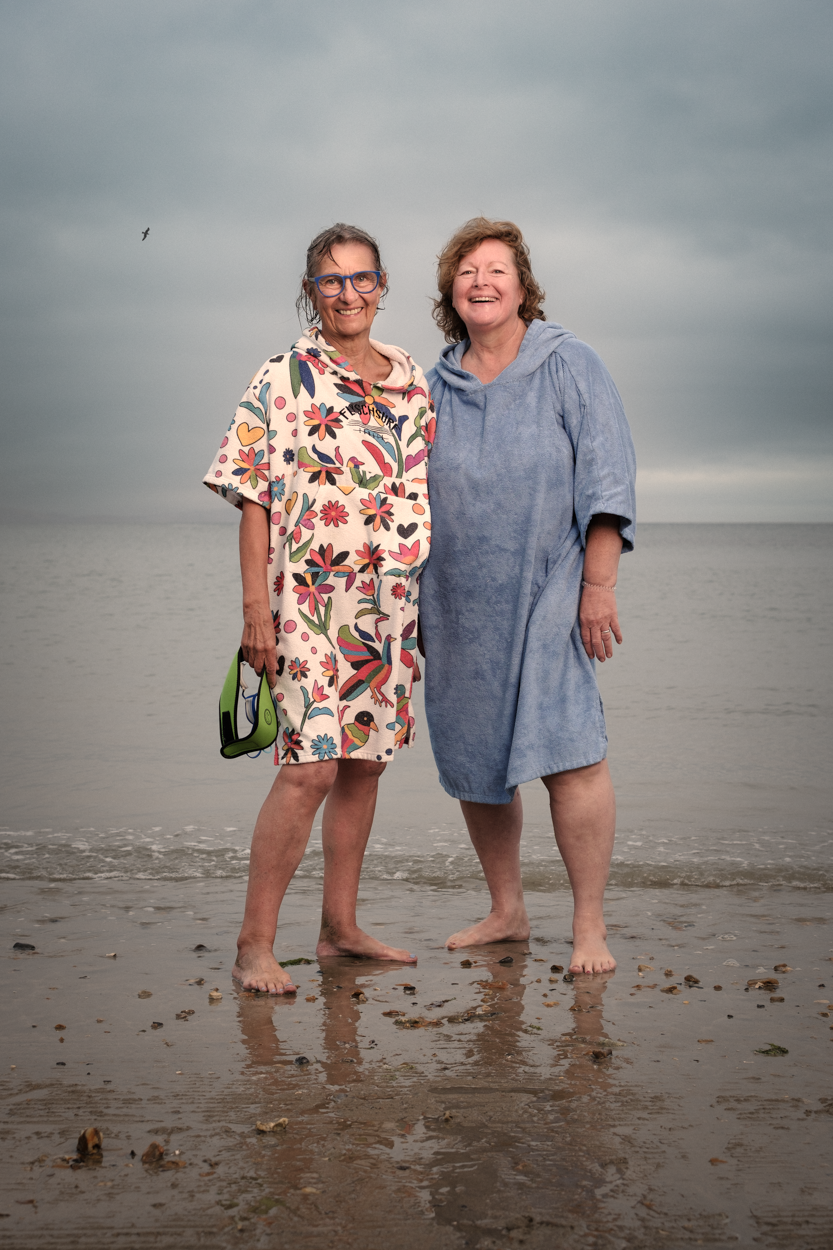
Low tide had been at around half four, and we were shooting at seven, so the sea was on its way back in but still a fair way out, so I waited until they'd had their swim and photographed the two of them together right on the water's edge, wet hair and robes.

Two early morning sea swimmers standing together in the shallows at Lyme Regis

Christine and Mary

My dear friend Steve Healy came along to help out and did a top job holding the light, which meant I could spend the time talking to Mary and Christine rather than fiddling about with a stand.

And then Neptune turned up

This is the part I couldn't have planned.

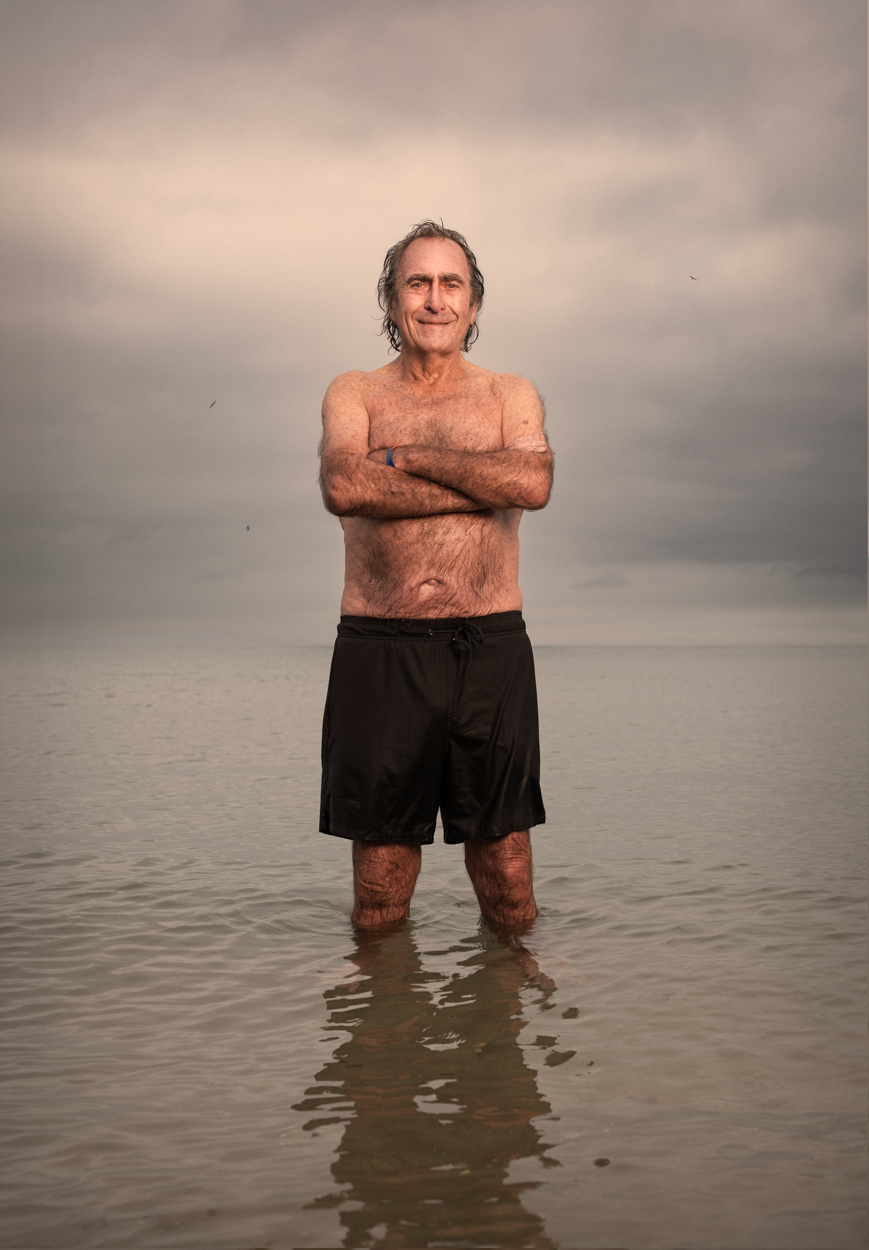
While we were shooting, Mary and Christine spotted a chap they knew coming out of the sea and pointed him out to me; Nick, known affectionately as Neptune, another early morning sea swimmer that has done so pretty much his entire life of 83 years; yeah I know what you’re thinking “He’s 83??” Yep, looks amazing huh. I guess there’s something in this sea swimming.

Bare-chested sea swimmer standing with arms folded in shallow water at Lyme Regis

Nick aka Neptune

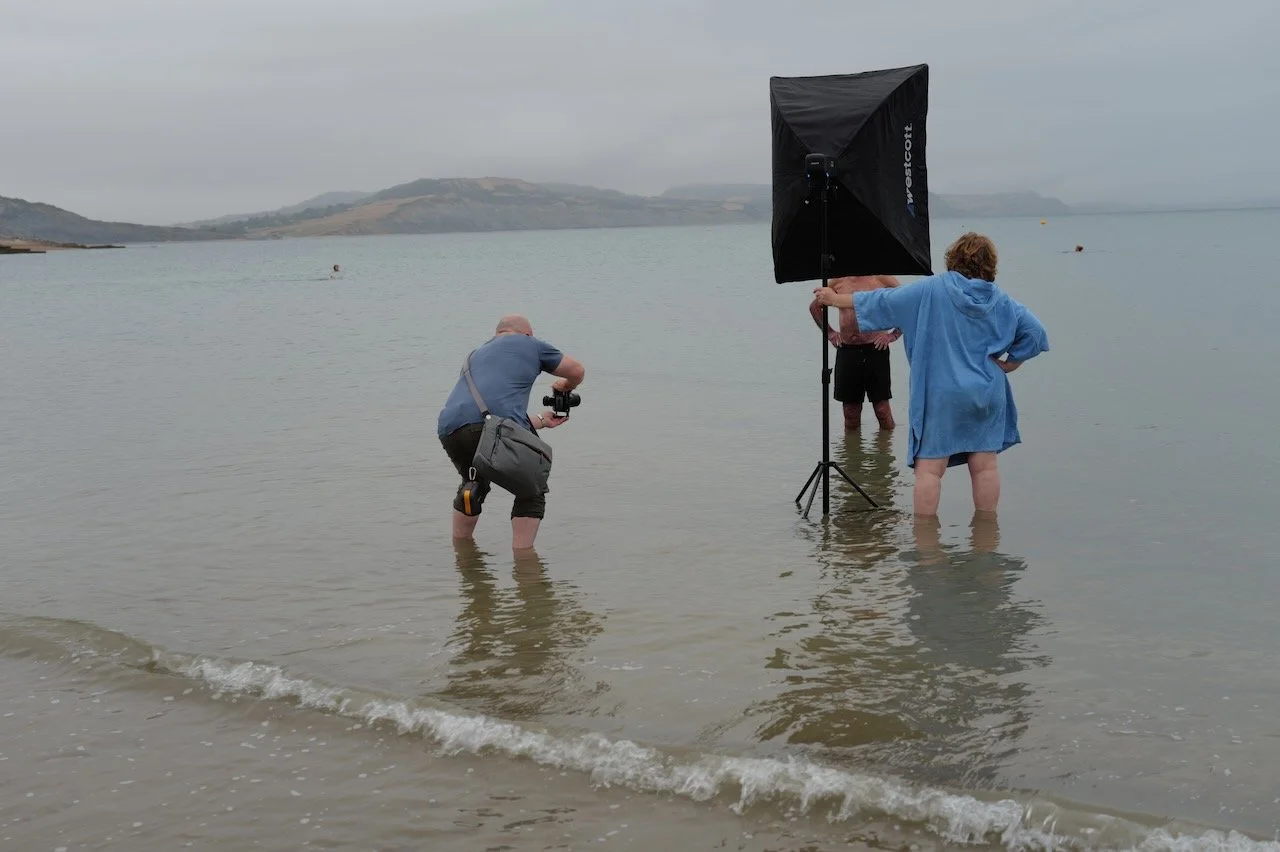
Anyway, they called him over and he was keen from the off, which always helps. For him though it had to be in the water, because anywhere else would have been wrong, so it was trainers off, trousers rolled up and in I went. Mary took over the light for that one, stood in the sea alongside me, and it was done in a handful of frames.

What I used

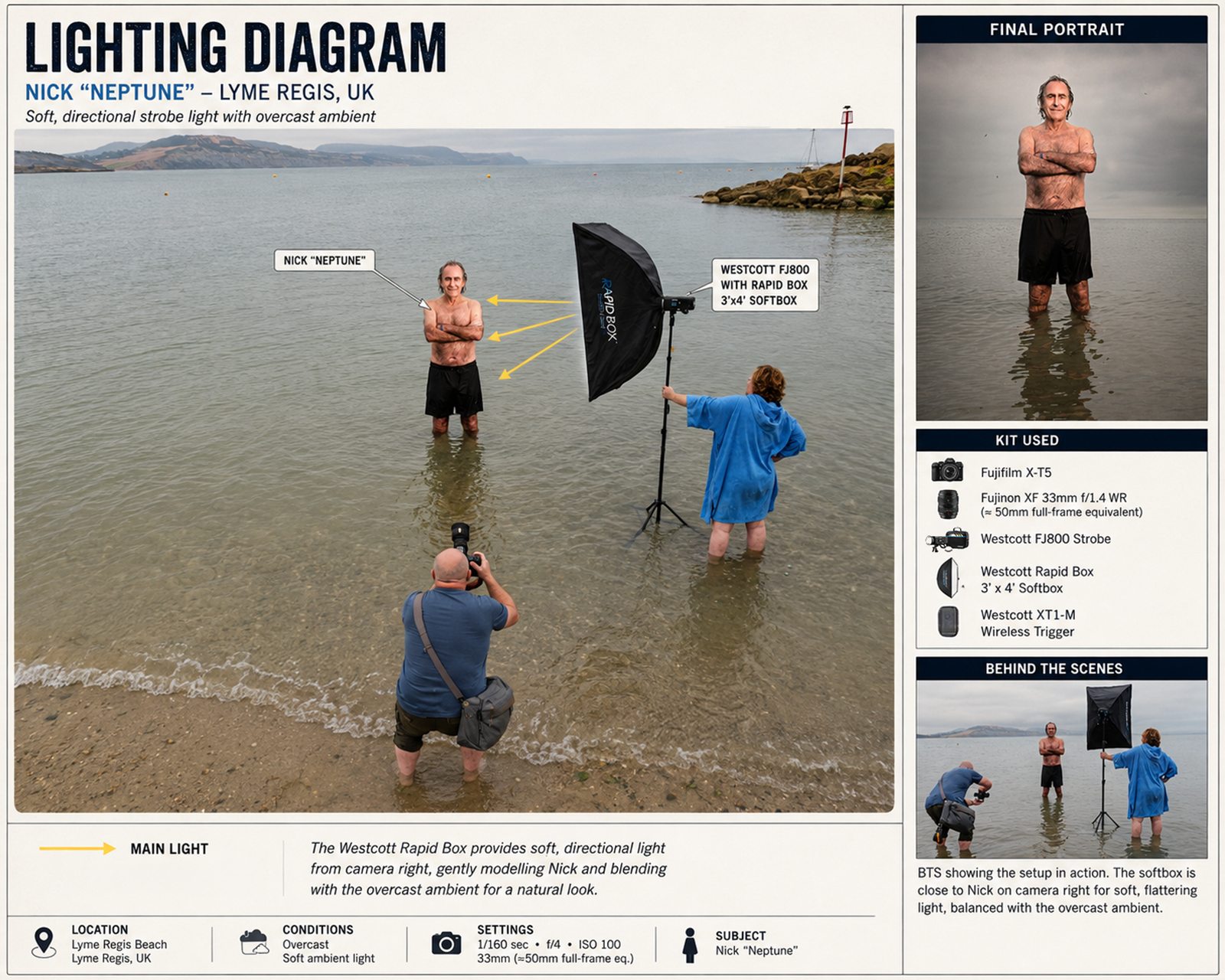
  • the Westcott FJ800 strobe

  • the Westcott Rapid Box, 3ft by 4ft softbox

  • the Fujifilm X-T5 with the 33mm f/1.4 WR lens

  • the Westcott XT1-M wireless trigger

That's the lot, and you'll notice there's no neutral density filter on that list.

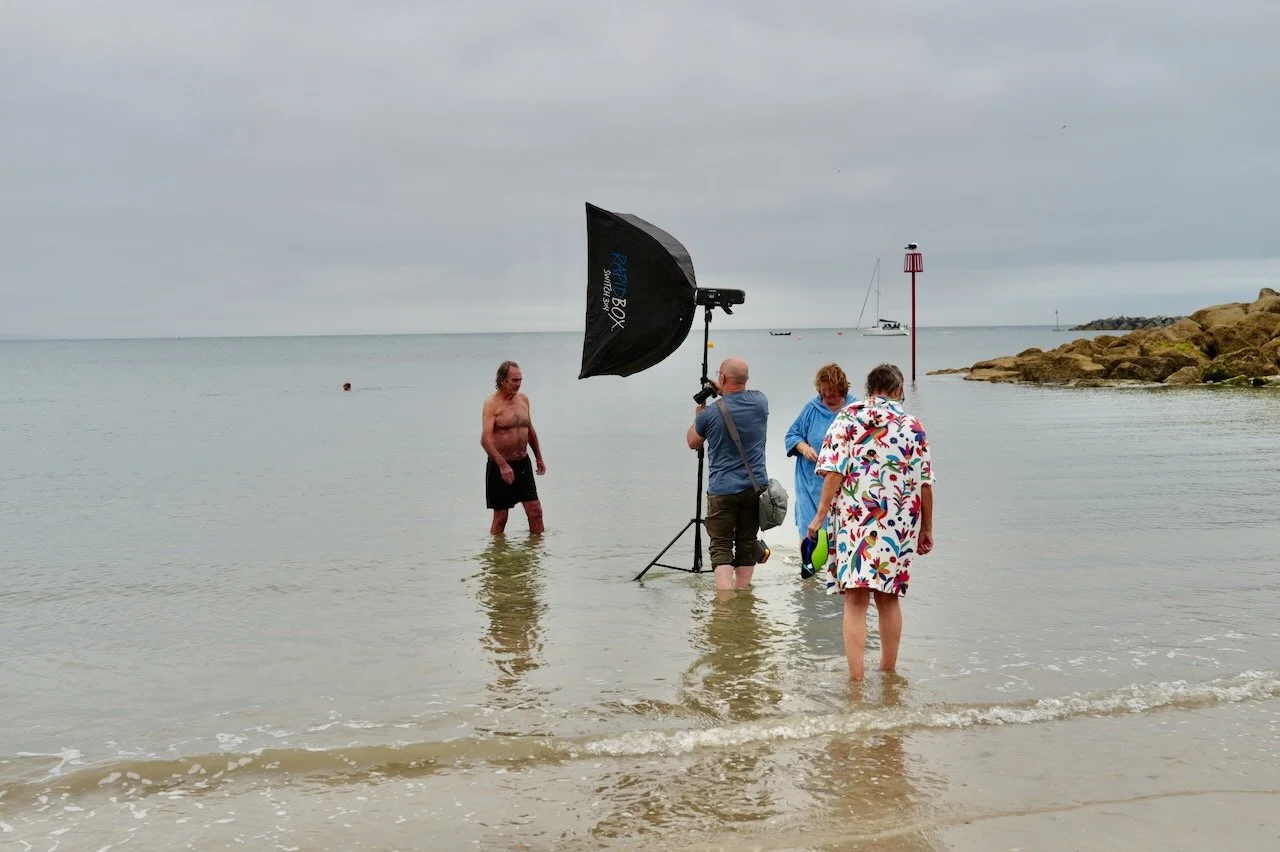
Behind the scenes of a portrait shoot in the sea with a softbox on a stand

The settings, and why there's no ND filter

Normally on the seafront I'd have one on to keep the shutter speed within sync while I'm shooting wide open, and to hold on to the detail in the sky. This morning was properly overcast though, so the sky was doing nothing dramatic and there was nothing to rescue. The grey did the job for me.

My Fujifilm X-T5 was in Manual with the following settings used to “set the scene” …

1/160 sec, f/4, ISO 100, with the 33mm giving me roughly the 50mm equivalent on the X-T5.

Photographer shooting a portrait standing in the shallows with a softbox beside him

For the flash, the FJ800 went into TTL first, purely to get the exposure right on the skin, and once it was there I locked it in using the TTL to manual function, which I keep banging on about. From that point on it fires exactly the same every single frame, so nothing shifts as I move around or recompose. It takes seconds to do, and on a morning when your subjects have just got out of the sea, seconds matter.

Matching the shadows, which is the bit most people miss

The softbox was in as close as I could physically get it, just out of frame, and that was a deliberate decision rather than habit.

When you're using flash outdoors, most of the attention goes on balancing the flash with the ambient, so the two brightnesses sit together and it doesn't look lit. That's only half of it. You also have to match the quality of the light, meaning the shadows your flash makes need to look like the shadows already in the scene, whether those are hard or soft.

Lighting diagram for the sea swimmer portrait with the kit list and final image

Yesterday morning was flat and overcast, so the light on everything around us was very soft, with shadows that were barely there. If I'd lit Mary and Christine with something small, or with a big modifier pulled back a long way, I'd have put a harder shadow on their faces than anything else in the frame had. The eye picks that up straight away, even when the person looking can't tell you what's wrong with it. It's one of the biggest giveaways that a flash was used.

So a 3ft by 4ft box, in tight, giving light almost as soft as the morning itself. On a hard, bright day I'd want the opposite, something that puts a shadow on the face with an edge to it, because that's what the sun is doing to everything else.

It's worth paying as much attention to that as you do to which modifier you own. Same softbox, wrong distance, and the picture tells on you.

BIG Thanks to Steve for holding the light all morning, to Mary for taking over when I waded in, and to Christine and Nick for being so game about the whole thing.

Latest Wex Roadshow Locations and Something That Stuck With Me

The last few days took me out on the road for the next two dates of the Wex Photo Video Roadshow, first at Milton Keynes and then up to Nottingham. Two very different days, and both of them a lot of fun.

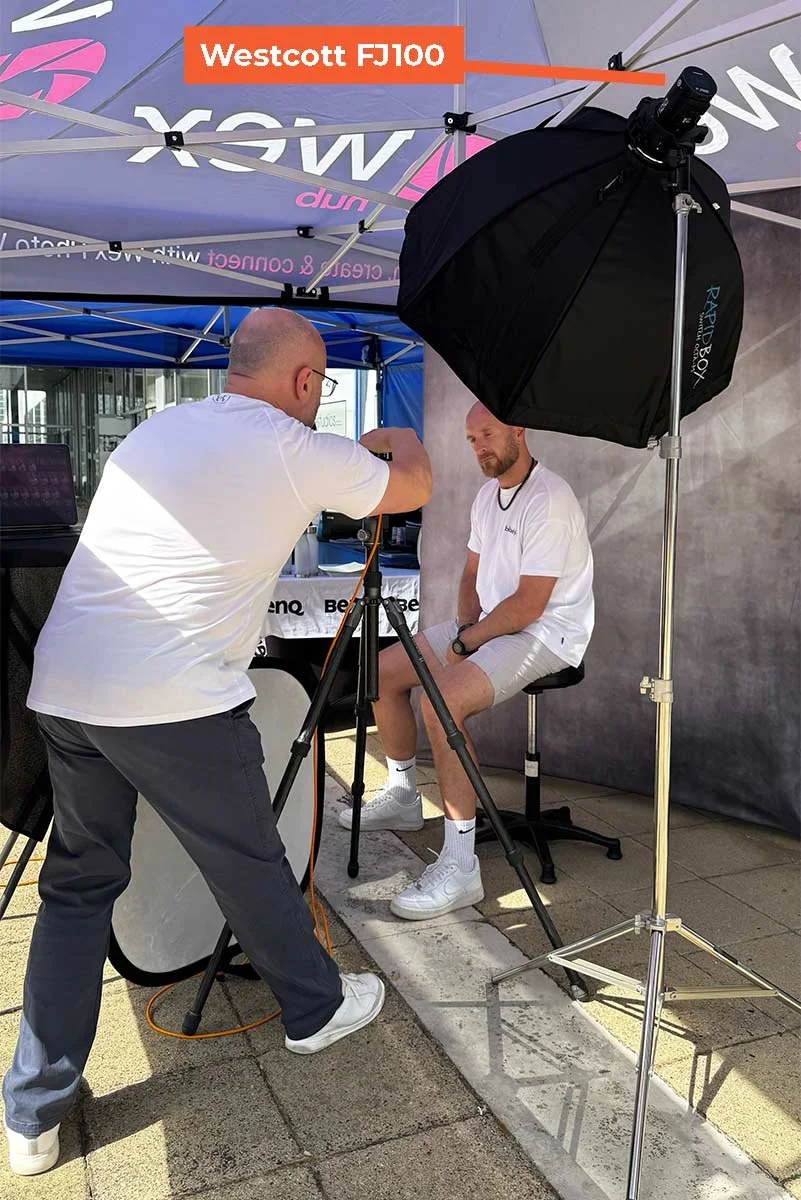
Milton Keynes was the testing one. It's a relatively small store, so there was no space indoors to set up for my bit showing how I take portraits with minimal kit in a small space, which meant being out the front of the store, under a gazebo, in 34 degrees.

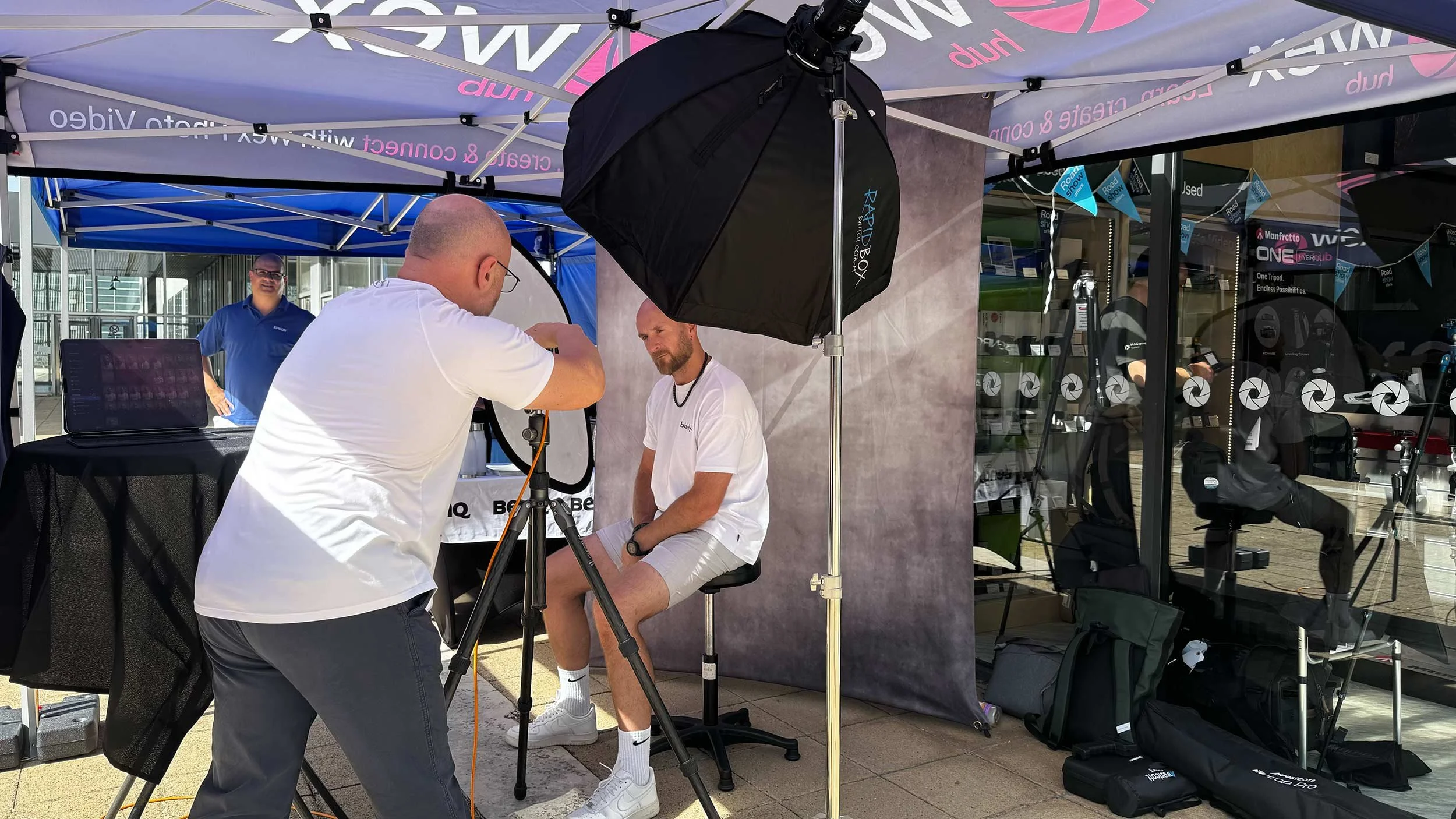
Working under a gazebo in the sun

It was hot, and on top of that we had the sun shifting round through the day and bright light coming in under the edge of the gazebo.

Photographer taking a portrait on a stool under a Wex gazebo during the roadshow

So the light was never quite the same for very long.

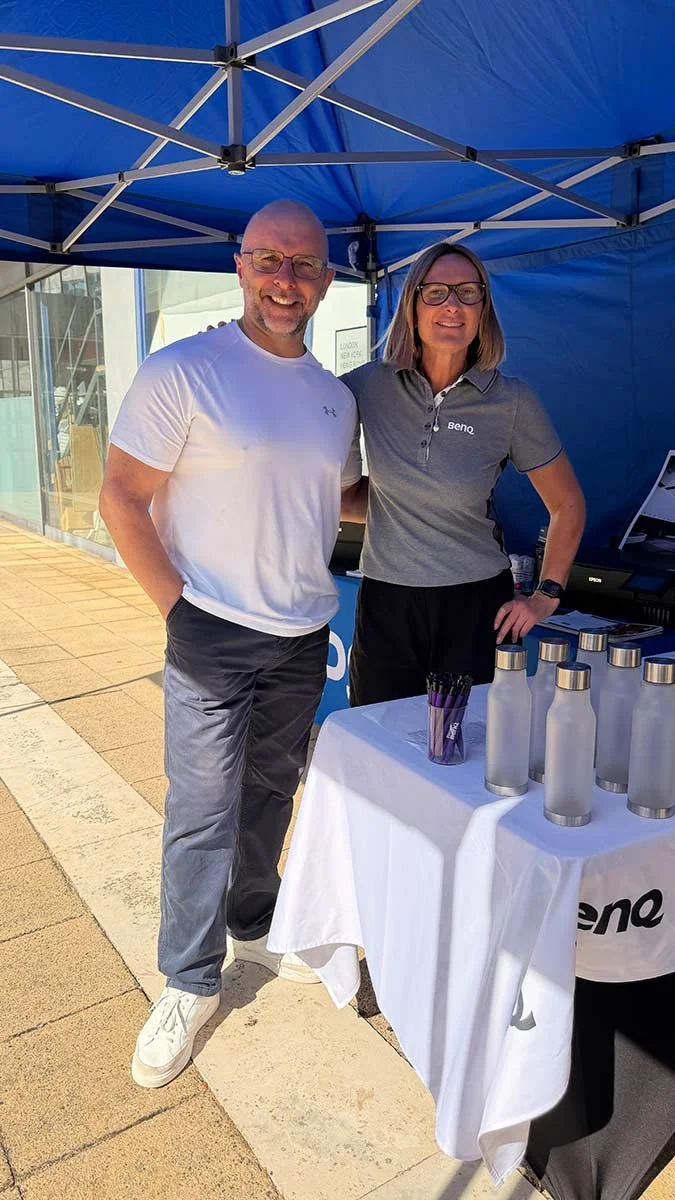
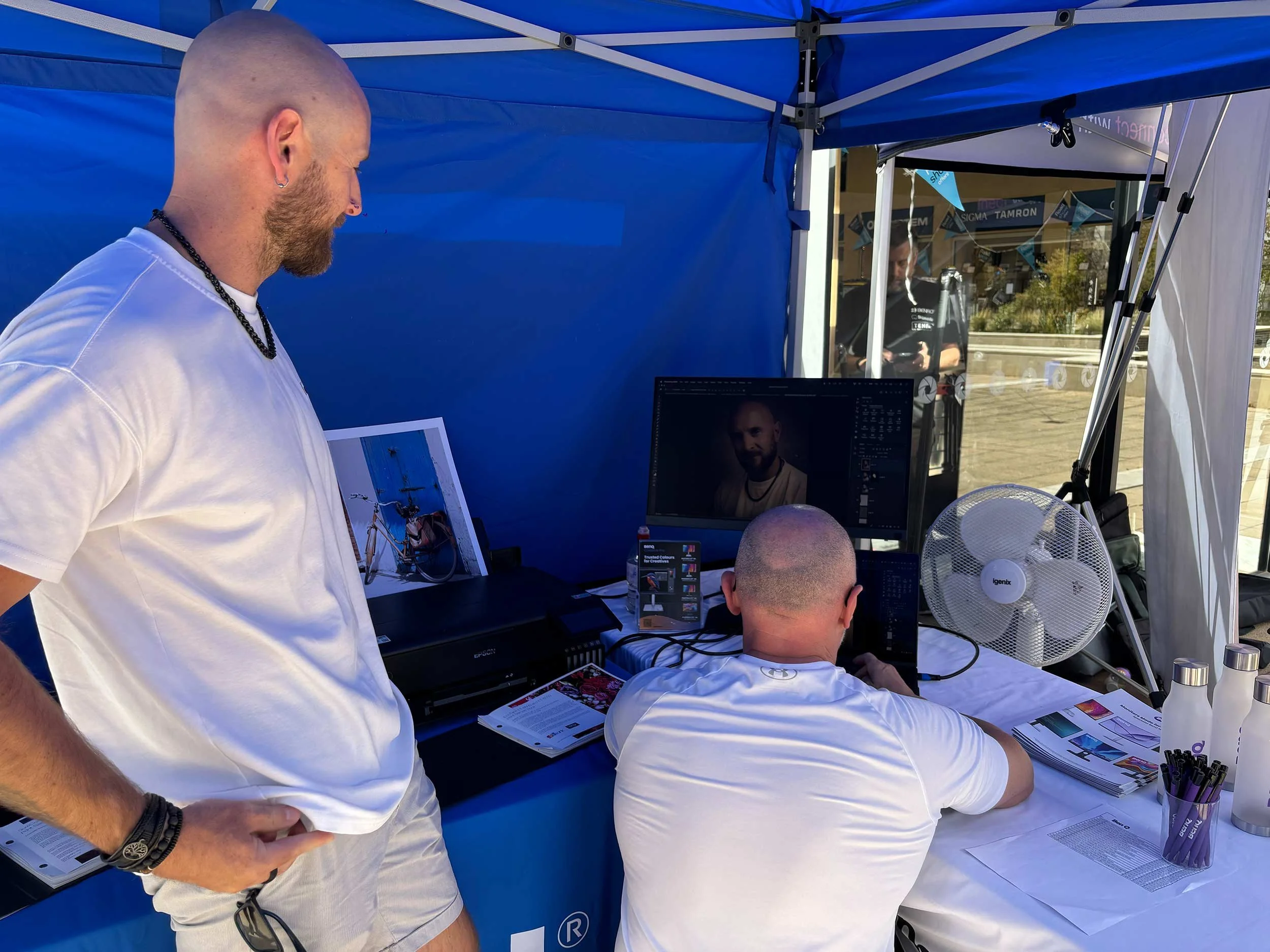
I had good company out there though, with my friend Carly from BenQ UK and my friend Dominic from Epson both under the gazebo with me.

Two people standing at a stand outside a Wex store

Carly from BenQ UK

I actually really enjoyed it; it kept me on my toes and it kept making me adapt, and more than that, it showed something I think is worth showing; whatever the environment, you can still make a good portrait … you just work with what you've got in front of you.

It was good to be able to talk people through the technical side of that, but also the other half of it, which is how I zone in on somebody so that all their focus is on me; voice, mannerisms, the way I talk to someone while I’m working. That's what helps them relax.

The people who sat in front of the camera

I wasn't photographing models over the two days, II was photographing whoever had come along and wanted to know more about what I do, which for me, is always the better way to do it.

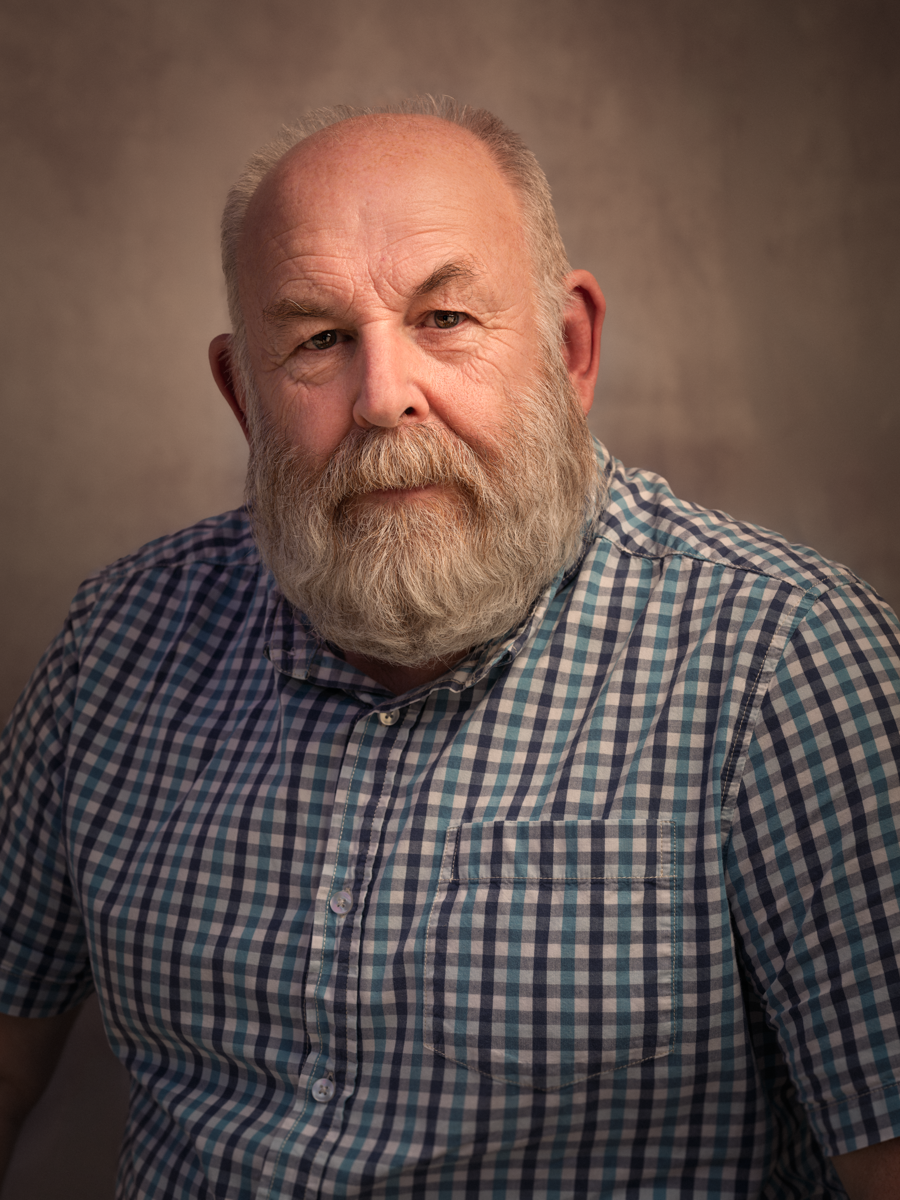
Portrait of a bearded older man in a checked shirt against a mottled backdrop

My friend Mick Hampson came along at Milton Keynes and I got a portrait of him that he’s really happy with. There was also a lady called Deborah, a photographer herself, who hates having her picture taken, but she's seen her portrait since getting home and she's really pleased with it, which is just wonderful to hear.

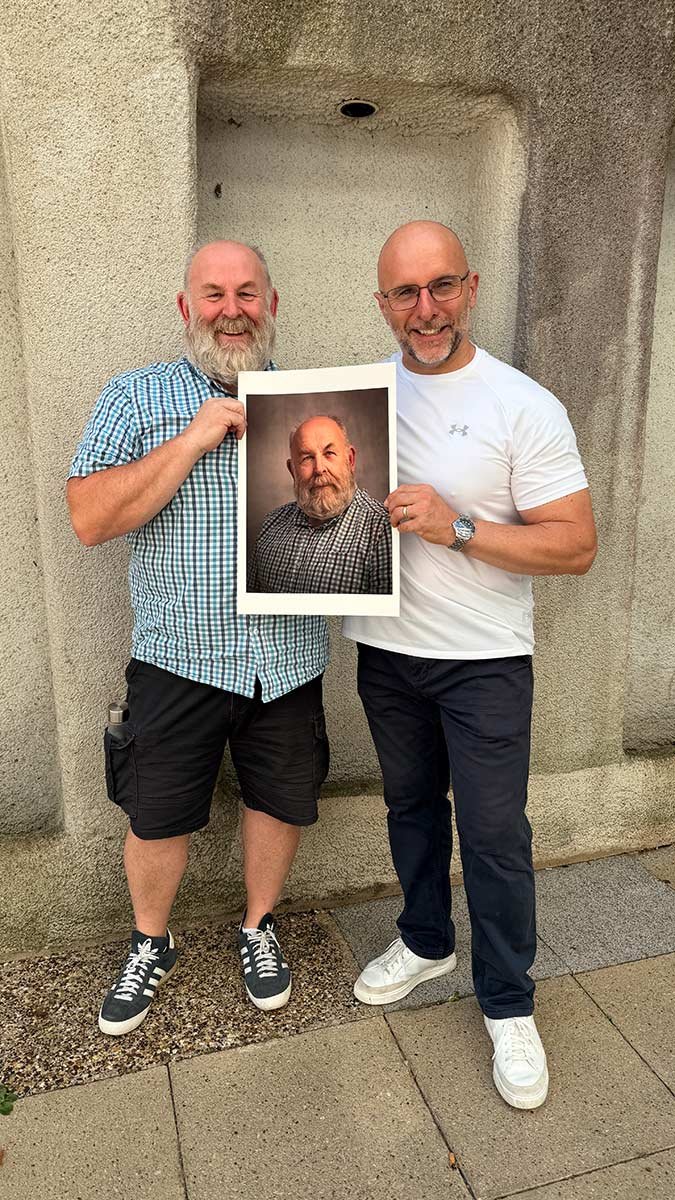
Two men holding a framed print of a portrait taken at the Wex roadshow

Mick with one of the other portraits I took of him

Then after Milton Keynes I had a lovely dinner with good friends Mick and Ian Munro before setting off up the road to Nottingham.

Nottingham, and the luxury of air conditioning

Nottingham is a much bigger store, so this time I was actually inside, with air conditioning, which after the day before, that felt like a proper treat.

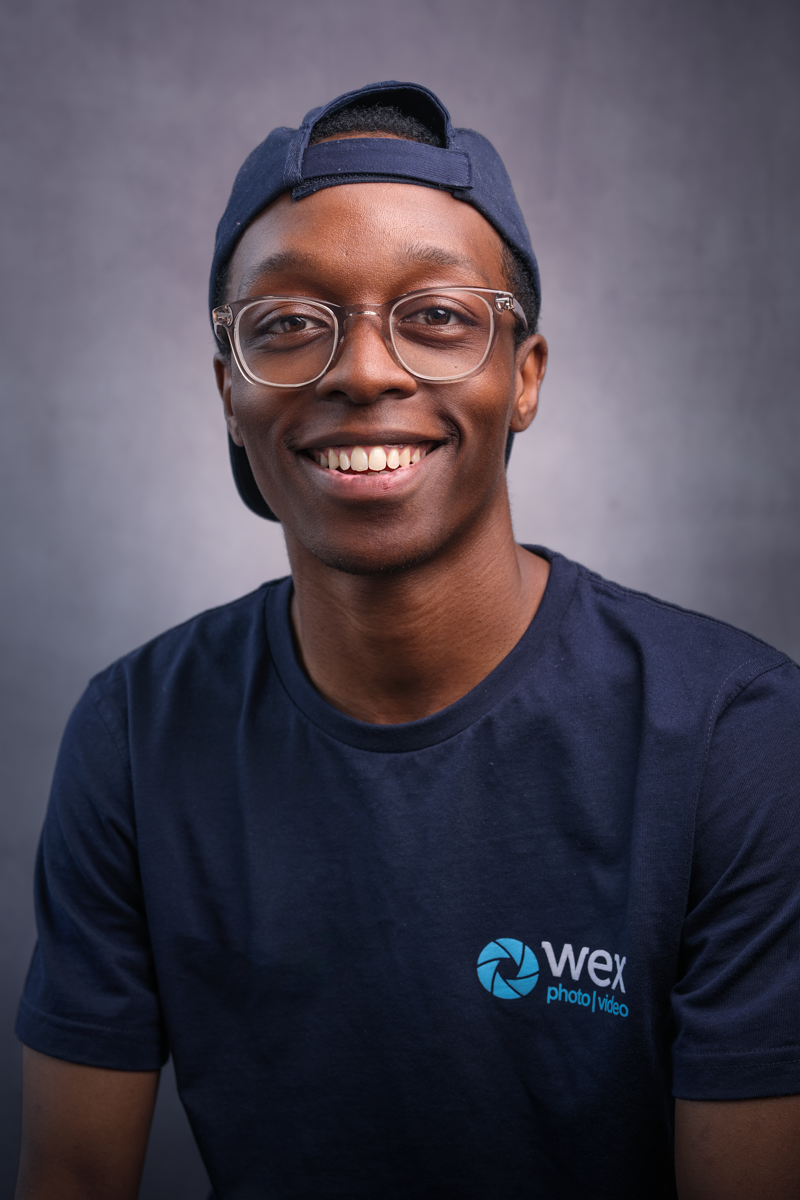
Smiling young man in a cap and Westcott T-shirt, studio portrait

Great day again, and lots of pictures taken, including one of a member of staff called Sam.

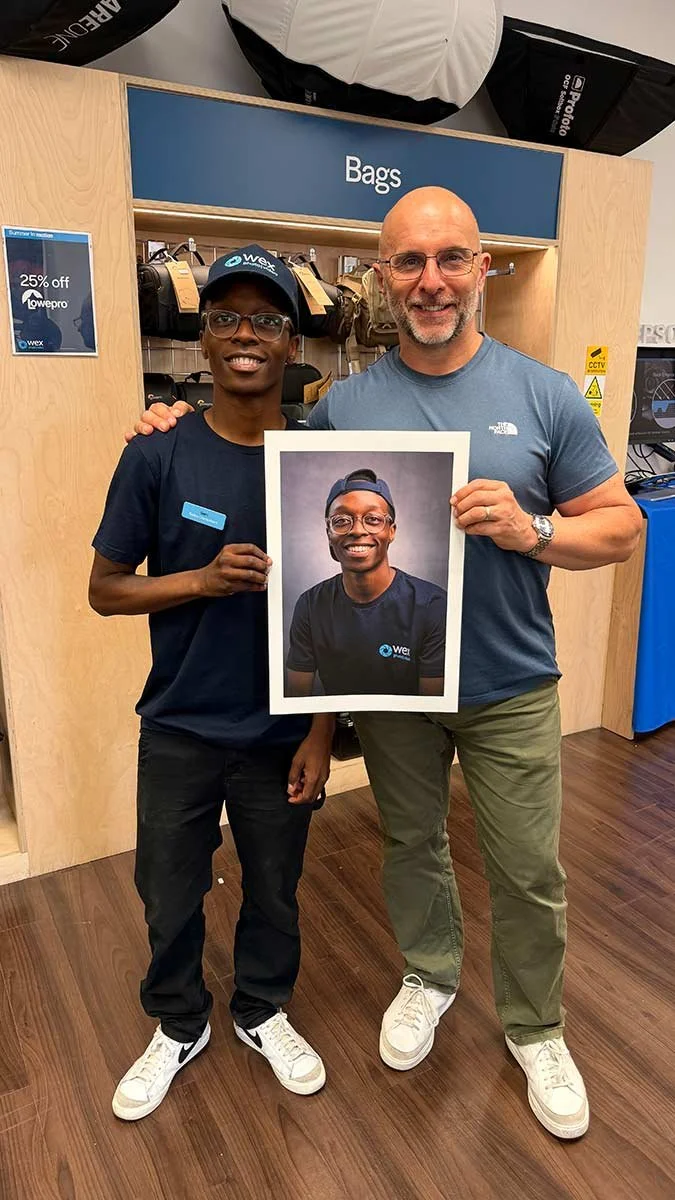
Two men holding a framed print of a portrait taken in a Wex store

I distinctly remember a lovely guy by the name of Kevin, who came along and told me straight out that he doesn't think he's very photogenic.

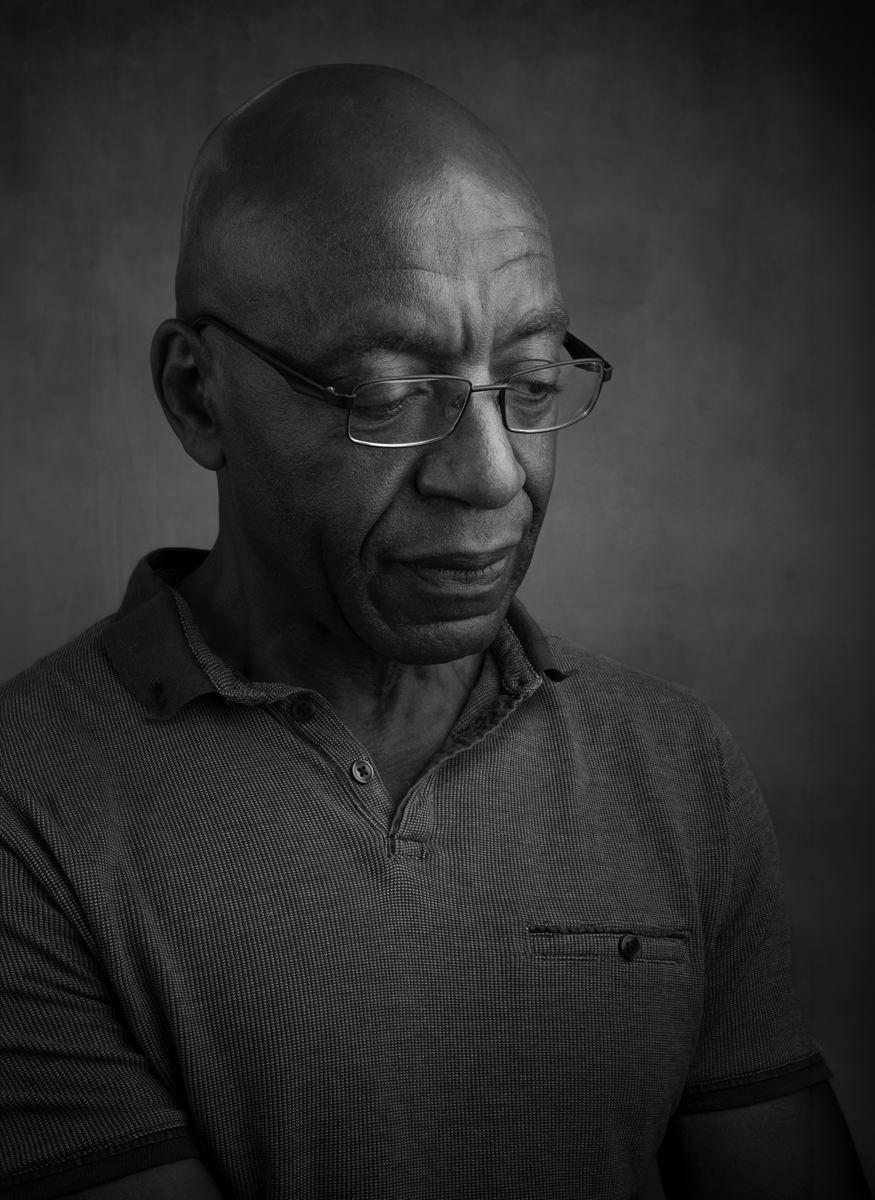
We got a black and white portrait of him looking away from the camera, a bit moodier, a bit more contemplative, which he's now seen and he's really happy with.

He said in an email reply that it's encouraged him to want to get back into taking portraits himself.

That sort of thing is why I do these days.

Black and white portrait of an older man in glasses looking down

The bit that stayed with me

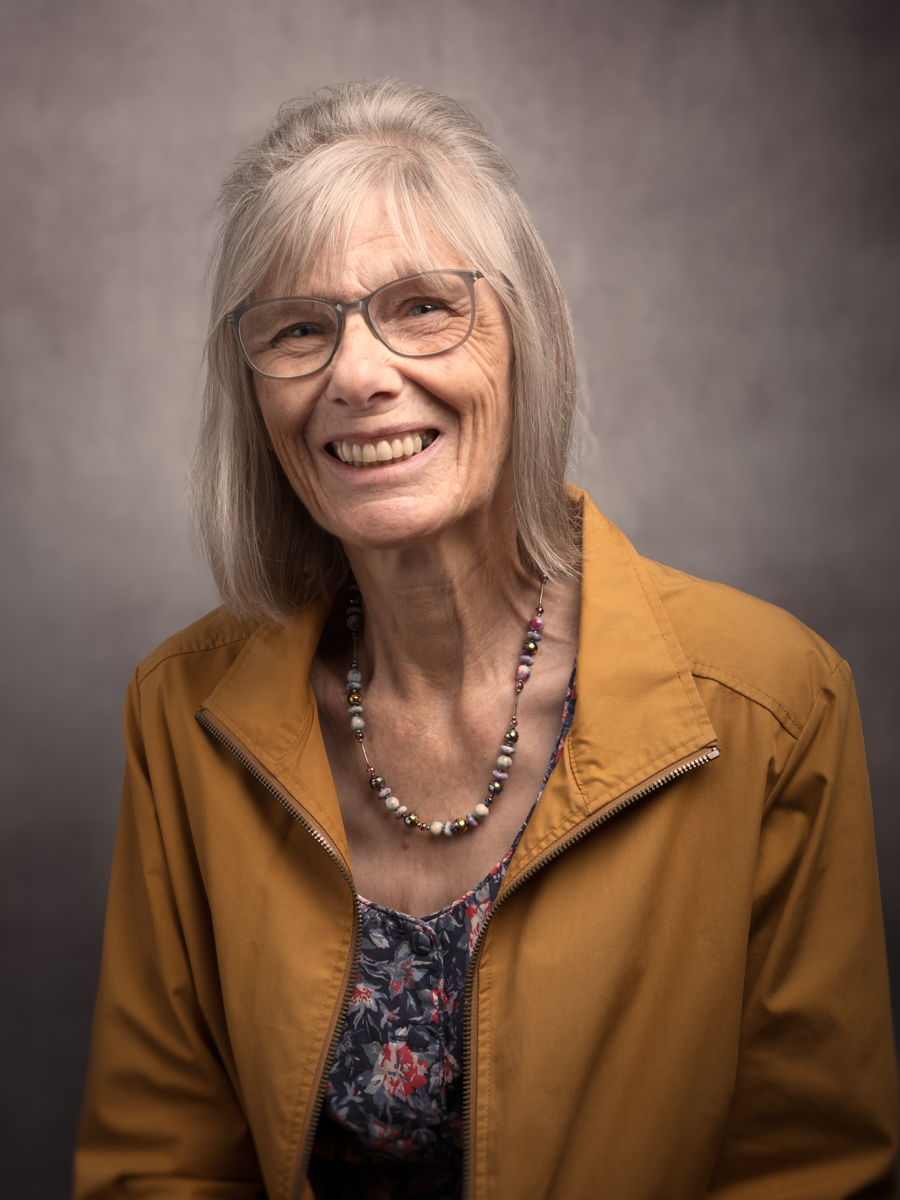
There was a chap at Nottingham who'd clearly been doing photography a long time. We got talking, and I invited him to take a seat so I could photograph him. His wife sat down instead, which was lovely.

While we were there, a friend of his came over and said to him, “oh, I'm surprised you're here, you already know how to do all this”, and he meant the setup, the lighting, all the technical side of it.

Smiling woman with long grey hair in a mustard jacket, studio portrait

That stuck with me, because that's not what portrait photography is about.

Yes, it's important to have nice light on someone, light that complements them or creates the mood you're after, but the most important thing of all is the person in front of the camera.

Smiling man in glasses and an orange T-shirt, studio portrait

Somewhere along the line, that chap's priorities had turned a hundred and eighty degrees, and the kit and the setup had ended up mattering more than the person sat in the chair.

It's the point I made over both days, and it's the one I'd want anyone to take away from this:
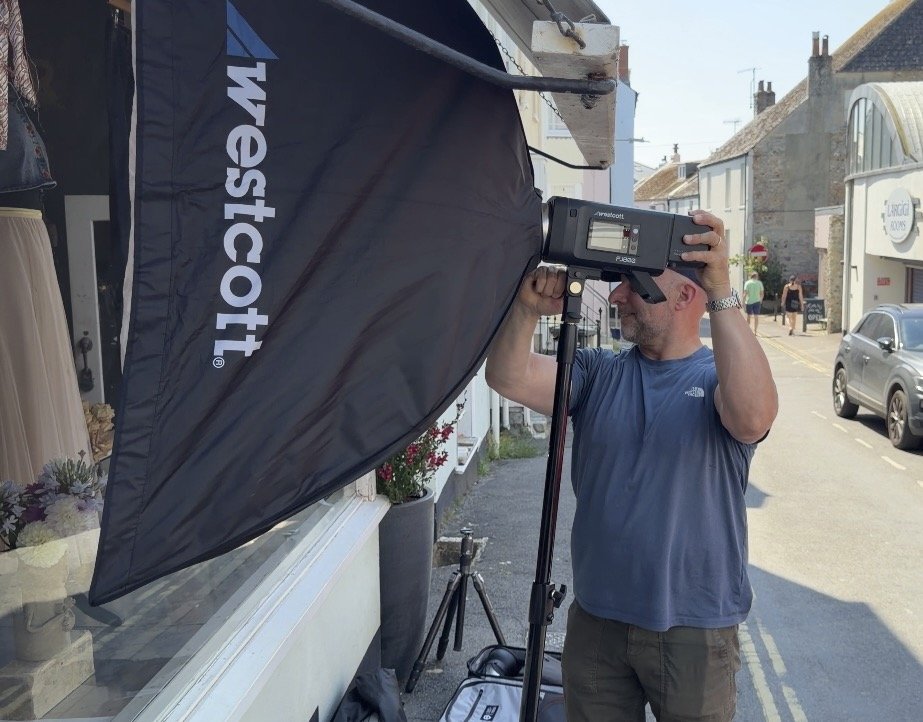
“If someone looks uncomfortable on camera, they will look uncomfortable in good light and in bad light. It makes no difference. So helping them become comfortable is the most important thing of all.”
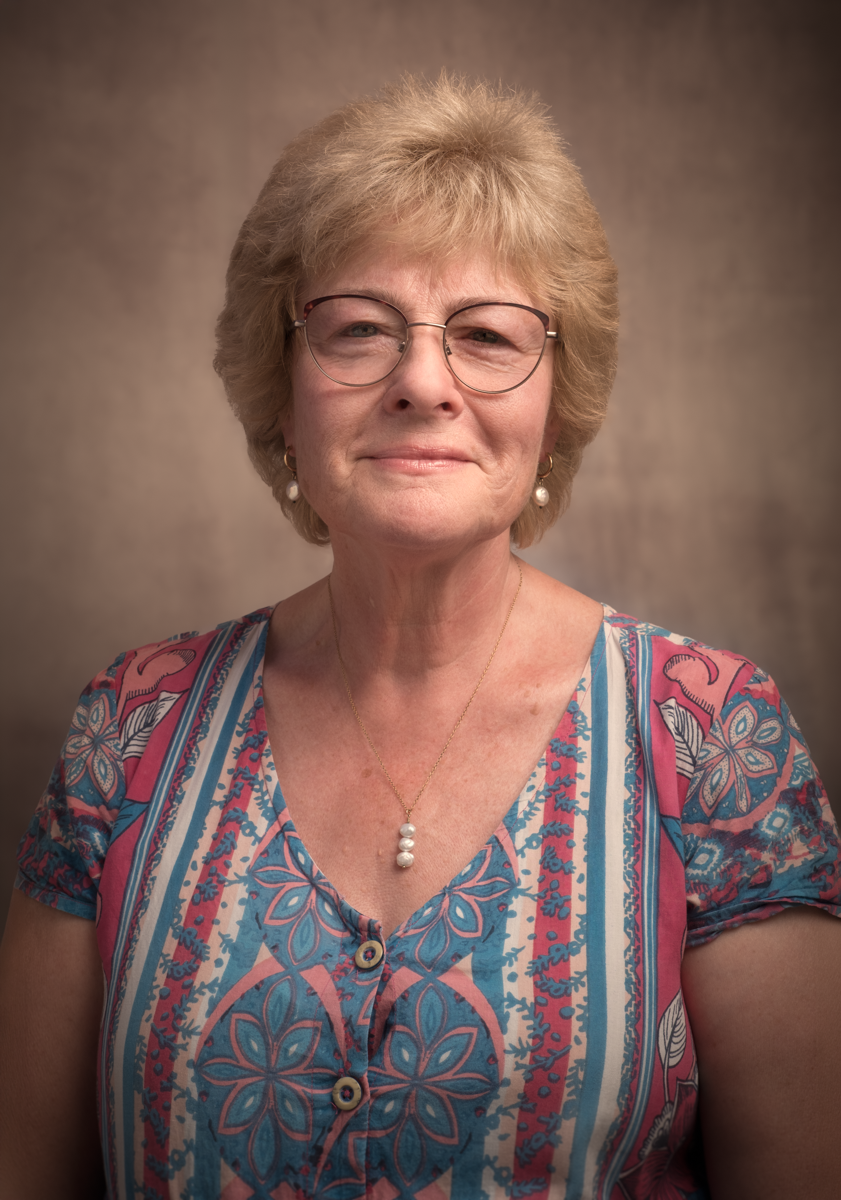
Smiling woman with blonde hair and glasses, studio portrait

Portrait, retouch, print, all in one go

The thing I enjoyed most over the two days was being able to show the whole process end to end, and that came down to teaming up with BenQ and Epson.

At Milton Keynes it worked like this…

Reviewing portraits on a laptop under a Wex gazebo during the roadshow

I'd take a portrait, then bring everyone round the laptop, which was hooked up to the BenQ SW272U, the same monitor I use day to day at home. I'd talk through the edit as I was doing it, with people stood there watching it happen. Then I'd hand it over to Dominic, who printed it out on a matt fine art paper.

We did the same at Nottingham, although Carly wasn't there for that one, so I was editing on my MacBook Pro screen and then passing the files to Dominic to print.

Man holding a print of his own portrait taken at the Wex roadshow

Somebody could sit for a portrait, watch it being retouched, and then hold a print of themselves in their hands, all within a few minutes. People really loved seeing that hands-on, and clearly something people want more of.

The kit

Nothing complicated, and all of it small enough to go in the car for two locations:

  • Fujifilm X-T5 and GFX 100S II

  • Westcott FJ100 strobe

  • Westcott Rapid Box Switch, the medium Octa

  • Westcott X-Drop Pro background

Photographer taking a portrait with a softbox under a Wex gazebo

That's the lot, and portability was the whole point of it.

The new FJ100 Storebe from Westcott perfromed flawlessly … and didn’t need a signle charge. In fact I doubt I’ll be charging it for the remaining tour dates.


where I'm off to next

Both teams at Milton Keynes and Nottingham were incredibly engaging and so welcoming, and there was a real buzz about both days, so a HUGE thank you to them.

Norwich is next, later this week; quite a drive for me but I’m really looking forward to it, so if you’re in the area … I’ll see you there ( LINK )

I am Lyme - Group Portrait on Victoria Pier

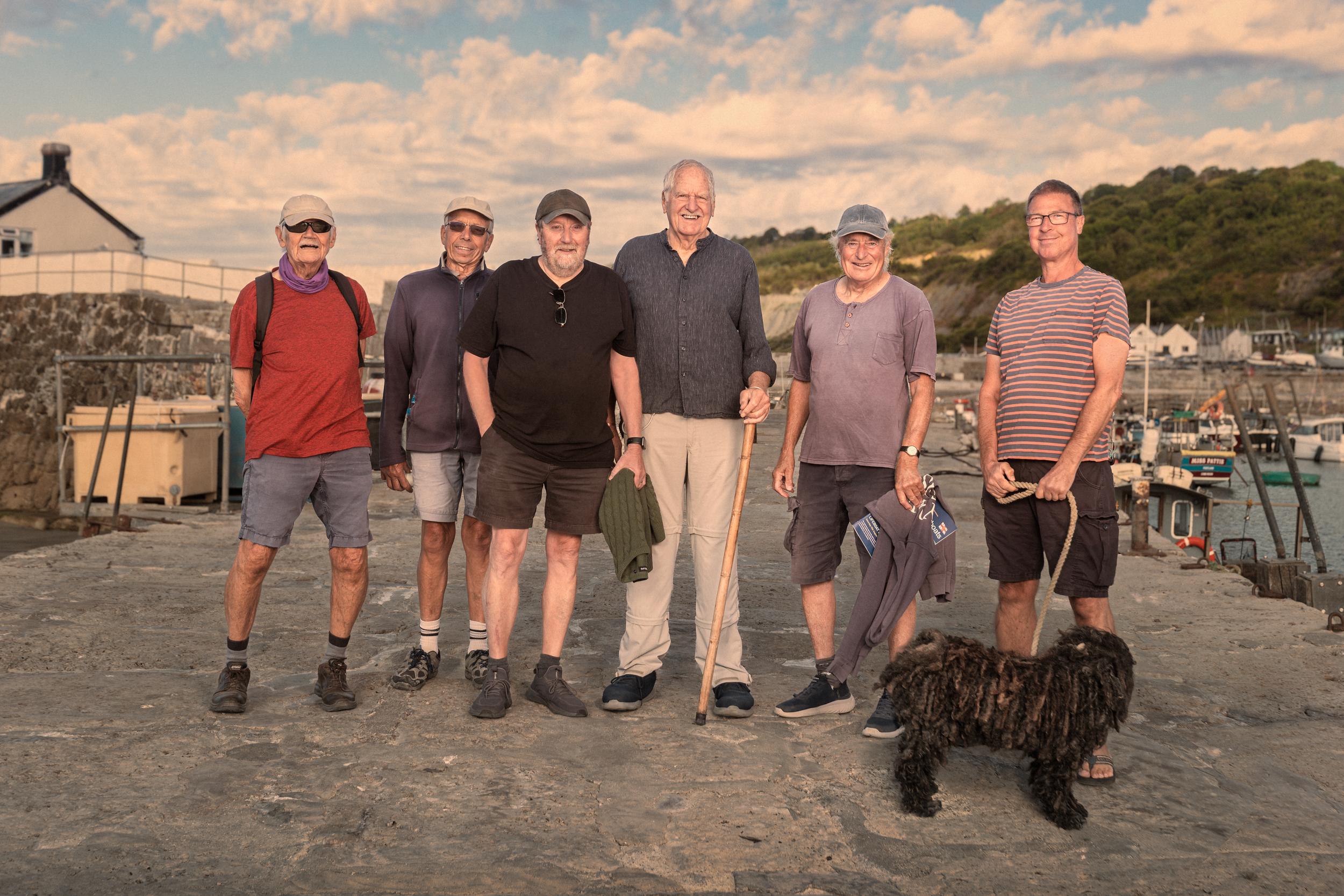
If you're ever in Lyme Regis and you happen to be on the Cobb at 7.35 in the morning, you'll meet these gentlemen. Seven days a week, come rain or shine, they're there.

Each of them is very well known in Lyme. I've lost count of the number of times I've heard people talk about this group, how good they are for one another and how good they are for the town. More than once someone has said to me that if you ever needed help, these would be the first men stepping forward.

Group portrait of local men and a dog on Victoria Pier, Lyme Regis, at sunrise

If you walk past them, all you'll hear is laughter. That morning walk is their own little bit of therapy, their own bit of escape, their own way of putting the world to rights. Whenever they stop and speak to somebody it's as if they've known them for years, and you always come away feeling better for it.

I'd wanted to photograph these men as a group for a good while to include in my "I am Lyme" project, because to me they really do represent Lyme Regis.

I was out with my great friend on Saturday morning and we happened to be on the Cobb, and sure enough, there they were. I stopped and explained about the project and they were more than keen, making jokes amongst themselves about getting their hair done and sorting out the makeup.

The following morning I went back, without telling them I'd be there.

I'd arranged to photograph Jason first ( LINK ) , so once that was done I carried my kit down to the far end of the Cobb, right by Victoria Pier. If you ever visit and go out on a sea fishing trip, that's the bit where you get on the boat.

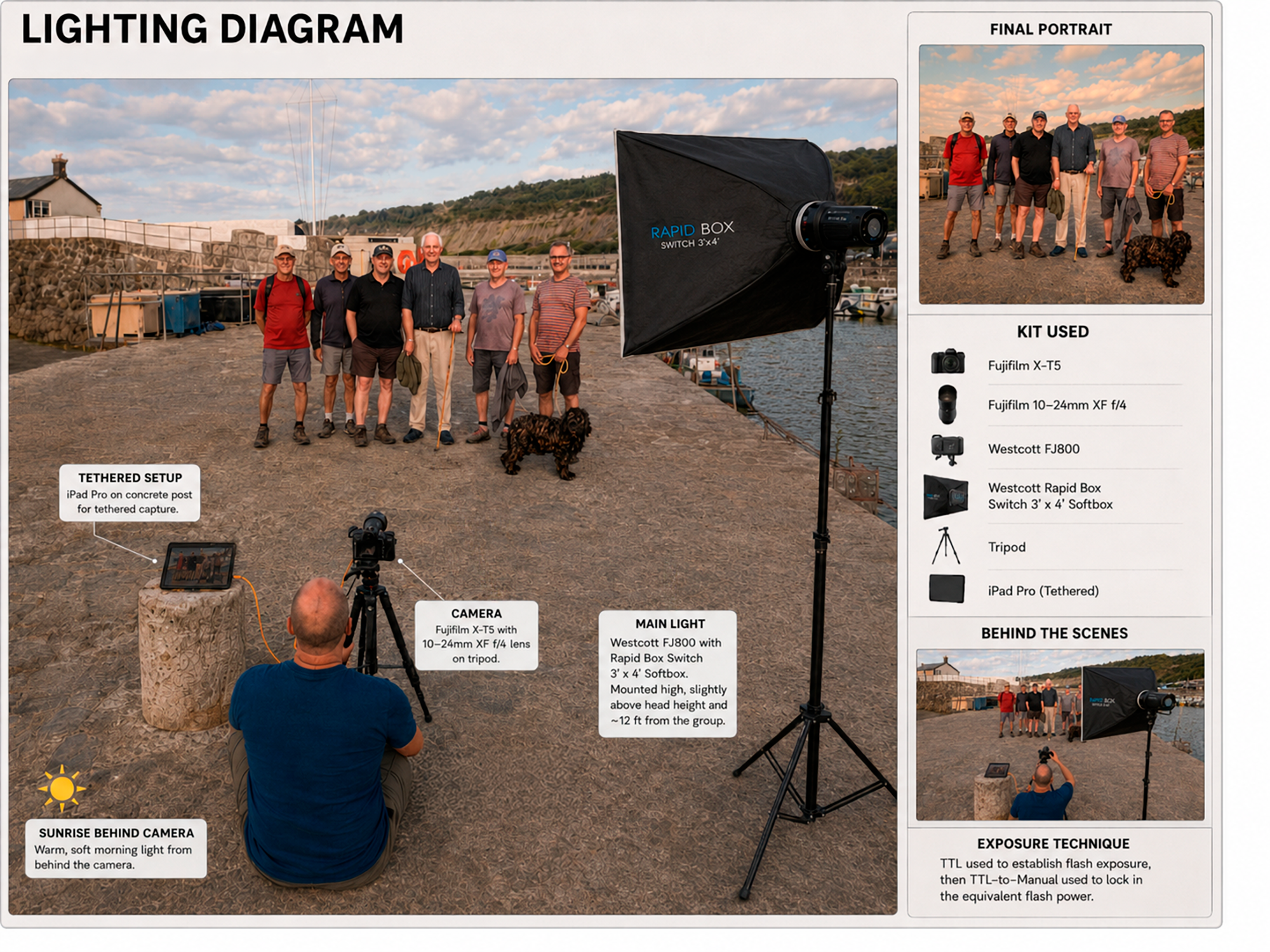
The kit was simple. Flash on a stand with my 3ft by 4ft softbox, and I had the softbox positioned horizontally because I knew I wanted to spread the light right across the group rather than have it drop off at either end. My back was to the sun, and so was the back of the softbox. Then I sat down next to it all and waited.

At 7.35, they turned up.

I walked over to one of the guys, John, who happens to be the brother of Harry May, who I photographed a few weeks back for the project. I said, "John, I said I'd be here. How do you fancy doing the group portrait now?"

Lighting diagram for the Victoria Pier group portrait with the kit list and final image

Two test shots, four frames, done. It took a couple of minutes at most, because the last thing I wanted was to hold up their walk.

As we were shooting, the wind picked up a bit and the stand needed some support, so I grabbed a volunteer from the group of people waiting to go out on a fishing trip. I never got his name, but he did a sterling job of holding everything steady.

I packed up and was about to head off to Town Mill for some breakfast, and I turned back to the guys and said, "Have a great day, and I'll see you soon with a print" , and each of them called out "Thank you Glyn" ,"Cheerio Glyn" , "See you soon Glyn"

I'd said my name once and each of them remembered it. I walked away with a beaming smile on my face.

This coming Tuesday I'm heading down to The Cobb nice and early to sit at the end of the Cobb by Victoria Pier with a coffee, and just wait for these great guys to turn up so I can hand them each their own print.

I cannot wait.

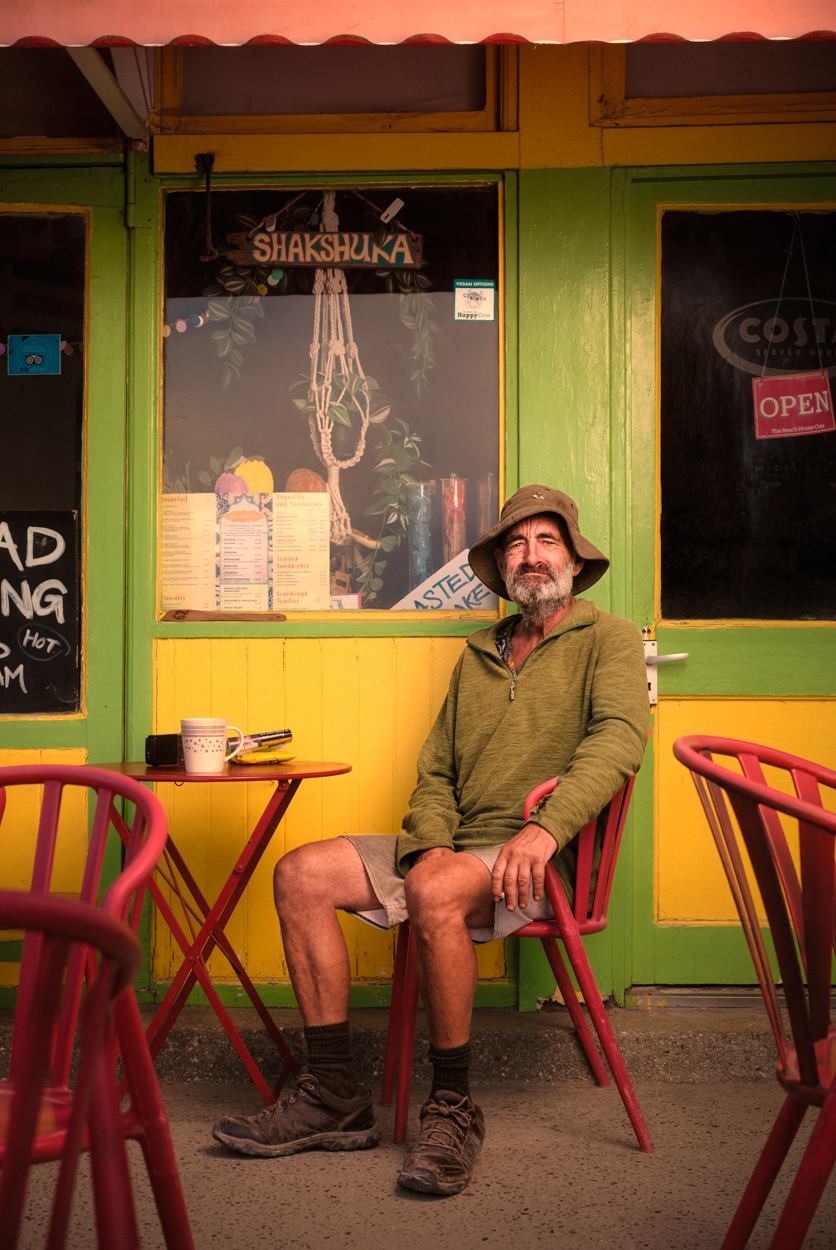
Photographing "Beach House Café Jason" for I am Lyme

I was up and out at 4.30 last Sunday morning to take an early morning sunrise photograph of a chap called Jason down on the seafront for my "I Am Lyme" project.

Jason is a well known face around Lyme Regis. Everyone knows him and everyone comments about him being such a kind, gentle soul. We chose The Beach House Cafe right on the front as the place to photograph him as he’s great friends of the owners.

I've seen him loads of times, always a “Good morning”, and the odd bit of chat, nothing much more than that, but I've wanted to photograph him for a good while.

Man in a bush hat and green jacket sitting outside the brightly painted Beach House Café, Lyme Regis

Turns out somebody else I'm shooting for the project soon had already mentioned it to him. So on the Saturday, when I was out with my friend Steve Healy and we happened to see him, we got chatting about the project and I asked him there and then. He was more than happy to be involved, and it was Jason who suggested six o'clock the following morning. So that's what we did.

Sitting down before picking the camera up

I got down there good and early and was set up by 5.30am, and before I even picked the camera up we sat and chatted, talking about all sorts.

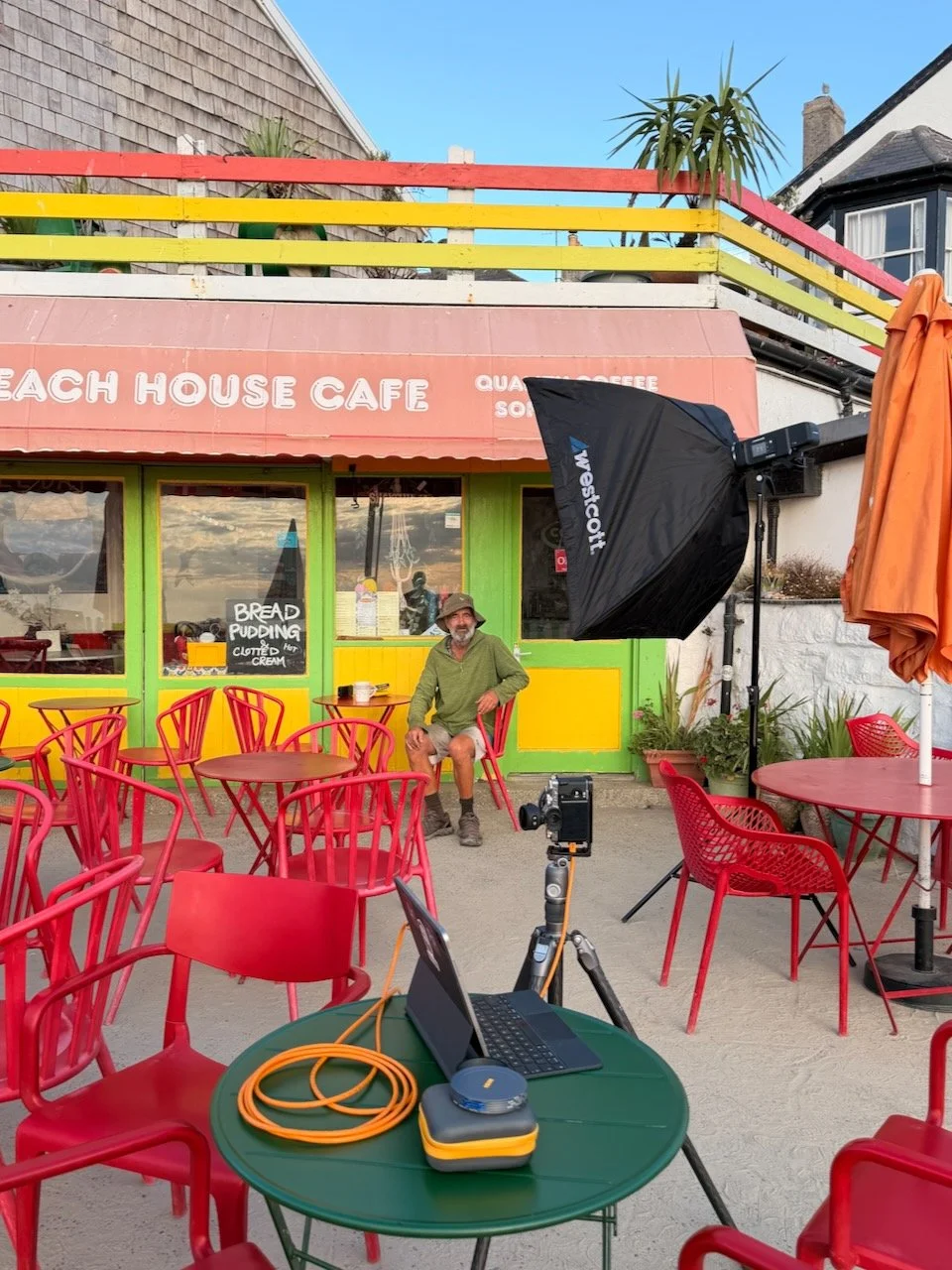
Behind the scenes of the portrait at the Beach House Café with a softbox and tethered laptop

That's when he told me he isn't originally from Lyme Regis; he's from Southampton, and a few years ago he was cycling round the world, all over India and Thailand, and he was making his way round the UK when he stopped off here and never left. He got the job at the cafe pretty much the next day and has run it ever since for the elderly couple who own it.

At one point in the conversation he also opened up about some fairly serious medical problems he's had to deal with in the not too distant past. It's not my story to tell so I'll leave it there, but it really struck me … you just never know what somebody has been through.

Taking the portraits

Once he'd finished setting up, that's when we started taking some portrait shots; all very slow paced with no rush at all, which was lovely.

It was genuinely a completely relaxing experience and that's exactly what I'm loving about the "I Am Lyme" project, much the same as I did with the veterans work. By sitting and chatting with people you get to know them a bit, you understand them a bit more, and I genuinely believe that comes through when you take their portrait.

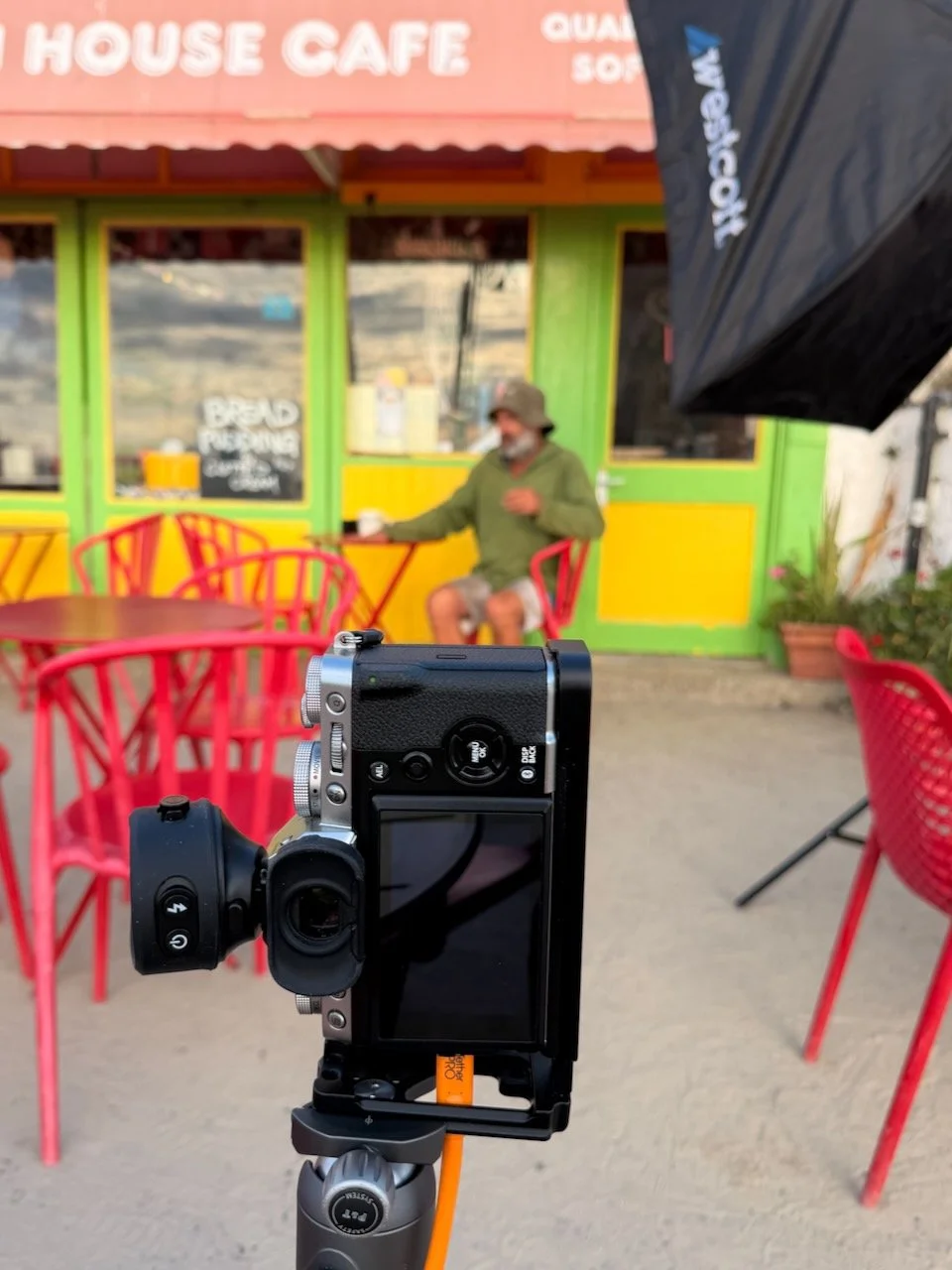
Camera on a tripod photographing a man outside the Beach House Café

The thing that really got me though was how many people said good morning to him while we were stood there. I honestly lost count. Everybody knows Jason.

The kit I used

Nothing complicated, and nothing I haven't used a hundred times before:

  • Fujifilm X-T5

  • Fujifilm XF 33mm f/1.4 R LM WR

  • Westcott FJ800

  • Westcott Rapid Box Switch Octa, 3ft x 4ft

  • Westcott XT-1M remote trigger

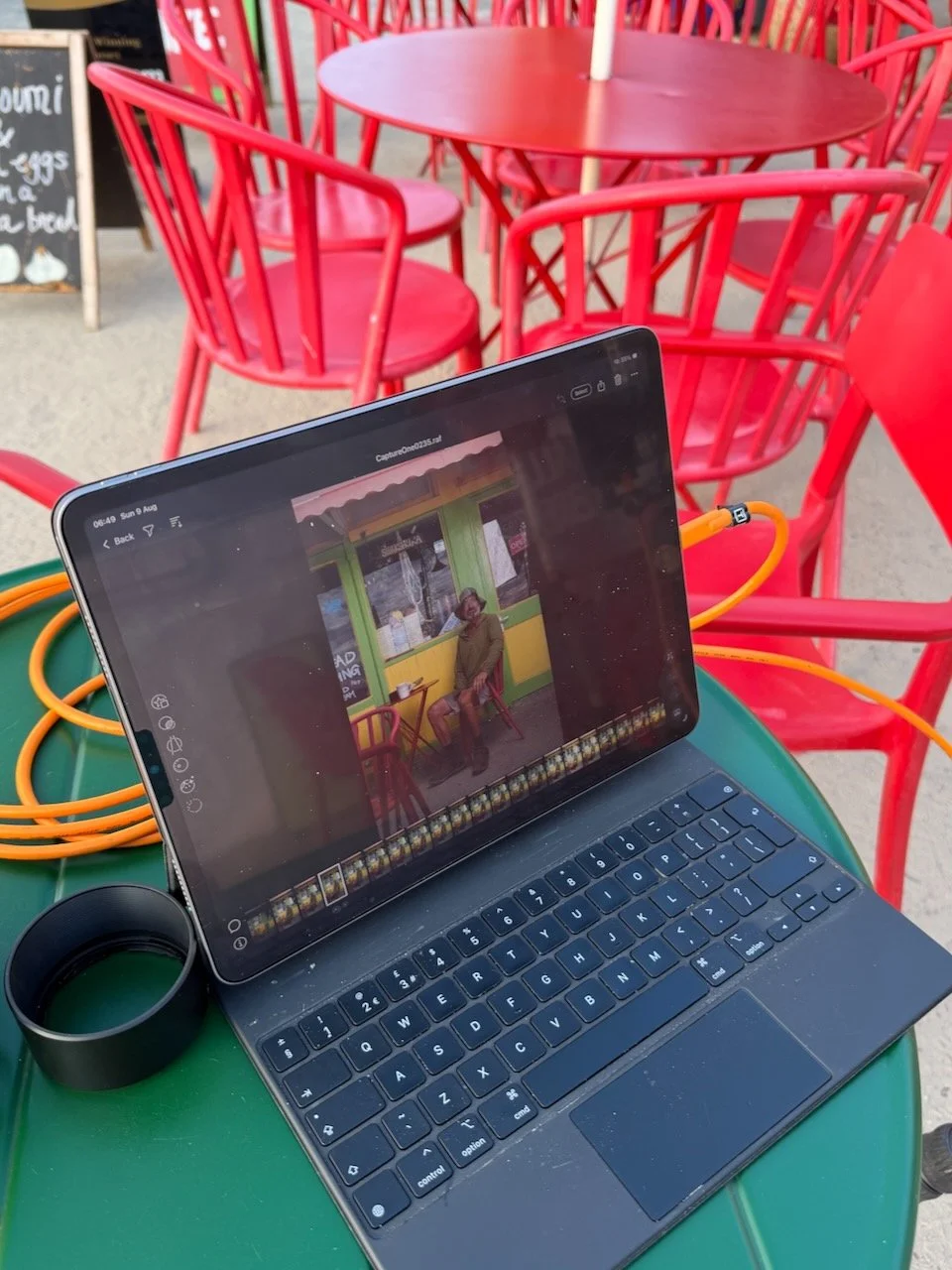
  • Tethered into Capture One Mobile on the iPad

Settings were ISO 100, f/4.0 and 1/125 sec.

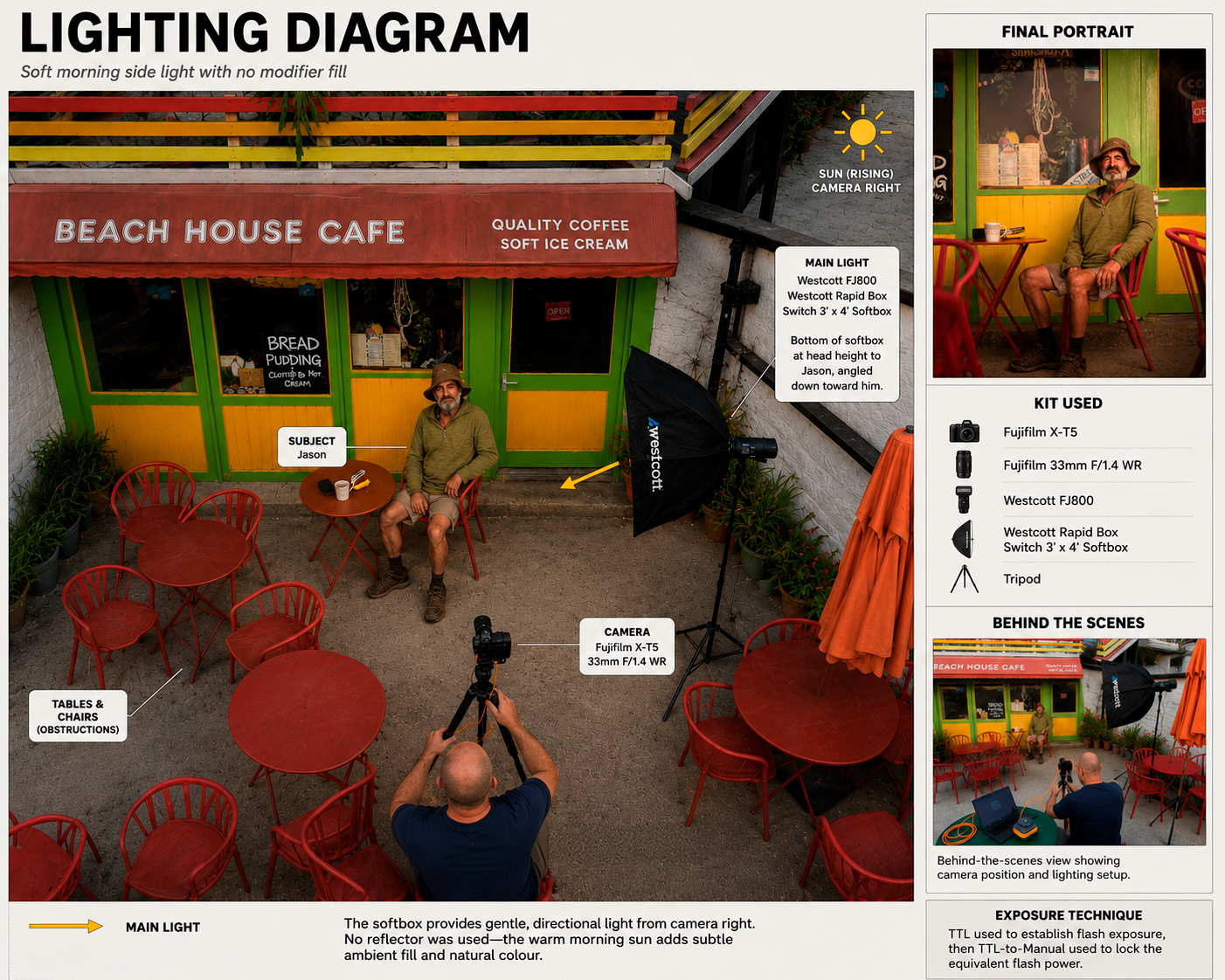
Lighting diagram for the Beach House Café portrait with the kit list and final image


TTL to manual, and why I keep banging on about it

The flash side of it is the bit worth explaining, because it's the thing that makes a shoot like this so much calmer than it sounds.

It works like this.

I set the flash to TTL and take a frame, and the flash works out for itself what it reckons is the perfect exposure. All I have to do then is nudge it up or down on the dial on the remote until it's where I want it, and use the TTL to Manual function to lock that power in.

That's it. Pretty much one shot and the flash exposure is bang on and we're good to go.

From then on the flash fires at exactly the same power every single frame, so nothing is quietly drifting about while I'm working, and that's really the whole point of it for me. It keeps the technical side of the photography simple and quick, so as a portrait photographer my time gets spent engaging with the person in front of my camera instead of being distracted by the tech.

Tethered tablet showing the portrait on a café table

For anyone who's been put off by the idea of manual flash, it's a lovely way in as well, because you're letting the flash do the maths and then simply keeping the answer.

The ambient was the interesting part that morning.

The rising sun was over to camera right and it kept appearing and then going back behind the clouds, so the light was changing every couple of minutes. Rather than chase it, I set my camera for the ambient with the sun behind cloud and then only took photographs when it was behind cloud. Wait, shoot, wait again.

It sounds like a faff but it isn't. It meant the ambient light was consistent, and because the flash power was locked in manual, that was consistent too. Same background, same light on his face, frame after frame.

The print

I'll be getting Jason's print to him in the next few days, which is the bit of this project I look forward to most. Handing somebody a print of themselves in person is a very different thing to sending them a file, and it's become the part of "I Am Lyme" that I wouldn't skip for anything.

I’ll make sure to grab a picture of Jason with his print and share it.

I Am Lyme: Nicola of Kathrens Rare Knitwear, Lyme Regis

Last week I was out shooting another portrait for my I Am Lyme project, this time with the wonderful Nicola Kathren, who owns Kathrens Rare Knitwear on Coombe Street in Lyme Regis.

I'd known of Nicola for ages but we'd never actually met, until Sarah from the Town Mill Bakery introduced us a week or so ago while I was there grabbing some breakfast. We hit it off straight away, got a shoot organised, and on the day my mate Anthony Crothers drove over from South Wales to lend a hand.

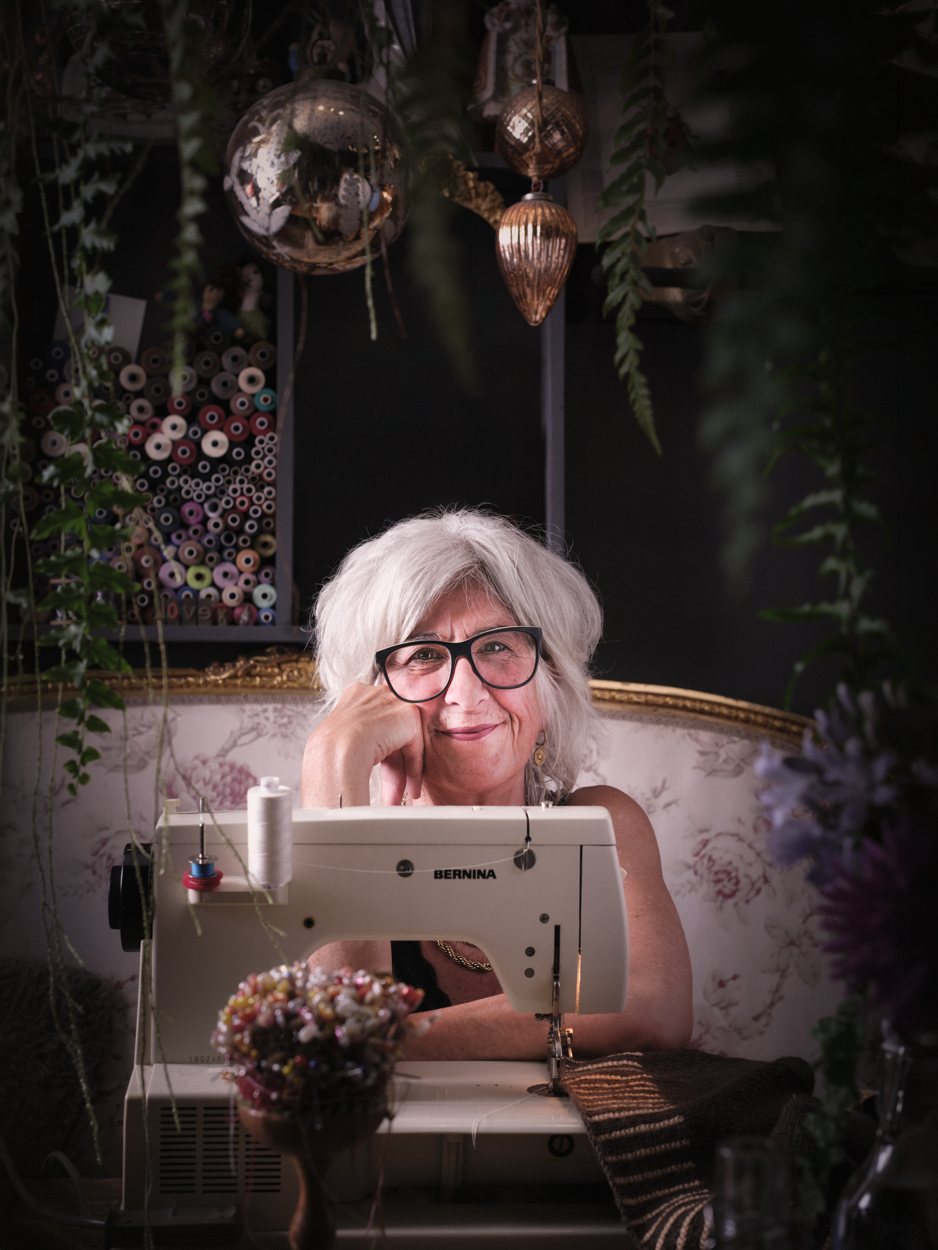
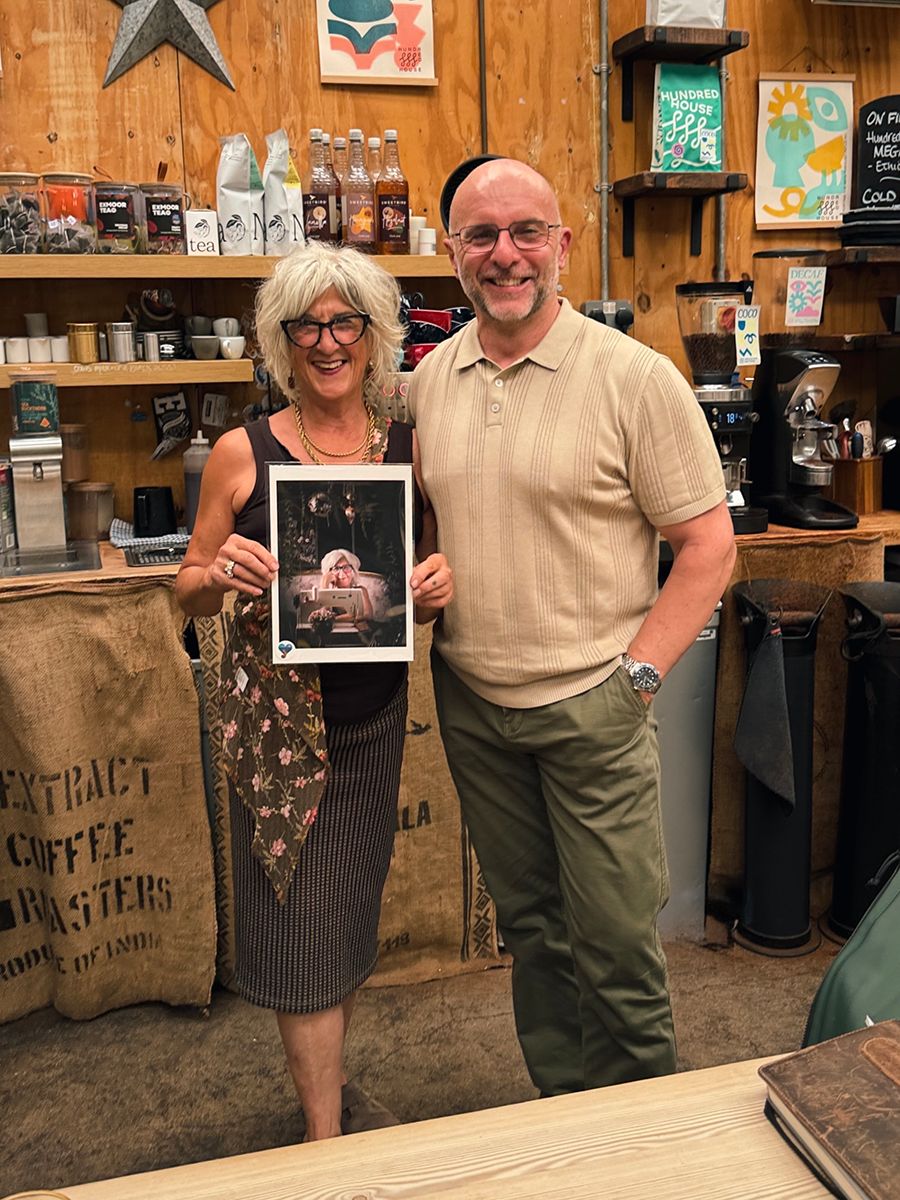
White-haired woman in glasses at her sewing machine, framed by hanging plants

The idea

Nicola has this big desk where she sits with her sewing machine and all her day-to-day bits around her, so it made sense to photograph her right there seeing as I Am Lyme is about the people who make this town what it is; an environmental portrait of her in her own space, doing what she does, felt exactly right.

The setup

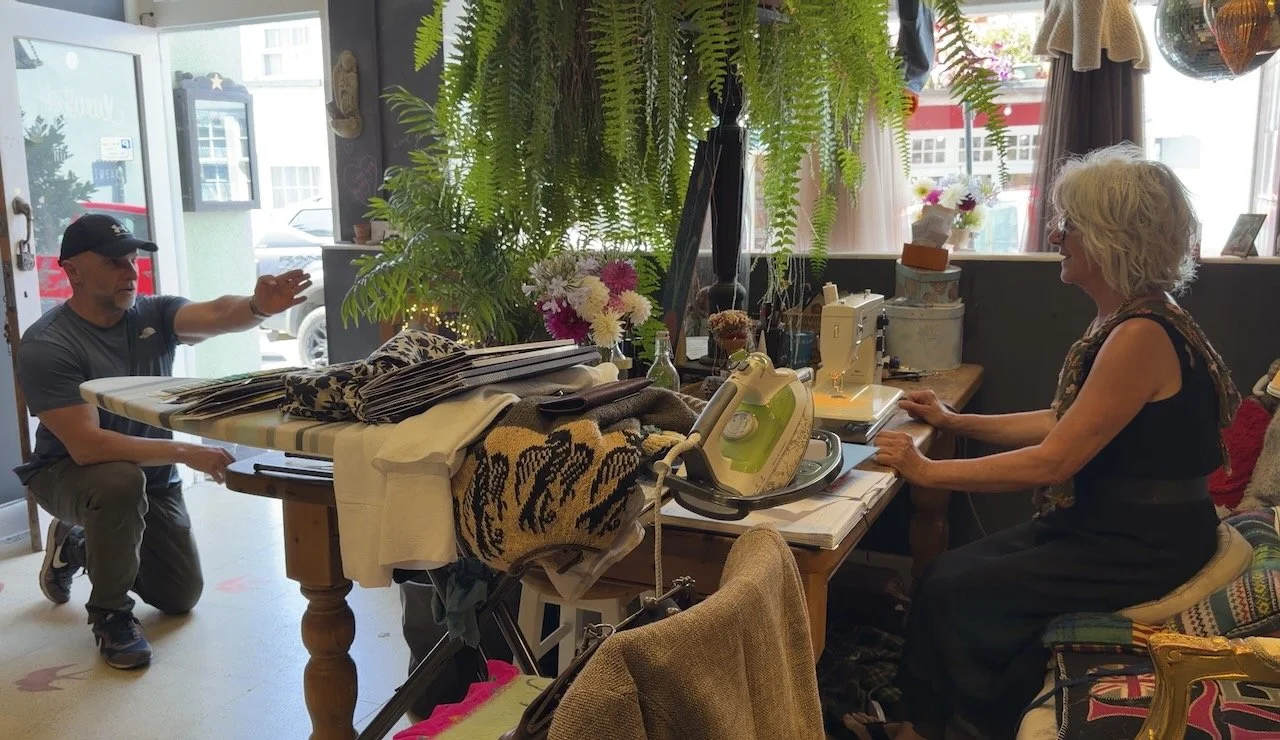
Nicola’s desk sits right by the shop's big front window, which looks straight out onto the narrow road outside. When the light comes through that window it's fantastic, but at the time we were shooting there just wasn't enough of it. It's a narrow street with tall buildings opposite, so they block a fair bit of the natural light, and at midday the position of the sun meant the shop front was sitting in shadow for much of the time.

Behind the scenes of photographing a knitwear shop owner at her sewing machine in her shop

The first challenge was actually the window display; we had to carefully reposition the mannequins so as not to disturb it, while still leaving enough of a gap for the light to come through.

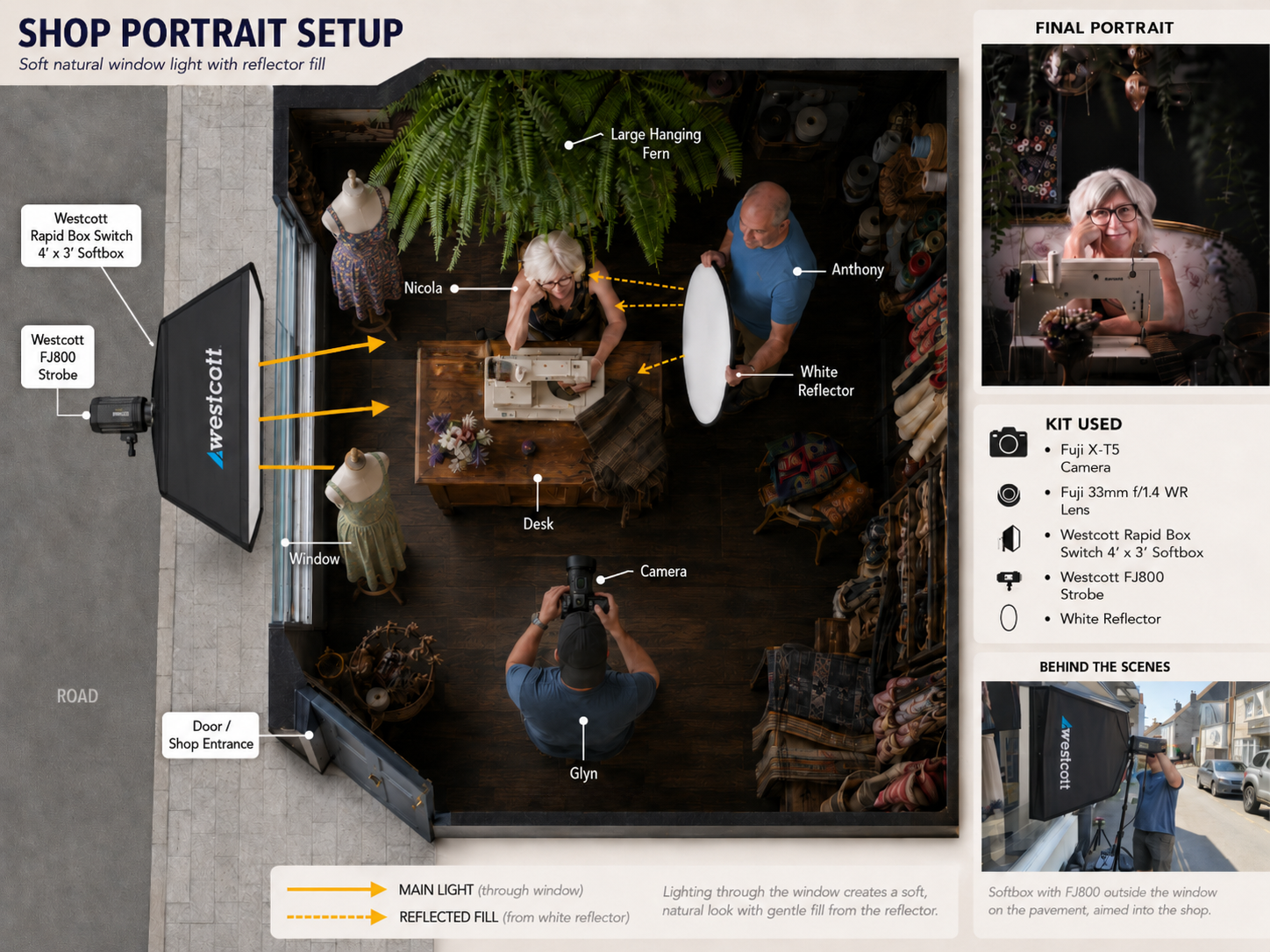
Keeping things simple, I went with one light, but this time I put it outside, pressed against the window, essentially to create my own window light. The direction of that natural window light and what it did was absolutely stunning; I just needed more of it.

Westcott softbox and light set up outside the knitwear shop in Lyme Regis

So I set up the Westcott Rapid Box 4x3 softbox and the Westcott FJ800 on the pavement, firing in, to enhance the direction that was already there rather than fight it, so it still read as natural, even though it was being lit.

Nicola's camera-right side needed a little lift, so Anthony stood just out of frame holding up a white reflector to bounce a touch more of that softbox light back onto her. I tried the silver side first, but it was too much … it flattened everything out and almost removed the shadows completely. The white gave just the gentle lift I was after.

Overhead lighting diagram of the shop portrait setup, with the final portrait and kit list

The shoot

It only took a few minutes to get everything up and running, so Nicola sat at her sewing machine and we just chatted. It felt like a conversation with the odd frame grabbed along the way, rather than a "shoot."

Then, in a lull, she rested her head against her hand and looked completely relaxed. That was the moment, and it came about naturally rather than being posed.

I was aiming the camera at Nicola through a gap in the big overhanging fern because I really wanted to add some layers to the image and show exactly the creative environment she works in.

Shot on the 33mm on my Fuji X-T5 (50mm equivalent), on a tripod, tethered into Capture One Mobile so I could see everything coming through as we went. Start to finish, about 45 minutes.

A brilliant shoot with a wonderful person.

Shop owner holding a print of her portrait alongside the photographer

What's next?

Keep ‘em peeld because very soon the I Am Lyme website will GO LIVE with the dates organised for the exhibiton in Summer 2027, to be held in the Town Mill Gallery.

Onwards and upwards 😃

🚨 Check out Kathrens Rare Knitwear, Lyme Regis ( LINK )

Photographing World War 2 Veteran Philip Truelove - Bomb Disposal

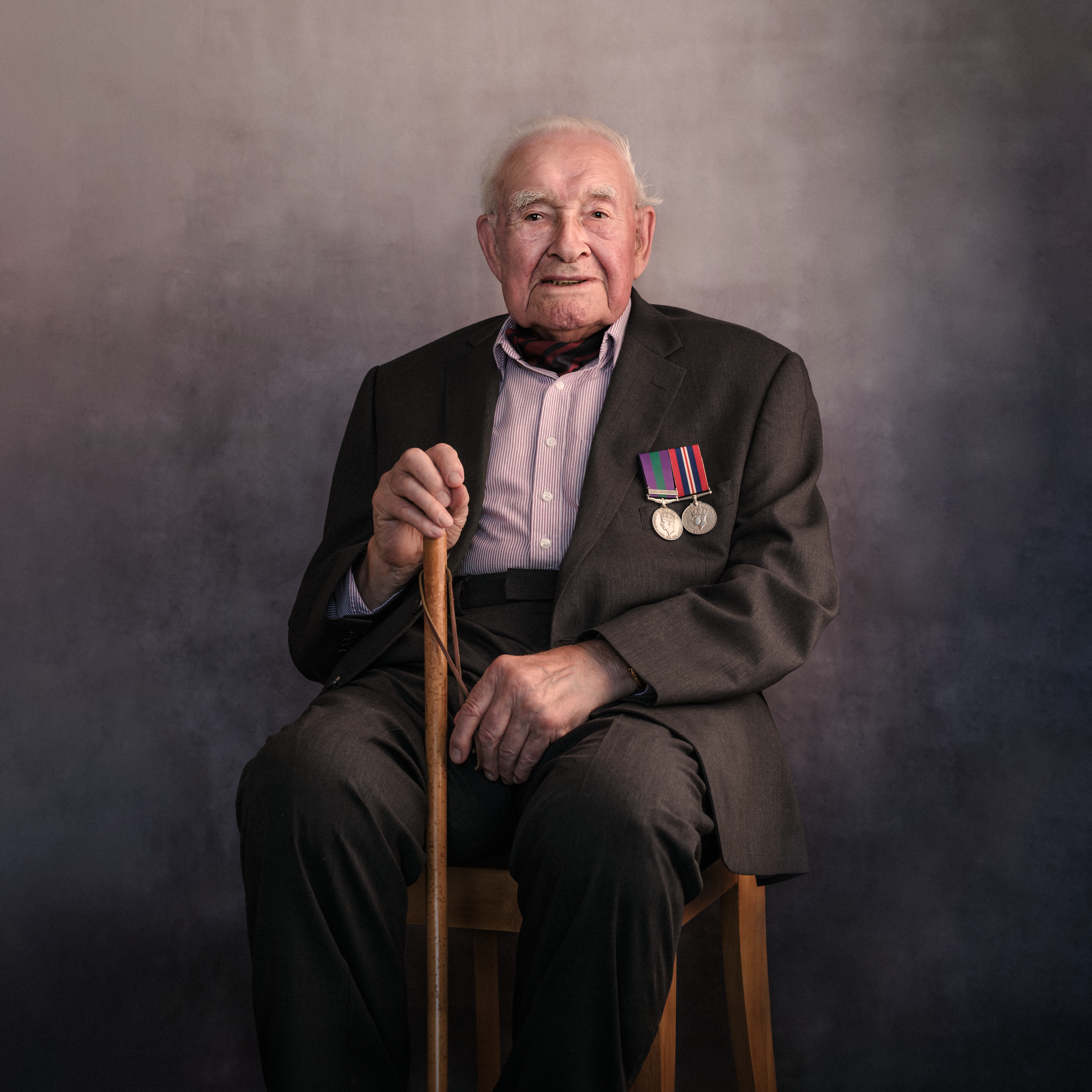
Last week I drove to Bath, Somerset to meet and photograph Philip Truelove, a Second World War veteran who served in 215 Platoon, No. 10 Bomb Disposal Company, Royal Engineers.

Portrait of a Second World War veteran in a suit and medals, seated holding a walking stick

I'd been contacted by his son Jez, a keen photographer himself, after he received the Fotospeed newsletter announcing my new partnership as one of their Ambassadors. He clicked through to my website, saw mention of the 39-45 Portraits Project, and got in touch. We exchanged a few emails and agreed a date for me to visit Philip at his home and take his portrait.

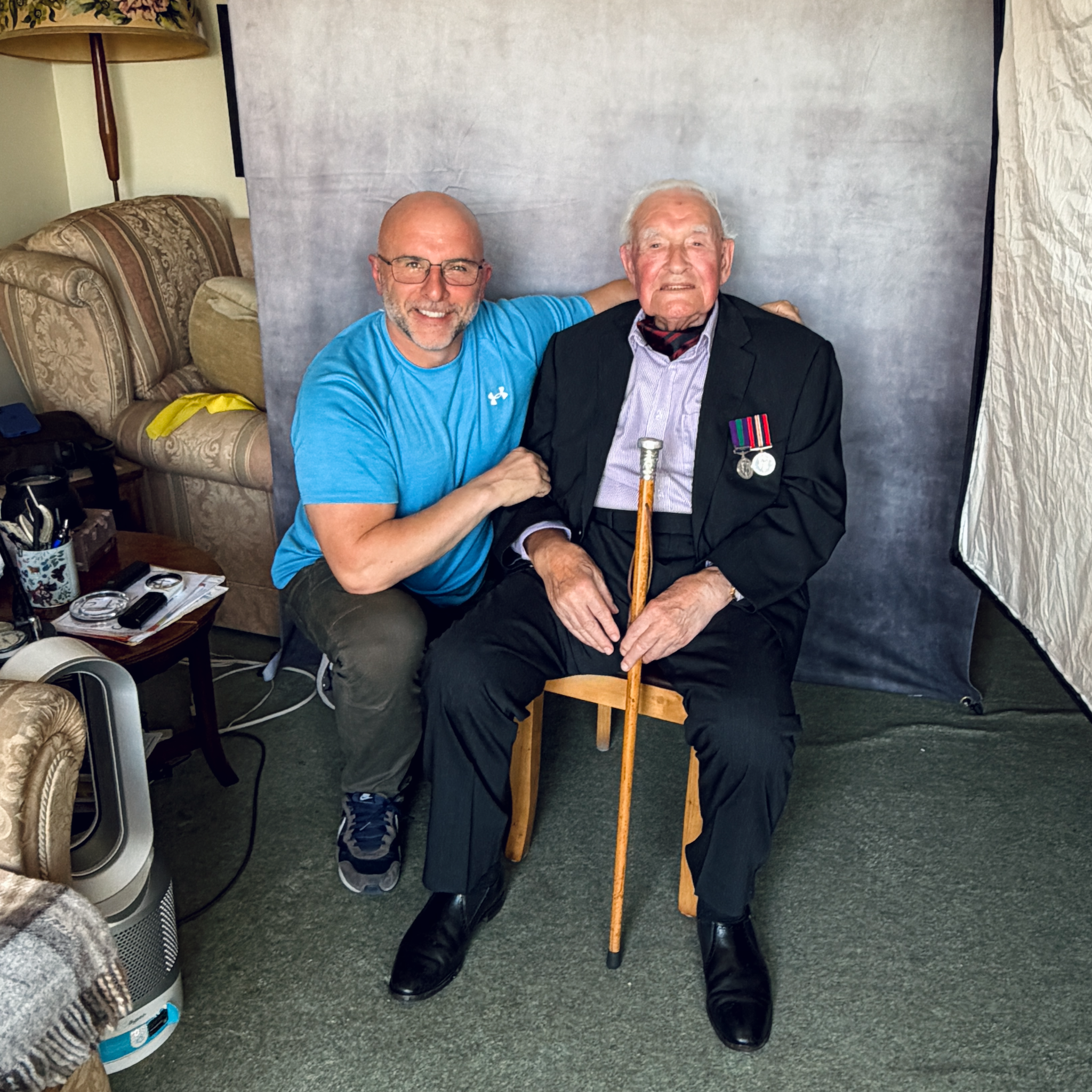
Photographer in a blue T-shirt sitting beside a smiling veteran with medals in front of a grey backdrop

I'd been looking forward to this for weeks. I'm no longer actively touring the UK photographing WW2 veterans, but if I'm contacted about doing so, I'll always make the effort to get it done. Meeting Philip today was such a treat.

A warm welcome

As planned, I arrived at midday and left my kit in the car for now. Jez met me at the door.

"My dad is very excited about this," he said, and then led me into the living room, where I was greeted with a beaming smile and Philip making the effort to get up from his chair to greet me.

"Well, hello Sir" was all that was needed, and away we went. The conversation flowed easily as Philip recounted stories of joining up and memories of friends, and at times he became a little teary.

I asked him what made him want to join Bomb Disposal.

"I didn't want to have to kill anyone," he told me.

At one point he spoke about a time he was guiding a group of German soldiers who had surrendered, moving them to a new location. Philip was clearing the way ahead, making sure it was safe, when one of the soldiers stepped over the white safety line he'd put in place to go to the toilet in a bush. Moments later there was an explosion. The soldier had stepped on a mine.

"That was my saddest day of the whole war," Philip said.

Taking the portrait

We chatted over a cup of tea, and then, with Jez's help, I brought my kit in from the car and set up. Philip was a natural in front of the camera and clearly enjoyed the experience.

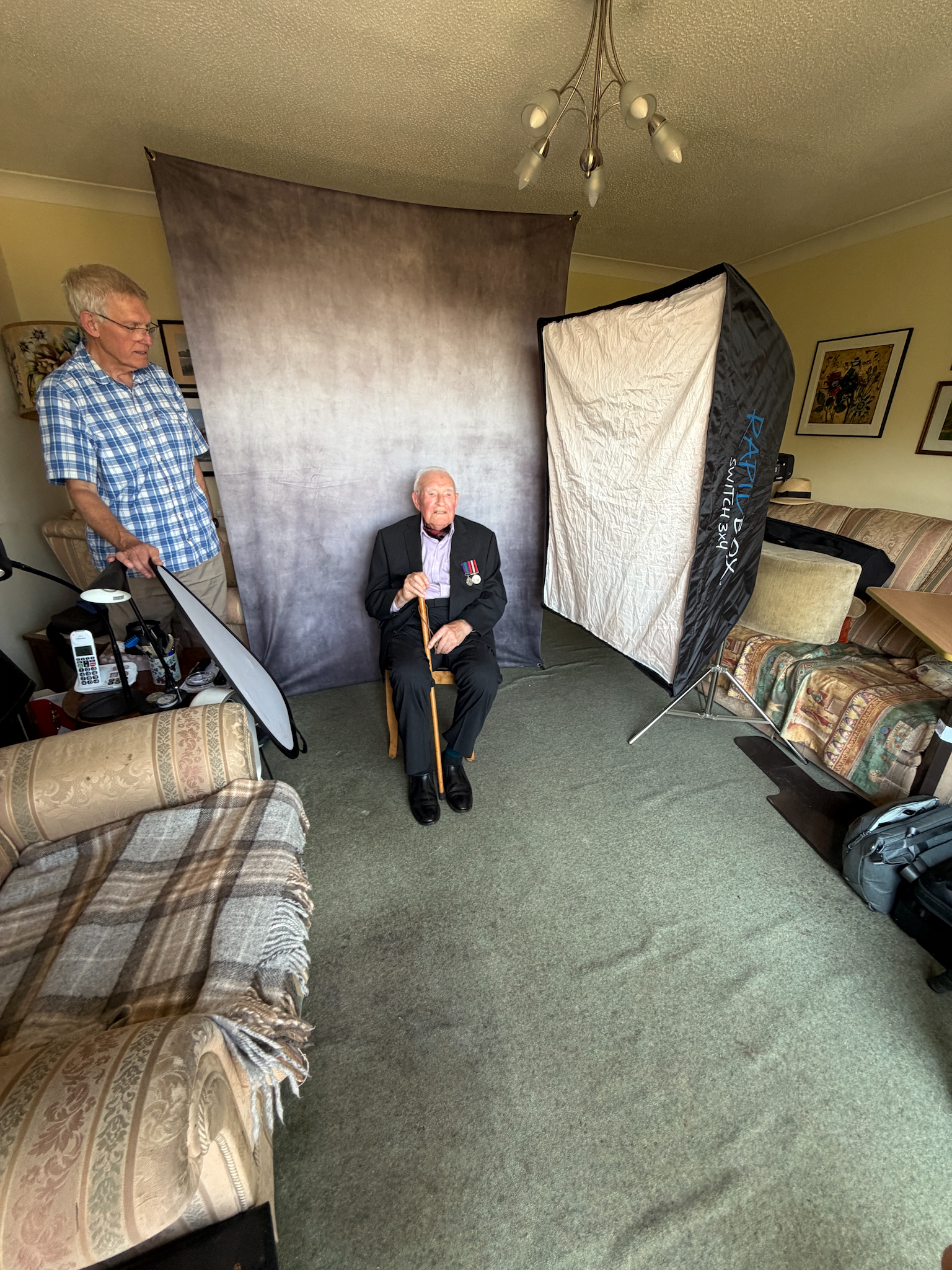
Space in the room was very tight, so tight that I couldn't use a tripod as I normally would. Instead I had to lean back against the patio doors and hold the camera about six inches from my chin, just to maintain eye contact with him through the lens.

Portrait setup in a living room with a veteran seated before a grey backdrop and a softbox to one side

By 1.02pm I was packed up and heading out the door. It wasn't a long visit, but it was more than enough quality time together. It was also a very hot day, and I was mindful that Philip was wearing his suit jacket and medals for the occasion. Despite my concerns, he was determined we should do this today, and I'm so glad we did.

KIT USED

  • Fuji X-T5

  • Fuji 33mm f/1.4 WR

  • Westcott FJ400 Strobe

  • Westcott 4’ x 3’ Rapid Box Switch Softbox

  • Westcott X-Drop Pro Background Support

  • Westcott Vintage Grey by Glyn Dewis (Background Material)

  • Westcott Silver / White Collapsible Reflector

🚨 Check out my full Kit List ( CLICK HERE )

What comes next

I'll be heading back in just under two weeks to hand deliver Philip's portrait, mounted and presented thanks to my friend Trevor at West Street Picture Framing in Axminster. First, though, I'll be editing the portrait later today.

Philip turns 100 years old on the 21st December this year, and in a couple of weeks the street he lives on will be holding a party to celebrate his birthday early. That alone tells you the kind of man he is, when an entire street wants to celebrate his birthday.

I can't wait to head back and see him again. In the meantime, I'll be reading his self-published book, The Chronicles of a Sapper, which recounts his memories from when he joined up in January 1945.

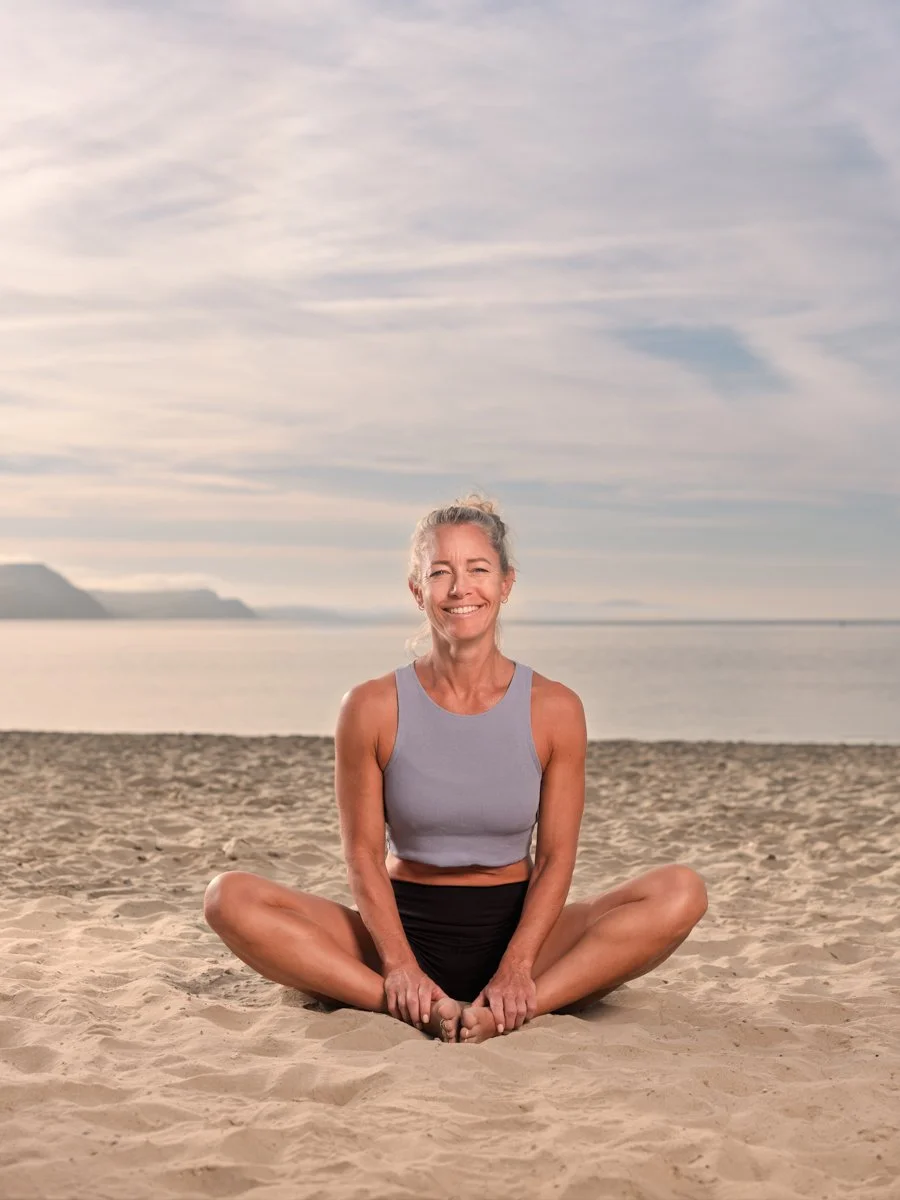
I Am Lyme: Beach Yoga at Sunrise

There's something about photographing people doing what they love, in the place they love doing it, that never gets old.

Woman in a grey crop top sitting cross-legged on a sandy beach at sunrise with the sea behind

That's exactly what happened a coyuple of weeks back, early morning when I met up with Pip, a local yoga teacher in Lyme Regis, for the latest instalment of my I Am Lyme project.

An Early Start on the Beach

Pip teaches beach yoga here in Lyme Regis, and there's no better way to capture that than actually being on the beach while the light is do`ing something special. So we met early, before the town had properly woken up, while the tide and the light were both in our favour.

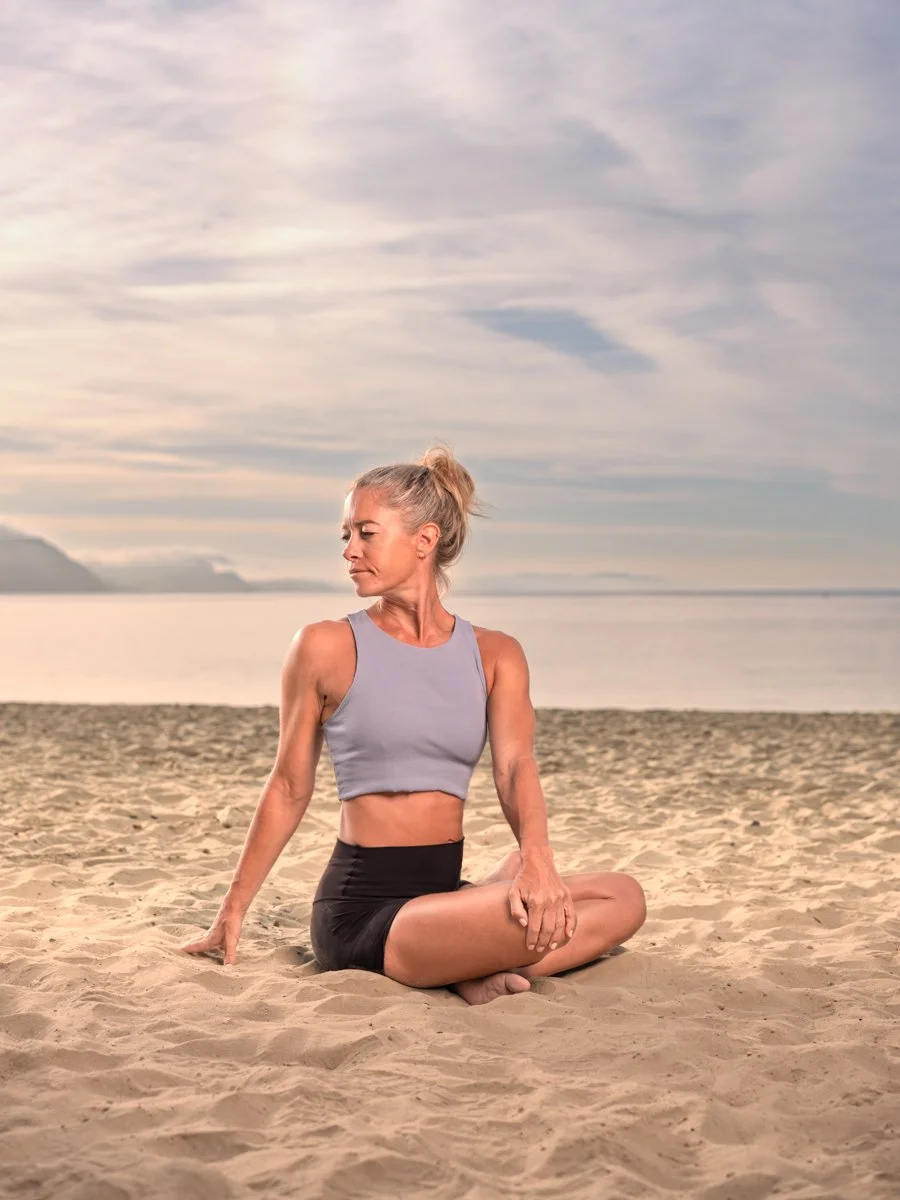
Woman in a grey crop top seated in a yoga stretch on a sandy beach under a soft morning sky

The plan was simple. Get set up before Pip's students arrived, grab the shots, and get out of the way so she could get on with teaching her class. In reality, that gave us a matter of minutes. Her students were already turning up on the beach as we were shooting, which meant no second chances and no faffing about. Everything had to be right first time.

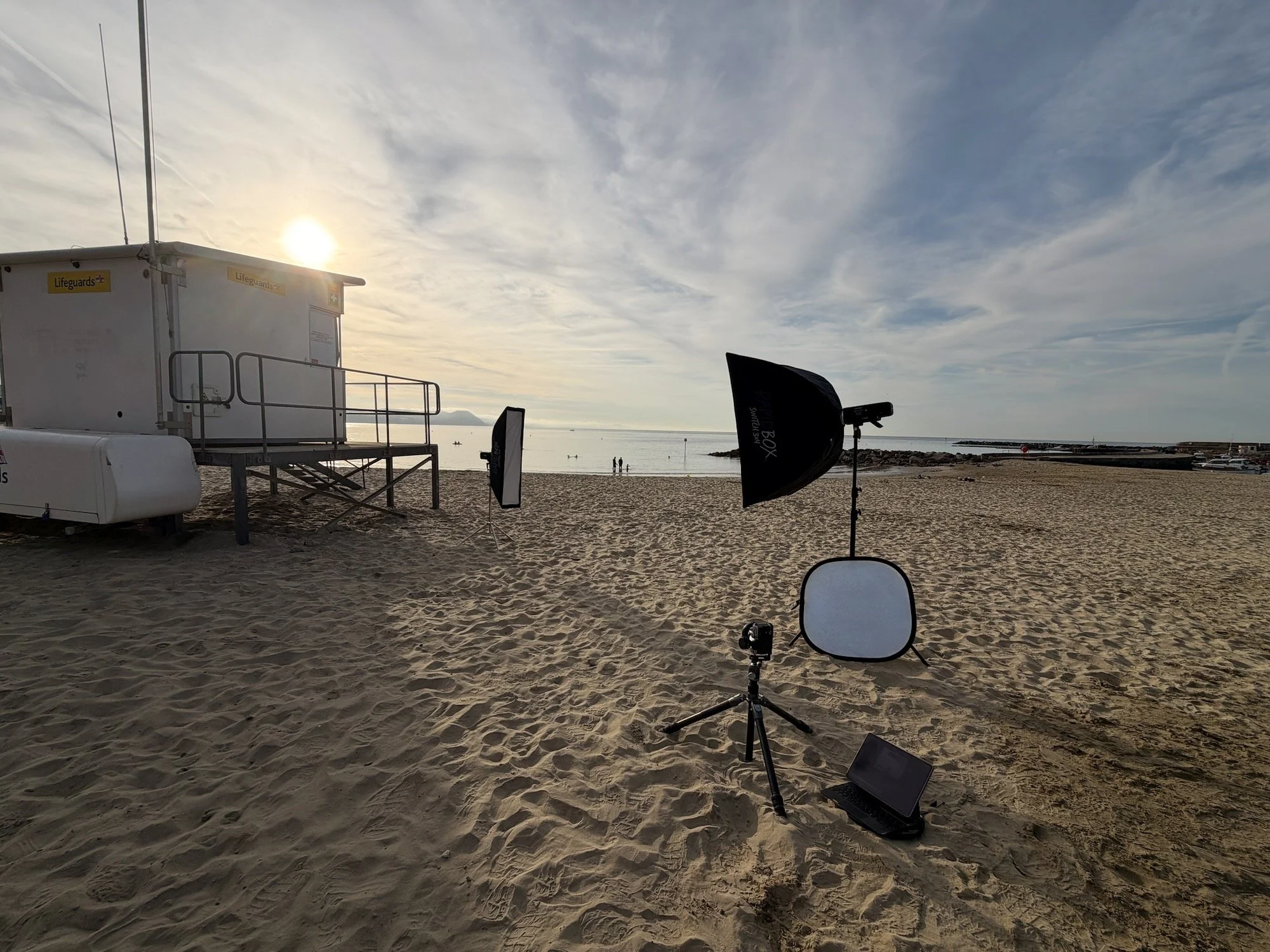
Lighting setup on a sandy beach at sunrise with a softbox on a stand beside a lifeguard hut

This is one of the things I love about the I Am Lyme project. It's not about staged studio perfection, it's about real people, in real moments, in and around the town. Pip fitting me in around her actual class, rather than a separate posed session, is exactly the kind of authenticity the project is built on.

The Lighting Setup

Shooting on a beach at sunrise sounds romantic, and it is, but it's also a technical puzzle. You've got a huge, ever-changing light source (the sky) and you need your flash to work with it, not fight it.

Here's what I used:

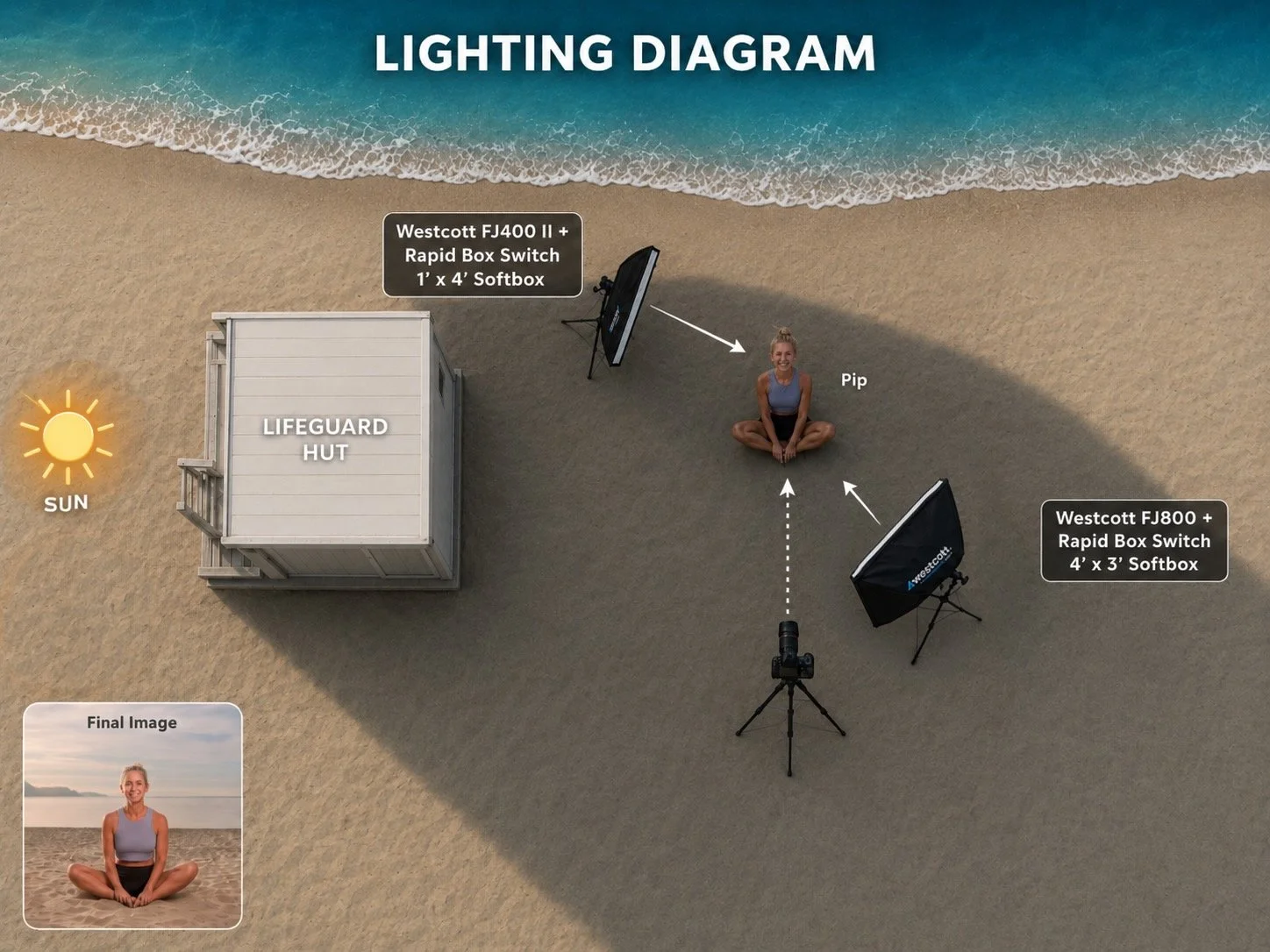
Camera right: A Westcott FJ800 fired into a Rapid Box Switch 4' x 3' softbox.

This was doing the heavy lifting as my main light on Pip.

Camera left, rear of Pip: A Westcott FJ400 II into a 1' x 4' Rapid Box Switch softbox.

This one was there purely to fake a bit of rim and separation, mimicking natural sunlight catching Pip from behind.

Lighting diagram of a beach yoga shoot showing two Westcott flashes with softboxes, the camera and the sun

To get the aperture I wanted (f/2.8) at native sync speed, I dropped in a 4 stop NiSi ND filter.

Without it, shooting that wide open at sunrise would have blown out completely, even with the softer early morning light.

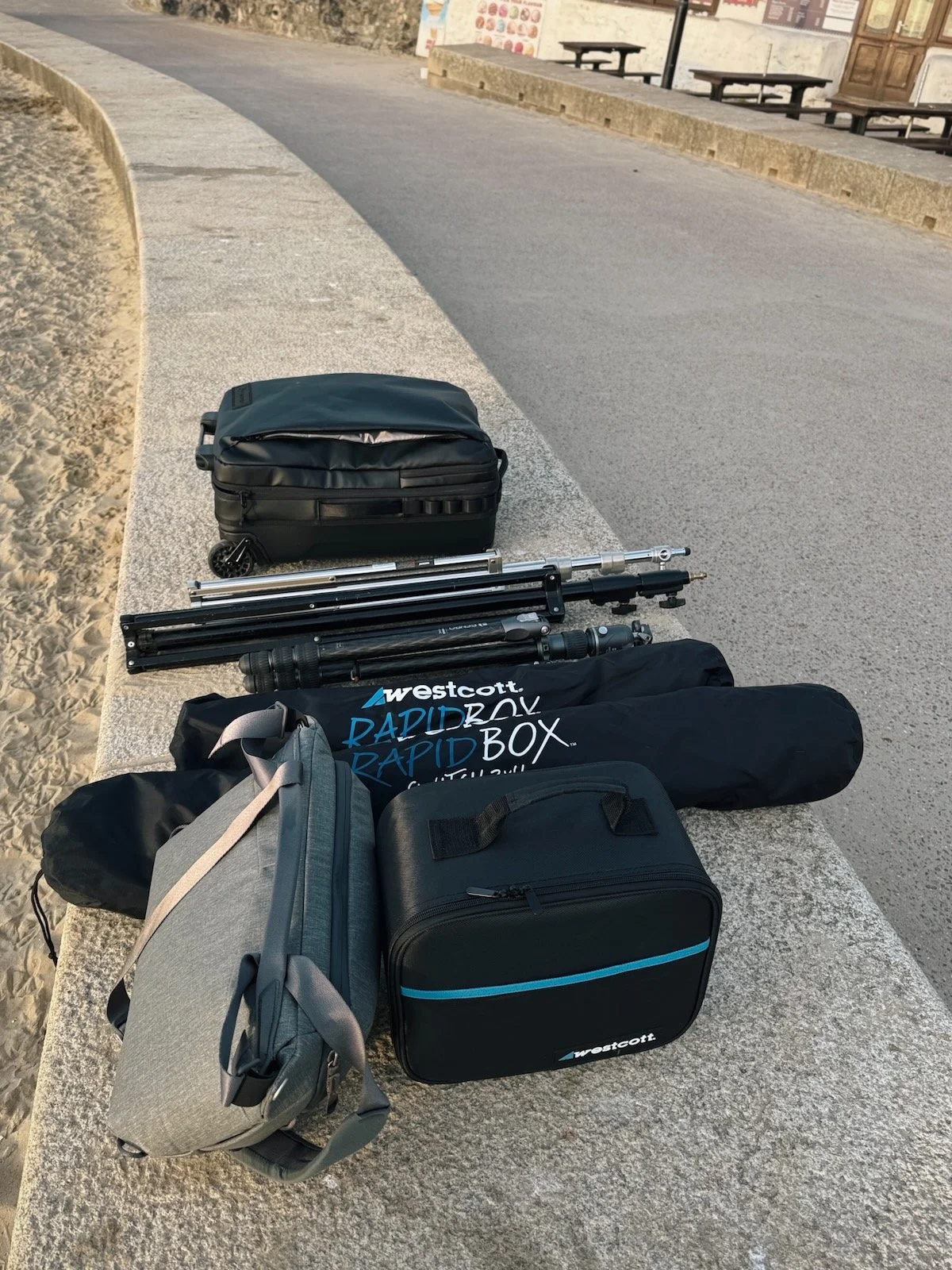
Camera bags, light stands and a Westcott Rapid Box softbox bag laid on a seafront wall

Both flashes were run in TTL, with the rear FJ400 dialled up to +1 stop compensation. That extra push made sure the rim light actually read as light, rather than getting lost against the brightness of the beach and sky.

Why It Worked

With only a few minutes to play with, having the lighting pre-set and tested before Pip even arrived (5.30am) made all the difference. There was no time to chase settings once she was in position, ready to switch straight into teaching mode. Everything from stands to softboxes to flash power was locked in beforehand, so once Pip stepped onto her mark, it was simply a case of composing, shooting, and trusting the setup.

It's a good reminder that a "quick" shoot still needs proper preparation behind it. The speed on the day only works because of the planning that happens before anyone presses a shutter button.

Part of Something Bigger

This shoot with Pip adds another face and another story to I Am Lyme, my ongoing project documenting the people connected to this town. Different job, different backdrop, same idea: real Lyme Regis people, captured as they are.

More shoots to come soon.