
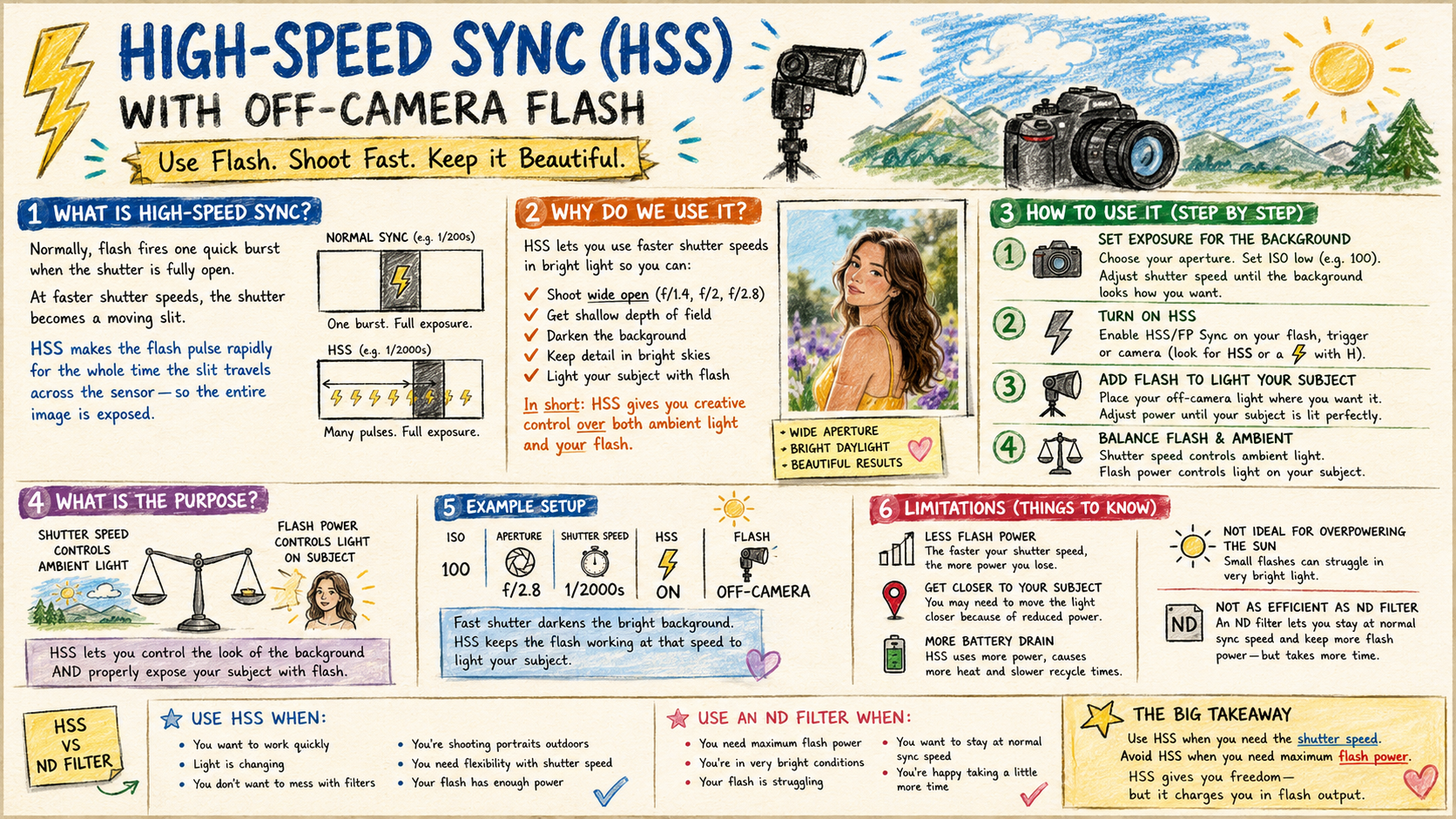
High-Speed Sync, or HSS, is a flash mode that lets you use flash at shutter speeds faster than your camera's normal flash sync speed.
For most cameras, normal flash sync speed sits around:
1/160 sec, 1/200 sec or 1/250 sec
Go faster than that and HSS becomes essential.
What High-Speed Sync Actually Does
Normally, when you take a flash photo, the flash fires one quick burst of light while the shutter is fully open. At normal sync speeds, that works perfectly.
But push past your camera's sync speed and the shutter is no longer fully open at any single moment. Instead, a narrow slit travels across the sensor. If the flash fired just one burst at that point, only part of the frame would be lit, leaving you with a dark band across the image.
HSS solves this by making the flash pulse rapidly for the entire time that slit is travelling across the sensor. So instead of one big pop, you get lots of tiny rapid pulses instead.
Why I Use It
The main reason is simple: it lets you shoot with wider apertures in bright light.
Say you're outside on a sunny day and you want to shoot a portrait at f/2.8, f/2, or even f/1.4. That gives you shallow depth of field, a blurred background, nice separation, and that more polished portrait look.
The problem is, in bright daylight, a wide aperture often forces your shutter speed up to something like 1/1000 sec, 1/2000 sec, or even 1/4000 sec. Without HSS, your flash simply won't sync properly at those speeds. With it switched on, you can keep that wide-aperture look and still use off-camera flash.
What It's Really For
Here's where a lot of photographers get it wrong: HSS isn't really there to freeze action. That's a common misunderstanding.
Its real purpose is to give you control over ambient light while still using flash. It frees up your shutter speed, which means you can darken the background, hold onto detail in a bright sky, shoot wide open, and still light your subject properly with flash.
Put simply: HSS lets you make daylight behave itself.
How I Use It in Practice
A typical off-camera flash setup with HSS goes something like this.
1. Set your exposure for the background first
Start without flash. Choose your aperture, for example f/2.8, and set your ISO low, around ISO 100. Then adjust your shutter speed until the background looks the way you want it. In bright daylight, that might mean 1/1000 sec or faster.
At this point your subject is probably too dark. That's where the flash comes in.
2. Turn on HSS
You'll usually need to enable HSS on the flash trigger, the flash head, the camera's flash menu, or sometimes all three, depending on the system. With Westcott, Godox, Profoto, Canon, Nikon, Sony and so on, the exact menu or button differs, but the principle is the same. Look out for HSS, High-Speed Sync, FP Sync, or a lightning bolt with an H next to it.
3. Add flash to light your subject
Position your off-camera light where you want it. For portraits, I'll usually go for around 45 degrees to the subject, slightly above eye level, using a softbox, beauty dish or umbrella, and close enough to keep the light soft and powerful. Then adjust your flash power until your subject looks right.
4. Balance flash and ambient
Think of it this way: shutter speed controls the ambient light, flash power controls the light on your subject. In HSS, that's mostly true, but there's one important catch. Because HSS reduces flash power, very fast shutter speeds will also make your flash work a lot harder.
A Simple Example
You're photographing someone outdoors at golden hour, or in bright sun. You want a blurred background, a dramatic sky, and your subject nicely lit.
Settings might look like this:
ISO 100
f/2.8
1/2000 sec
HSS turned on
Flash in a softbox, off-camera
The shutter speed brings the bright background down. The flash brings your subject back up. That's HSS doing its job.
Why Not Just Use Normal Flash Sync?
At normal sync speed, say 1/200 sec, bright daylight might force you to use f/8, f/11 or even f/16. That gives you more depth of field, so the background is sharper.
That can work fine for some shots, but if you're after that more cinematic, shallow-depth portrait look, it becomes limiting fast. HSS removes that restriction entirely.
The Limitations of High-Speed Sync
HSS is brilliant, but it's not without trade-offs.
1. You lose flash power
This is the big one. Because the flash is pulsing rapidly rather than firing one full burst, the available power drops significantly. The faster your shutter speed, the more power you lose. At 1/4000 sec, your flash has nowhere near the effective reach it has at 1/200 sec.
2. You may need the flash closer
With less power available, you'll often need to bring the light in closer to your subject. That's not necessarily a bad thing, closer light is usually softer, but it can be a problem if you need to light someone from further away.
3. Battery drain is higher
HSS makes the flash work harder, which means more battery use, slower recycle times, more heat, and fewer shots per charge. Fine for a quick portrait session. Worth thinking about for fast-paced shoots, events, or long days.
4. It's not ideal for overpowering the sun
You can use HSS in bright sunlight, but if your goal is to completely overpower harsh midday sun, you need a genuinely powerful light. Small speedlights tend to struggle here. Something like a Westcott FJ400, or similar, is much better suited to the job.
5. It can be less efficient than an ND filter
An ND filter lets you keep your shutter speed at normal sync speed while still shooting wide open. For example:
ISO 100
f/2.8
1/200 sec
ND filter fitted
Flash at normal sync
This keeps far more flash power in reserve. So the real choice often comes down to this:
HSS is faster and simpler, with no filter needed. An ND filter gives you more flash power, but it's slower to work with.
HSS vs ND Filter
Use HSS when:
you want to work quickly
the light is changing
you don't want to mess about with filters
you're shooting portraits outdoors
you need flexibility with shutter speed
your flash has enough power to spare
Use an ND filter when:
you need maximum flash power
you're working in very bright conditions
your flash is struggling to keep up
you want to stay at normal sync speed
you're happy taking a little more time
Neither is better than the other. They're just different tools for different jobs.
The Big Thing to Remember
High-Speed Sync is mainly about creative control. It lets you shoot with flash at fast shutter speeds so you can use wide apertures, darken the ambient light, hold onto detail in bright backgrounds, create separation, and light your subject properly outdoors.
The price you pay is reduced flash power. So the practical rule I stick to is this:
Use HSS when you need the shutter speed. Avoid it when you need maximum flash power.
That's HSS in a nutshell. It gives you freedom, but it charges you for it in flash output.