photography

Why AI Enhancement Isn't Cheating in Wildlife Photography

Wildlife photography is something I'd love to do more of, but at the moment, time doesn't allow it. However, when I do get the chance to head out with a long lens to give it a go, I gain deep respect for what it takes to capture the shot.

That's why the debate around AI editing tools fascinates me.

Critics argue that tools like Topaz Gigapixel or AI sharpening "ruin" wildlife photography. If your lens wasn't long enough or your sensor didn't capture fine details, using AI to reconstruct them is cheating.

I disagree completely.
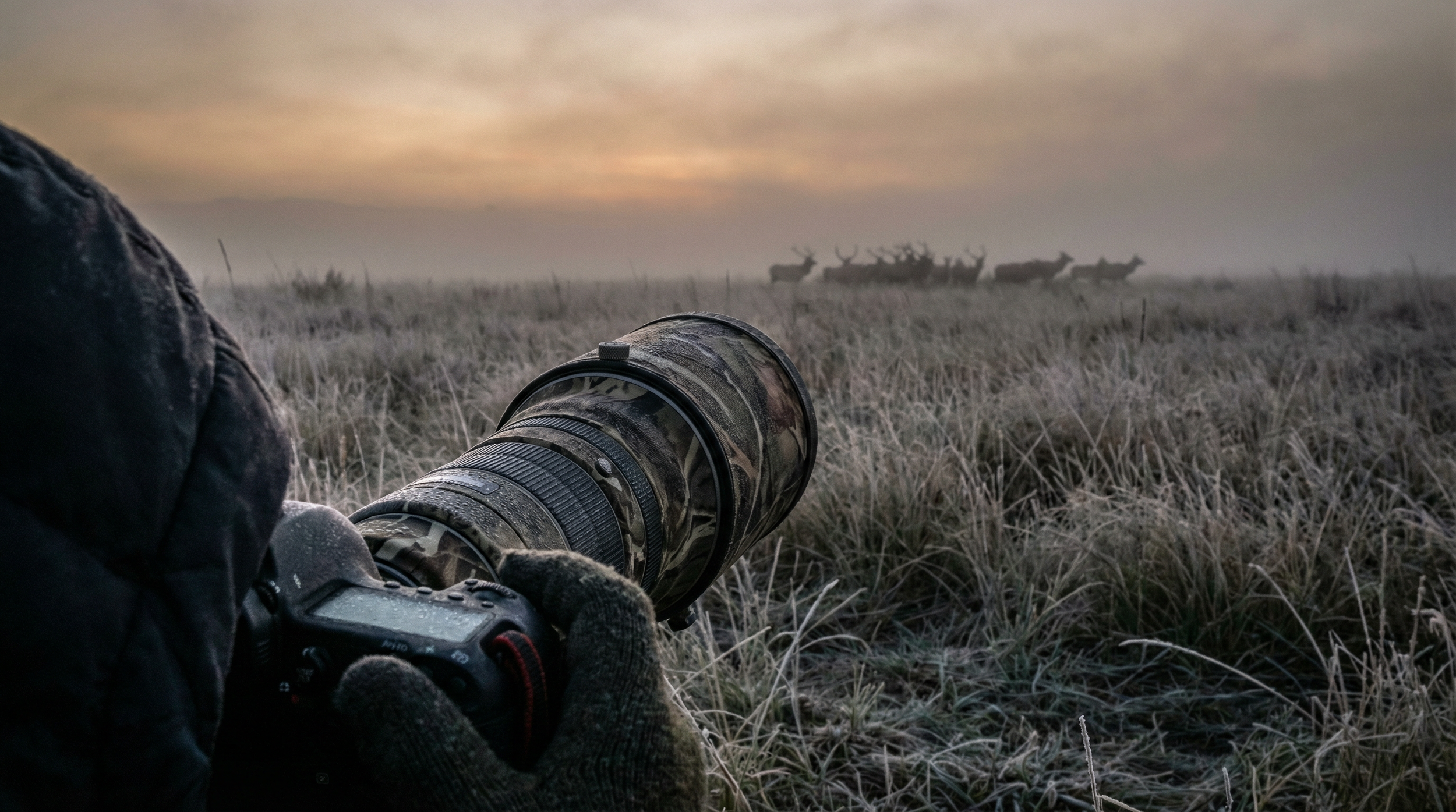
Photographer lying low with a long telephoto lens in a frosty field at dawn

The soul of wildlife photography is being there. If you hiked to a remote location, endured harsh weather, and invested hours of patience to witness a specific behaviour, that has real value. That's the foundation of your photograph.

So why should using AI to overcome your gear's physical limitations invalidate your fieldwork?

AI enlargement or texture refinement doesn't fabricate what the animal did. When a predator chases prey, AI doesn't invent the event. It helps your image reflect what you actually witnessed. It bridges the gap between your equipment's constraints and the magnitude of the moment.

We obsess over the technical "purity" of raw files, but we should focus on the effort required to be standing in that field. Cameras are tools, and every tool has limits. If software rescues a once-in-a-lifetime encounter from being a blurry mess, that's a win.
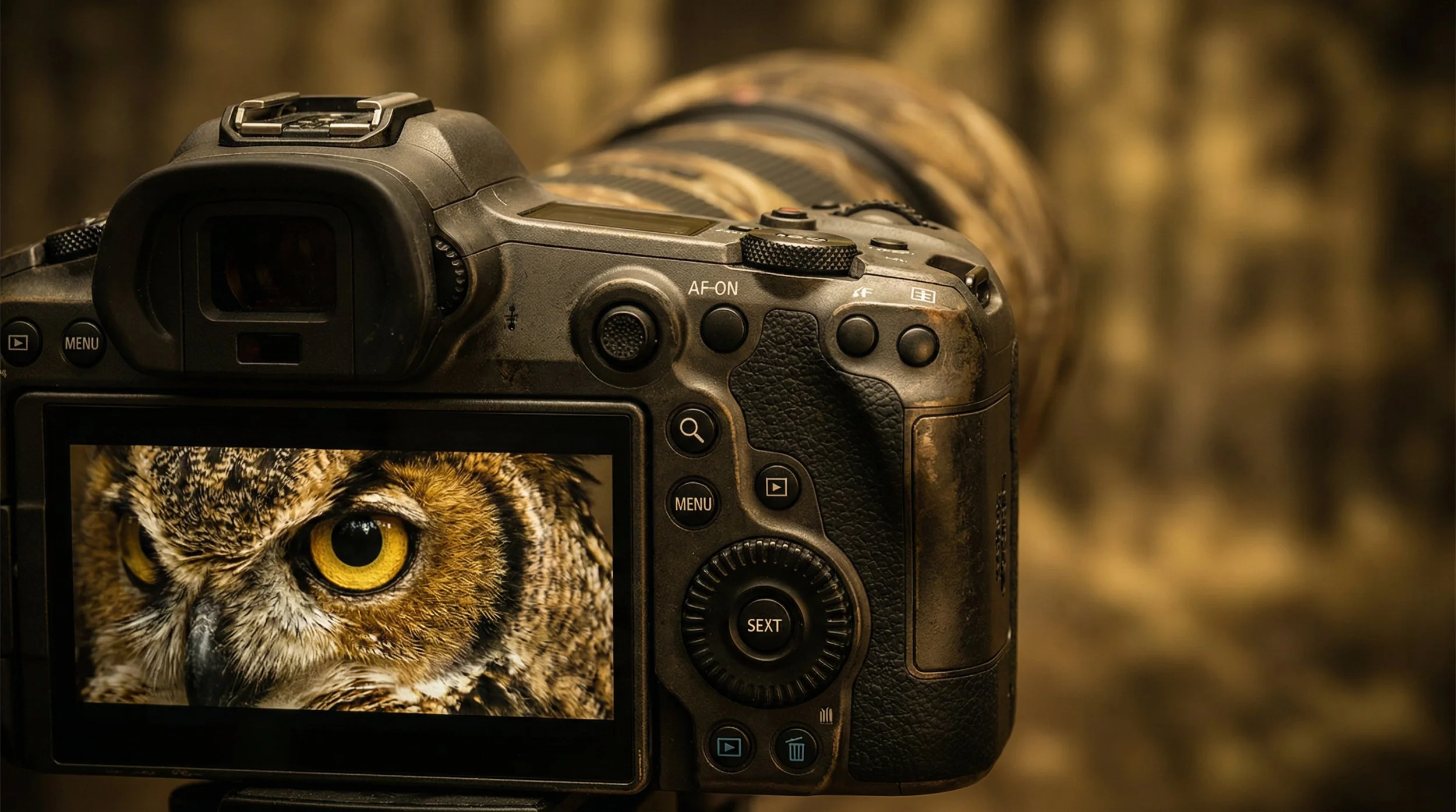
Camera with a long lens showing a close-up of an owl on its rear screen

The truth of wildlife photography isn't in the pixels. It's in the person willing to get cold, wet, and tired to document the natural world.

What's your take?

Does AI enhancement cross a line, or does the real work happen in the field?

I'd genuinely love to hear your perspective.
The Smartphone AI Photography Controversy: What's Really Going On?

The smartphone photography world is having a bit of an identity crisis right now, and it's forcing us all to ask an uncomfortable question: when does making a photo look better cross the line into just making stuff up?

Samsung's Moon Photo Fiasco

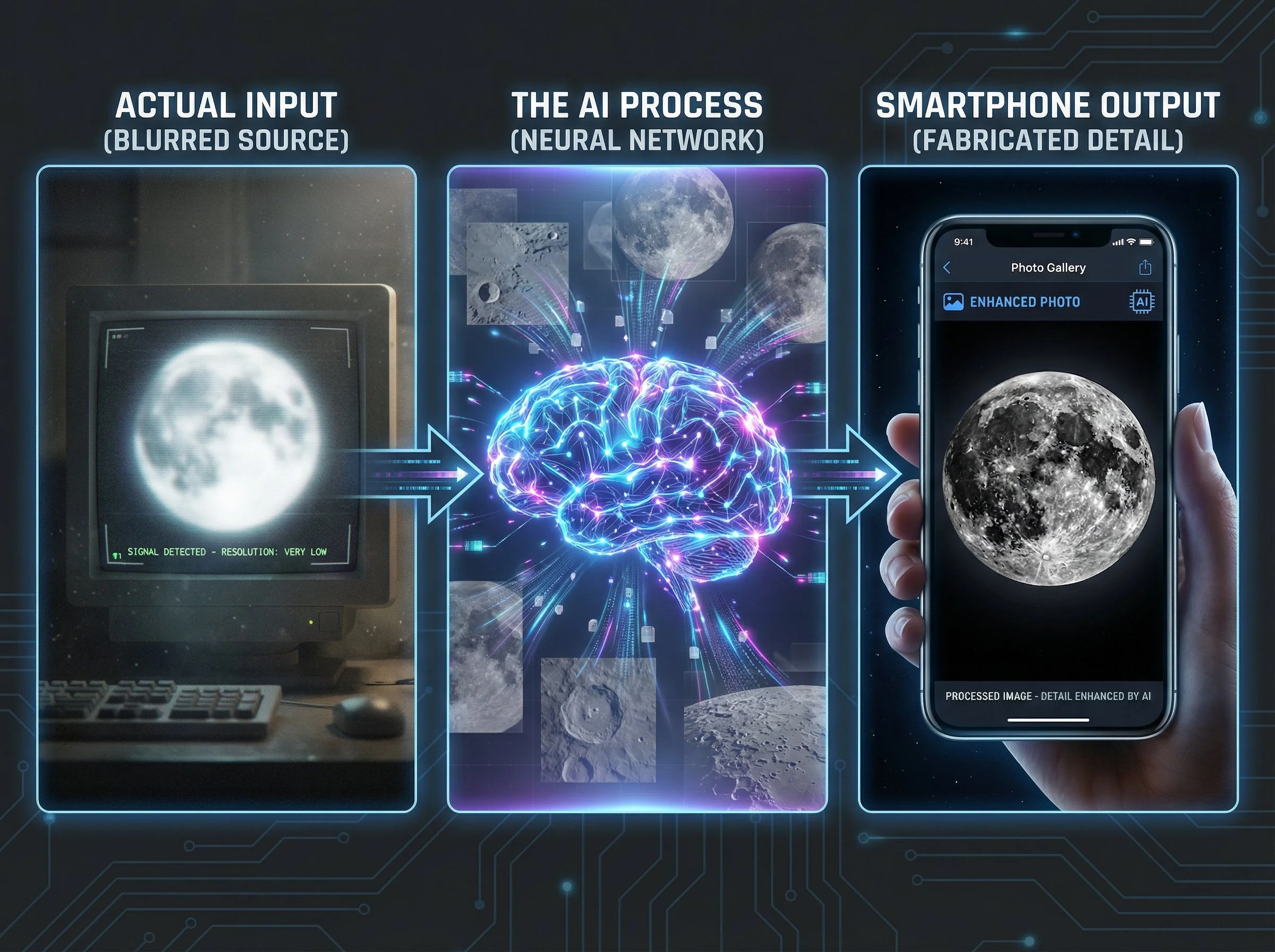
The whole thing kicked off properly in March 2023 when a Reddit user called ibreakphotos ran a brilliant experiment. They took a high-resolution moon photo, blurred it until you couldn't see any detail at all, stuck it on a monitor, and photographed it from across the room using a Samsung Galaxy phone's Space Zoom. What happened next was pretty shocking: Samsung's camera added crisp crater details that simply weren't there in the blurry image.

Illustration of how a smartphone's AI turns a blurred moon photo into fabricated detail

This wasn't your typical computational photography where the phone combines multiple frames to pull out hidden detail. Samsung was using a neural network trained on hundreds of moon images to recognise the moon and basically paste texture where none existed. The company more or less admitted this in their technical explanation, saying they apply "a deep learning-based AI detail enhancement engine" to "maximise the details of the moon" because their 100x zoom images "have a lot of noise" and aren't good enough on their own.

The controversy came back round in August 2025 when Samsung's One UI 8 beta revealed they were working to reduce confusion "between the act of taking a picture of the real moon and an image of the moon". In other words, they admitted their AI creates moon photos rather than capturing them.

Other Companies Are At It Too

Samsung isn't the only one playing this game. Huawei faced similar accusations with its P30 Pro back in 2019, using AI to enhance moon photography beyond what the camera actually saw. The pattern is pretty clear: smartphone manufacturers are using AI to make up for physical limitations that no amount of clever software can genuinely overcome.

Google's Approach to Reality

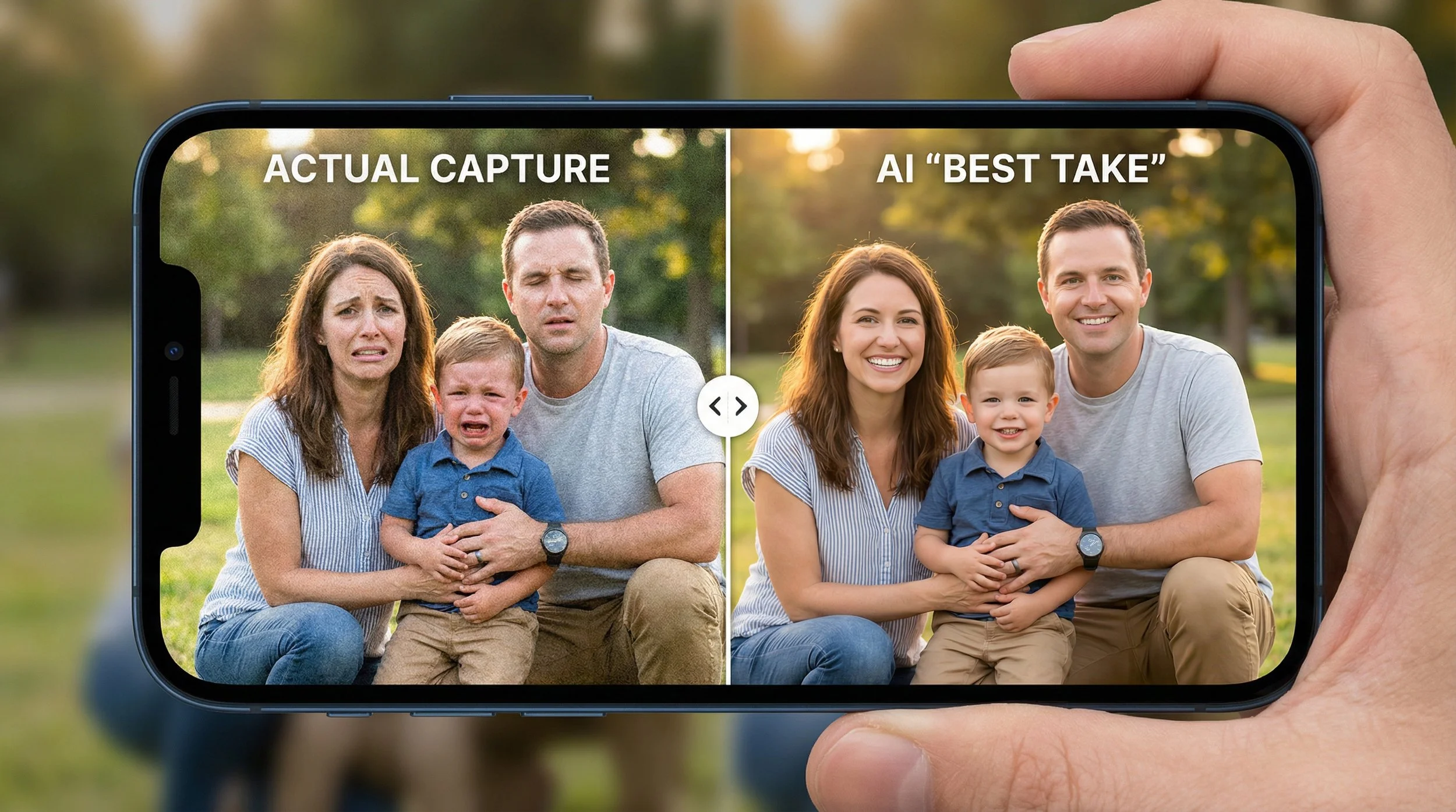
Google went in a slightly different direction with the Pixel 8 and 8 Pro, introducing "Best Take", a feature that swaps facial expressions between different photos in a sequence. If someone blinks or frowns in a group shot, the phone finds a better expression from other photos and drops it into your chosen image.

Phone screen comparing an actual family photo with an AI best take version

They also launched "Magic Editor", which lets you erase, move, and resize elements in photos (people, buildings, whatever) with AI filling in the gaps using algorithms trained on millions of images. These tools work on any photo in your Google Photos library, not just ones you've just taken.

Tech commentators called these features "icky", "creepy", and potentially threatening to "people's (already fragile) trust of online content". Google's Isaac Reynolds defended the approach by saying that "people don't want to capture reality, they want to capture beautiful images" and calling the results "representations of a moment" rather than documentary records.

Photographers Are Fighting Back

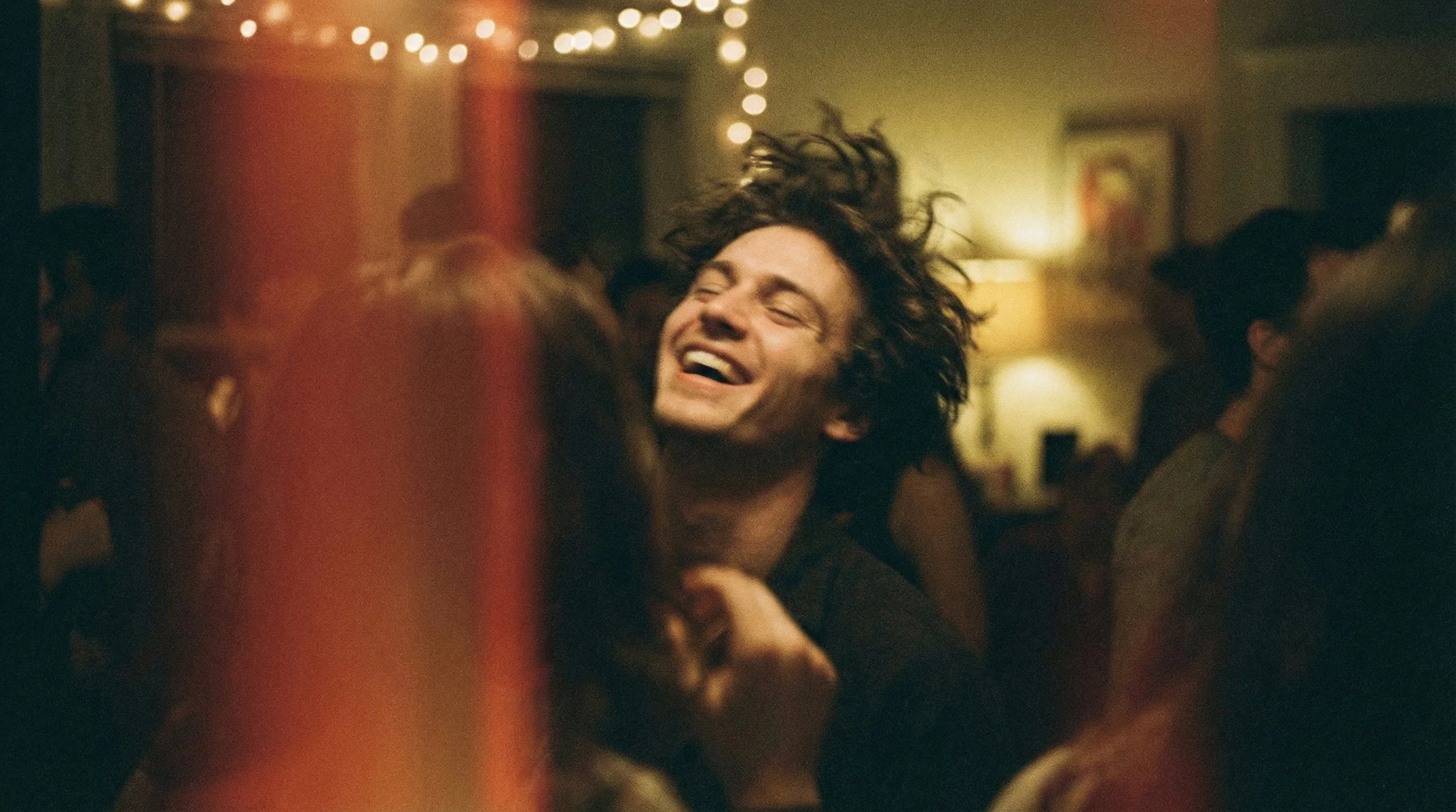
The controversy has created what some observers call a "perfection paradox". As AI became capable of churning out flawless imagery at industrial scale in 2025, perfection itself lost its appeal. Social feeds filled up with technically immaculate visuals, but the images actually getting attention were the ones showing signs of real human touch.

Smiling young man photographed in a warmly lit room

Professional photographers responded by deliberately embracing film grain, motion blur, quirky colours, accidental flare, and cameras with intentional limitations. The message is clear: authenticity and imperfection have become the things that set you apart in an AI-saturated landscape.

One photographer noted that when clients were offered choices between AI-crafted footage and work shot by humans with clear creative perspectives, they "still gravitated to the latter". Despite AI's technical achievements, there's still a "gap between technological capability and cultural readiness".

The Trust Problem

The fundamental issue is that smartphone manufacturers market these AI enhancements as camera capabilities without clearly telling users when AI is manufacturing details rather than capturing them. Samsung's moon photos showcase this perfectly. Users think they've captured incredible detail through superior hardware and processing, when actually the phone has just overlaid trained data.

Professor Rafal Mantiuk from the University of Cambridge explained that smartphone AI isn't designed to make photographs look like real life: "People don't want to capture reality. They want to capture beautiful images". However, the physical limitations of smartphones mean they rely on machine learning to "fill in" information that doesn't exist in the photo, whether that's for zoom, low-light situations, or adding elements that were never there.

What's Happening Next

There's growing pressure on the industry for what's being called "the year of AI transparency" in 2026. People are demanding that manufacturers like Samsung, Apple, and Google disclose when and how AI is manipulating photos.

Illustration of a smartphone scanning a photo and detecting AI-generated content

Google has started responding with detection tools, rolling out AI detection capabilities through Gemini that can spot artificially generated photos using hidden SynthID watermarks and C2PA metadata. These watermarks stay detectable by machines whilst remaining invisible to human eyes, surviving compression, cropping, and colour adjustments. The system analyses images on-device without sending data to external servers.

Samsung, meanwhile, continues embracing AI integration. They recently published an infographic declaring that future cameras "will only get smarter with AI" and describing their camera as "part of the intuitive interface that turns what users see into understanding and action". This language notably sidesteps the authenticity questions that plagued their moon photography feature.

The Cultural Pushback

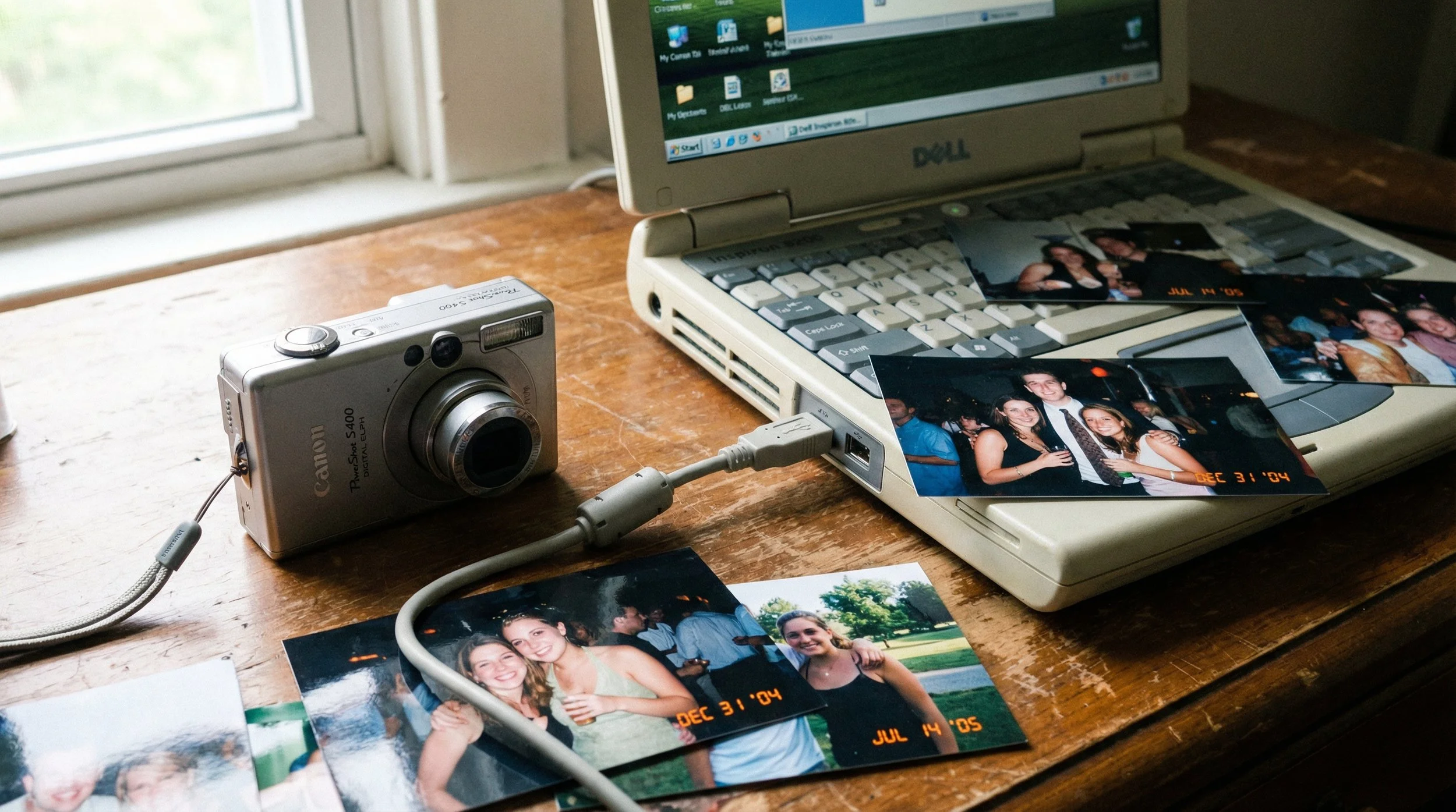
Perhaps most tellingly, younger users are increasingly seeking cameras that produce "real" and "raw" photos rather than AI-enhanced imagery, driving a resurgence of early-2000s compact digital cameras. This represents a rebellion against smartphone AI manipulation and a genuine desire for photographic authenticity.

Compact camera and printed photos on a desk beside an old laptop

The controversy forces a broader reckoning about what photography means in the AI era. As one analysis noted, 2025's deeper story wasn't simply that AI improved, it was "the confrontation it forced: what counts as real, what counts as ours, and what creativity looks like when machines can mimic almost anything".

The Bottom Line

The core issue is straightforward: smartphone manufacturers are using AI to create photographic details that cameras never actually captured, then marketing these capabilities as camera performance rather than AI fabrication.

Companies haven't clearly disclosed when AI is manufacturing versus enhancing, which is eroding trust in smartphone photography. Real photographers are differentiating themselves by embracing authenticity and imperfection as AI floods the market with technically perfect but soulless imagery.

And 2026 is shaping up as a pivotal year for AI transparency demands and authenticity verification tools.

This controversy represents more than just technical debates. It's fundamentally about trust, authenticity, and what we expect from our photographic tools in an increasingly AI-mediated world.

Picture This - A Musical Gift 🎸

I was left completely speechless when I logged in to our weekly coffee hour with members of The Photography Creative Circle and found far more people there than usual. I soon found out why. Member and dear friend Jean-François Léger began reading out something he'd prepared, a surprise from the group about how the community had grown since I started it around six months earlier. People had joined to learn, to master their cameras and refine their editing, but it quickly became something much deeper: a place where we share our lives, celebrate our successes and support one another through difficult times. This video, Picture This, is the musical gift that came with it, with the words, music, mix, filming and editing all by Jean-François.

Catching the New Years Day Sunrise 2026 ☀️

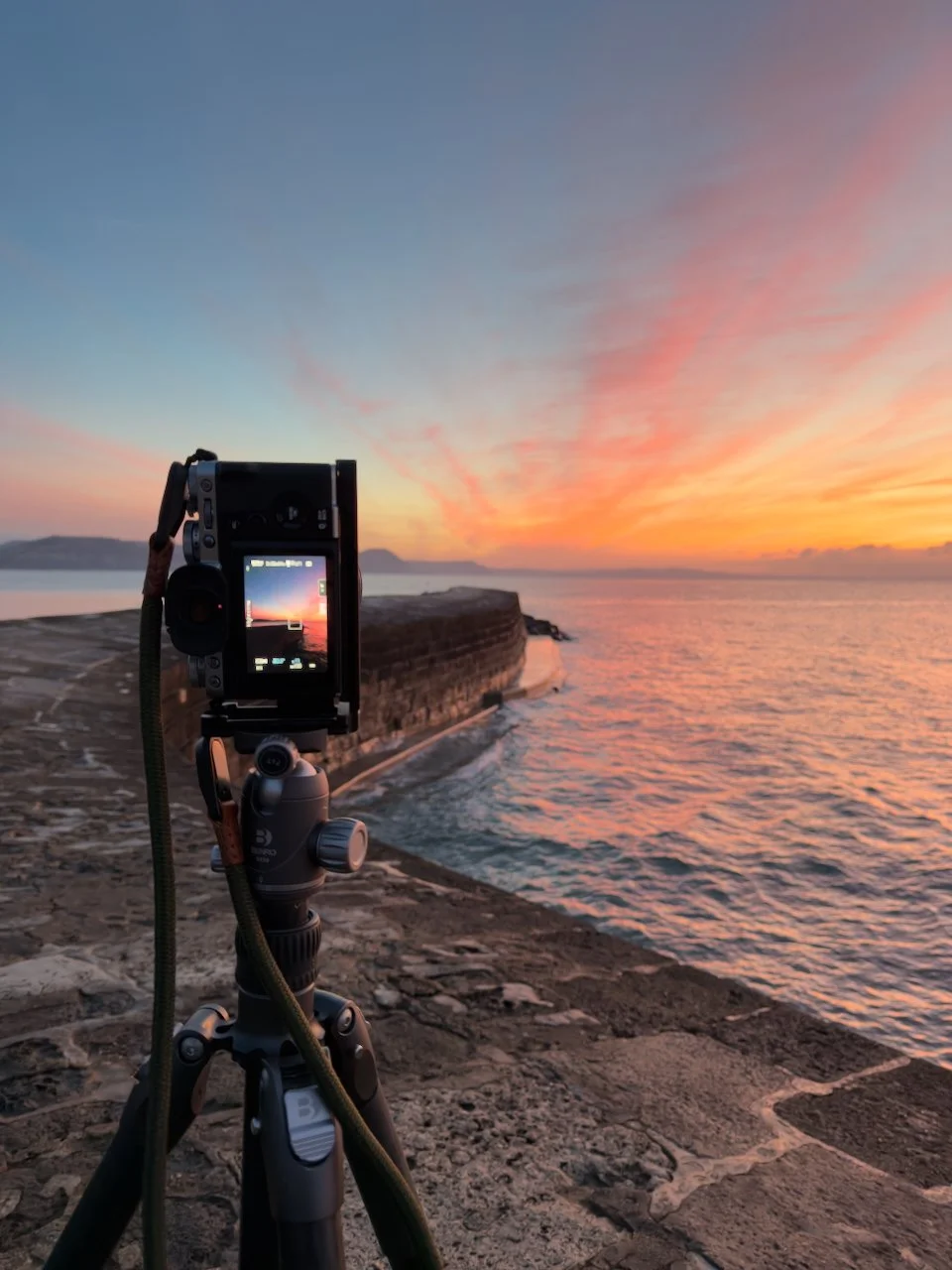
Got up early and popped down to the local beach to photograph the sunrise, and Mother Nature did not disappoint 😍

Happy New Year 🎉

Curving stone harbour wall stretching out to sea under a vivid red and pink sunrise sky

Fuji X-T5
Fuji 18mm f/1.4 @ f/11
2.5 sec, f/11 , ISO 125

NiSi 3 Stop JetMag Pro ND Filter

Benro Rhino Carbon Fibre Tripod

Camera on a tripod on a harbour wall framing an orange sunrise over the sea

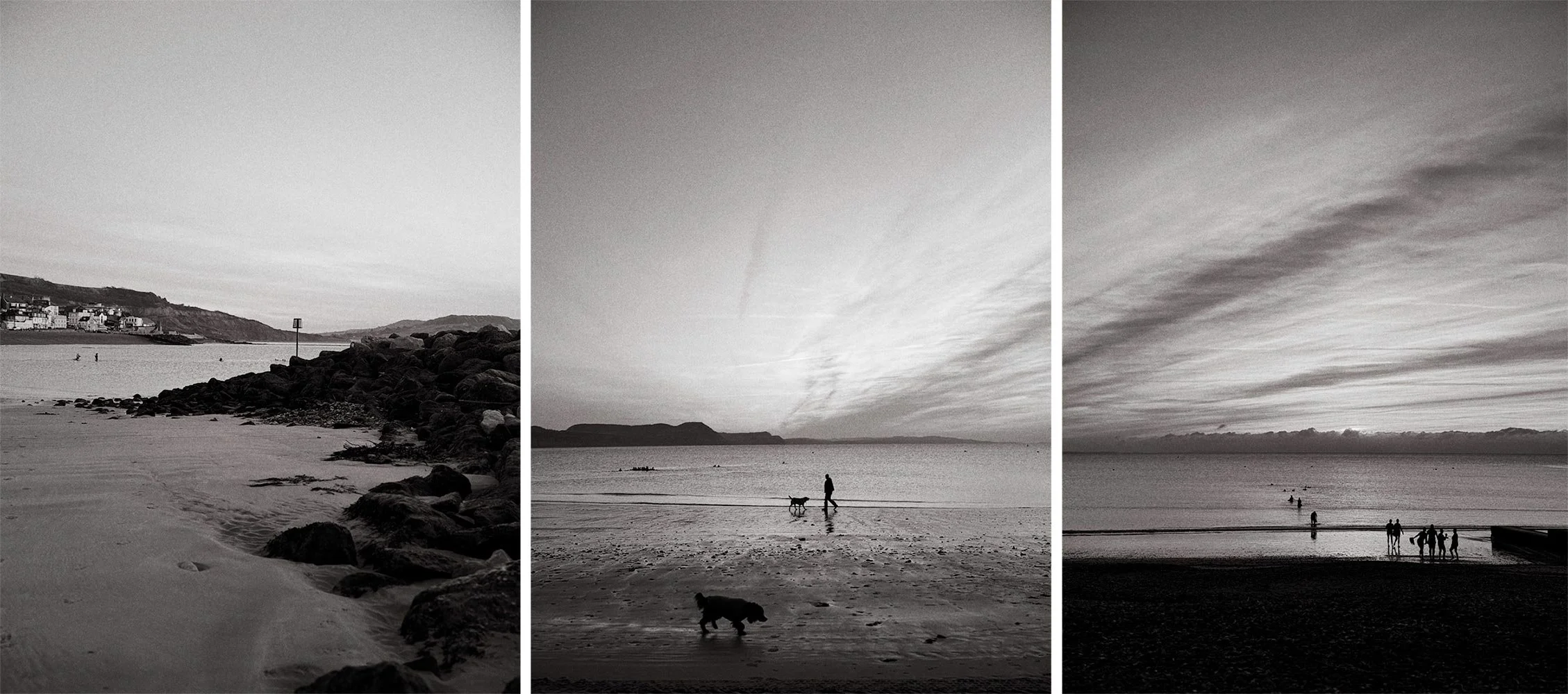
Images below captured on my iPhone 17 Pro Max using the Leica Camera App and the Greg WLM B&W setting…

Three black and white photos of a beach and coastline, one with a person walking a dog

Why "Digital Infinity" is Killing Your Creativity (and How to Fix It)

We often see videos on YouTube claiming that one "magic trick" will change your life, but they usually fall a little bit flat. However, I recently ran an experiment in our creative community that I don't just believe will transform your photography, I know it will.

We live in an age of "digital infinity." Our phones can hold thousands of images, and it costs us absolutely nothing to press the shutter button. But this unlimited choice has a hidden downside: it can make us lazy.

To combat this, I set a challenge for our photographers that was brutally simple, and the results were completely unexpected.

The 10-Exposure Challenge

The rules were designed to strip away the safety nets we've become so reliant on:

  1. Only 10 exposures. That's it.

  2. No fixing it in post. What you shoot is what you get.

  3. No do-overs. If you click it, it counts, even if it's an accidental selfie.

The "Maddening" First Step

For many, the first reaction wasn't creative bliss; it was pure frustration. We had a studio photographer, Sarah, who is used to total control over lighting and props. Suddenly, out in the real world with only 10 frames, that control vanished. She described the experience as "maddening."

Another photographer, Francois, usually shoots a hundred frames just to get one perfect food shot. Having to tell the entire story of a meal in just 10 frames was a massive mental shift.

The Turning Point: Slowing Way Down

Once the frustration settled, something powerful happened. The photographers started to see this limitation as a lens that focused their attention.

They were forced to stop, look, and truly see what was in front of them. One member, Brian, took the challenge on his usual 90-minute walk. It ended up taking him three hours to take just 10 photos. That is the pace of deliberate creation.

What We Learnt

This challenge acted like a time machine, throwing us back to the discipline of the film era where every shot cost money. Here are the big takeaways:

  • Visualise first: We rediscovered the importance of walking around and using our eyes to find the angle before ever lifting the camera.

  • Embrace imperfection: Francois realised that his industry's obsession with "perfection" wasn't authentic. By embracing little imperfections, his photos felt more real and more appetising.

  • Constraint is liberating: Without the pressure of endless choices and editing, the simple act of taking a picture became joyful again.

The Final Verdict

Would they do it again? It was a resounding yes across the board. One member was so inspired he actually went back to shooting on real film.

The value wasn't really in the final 10 images; it was about rediscovering a mindful, deliberate way of working.

So, I have a question for you. In a world of unlimited options, what's one constraint you could impose on yourself to unlock a new level of creativity?

Give this challenge a go. I guarantee you'll see a difference and feel like an artist again.

✅ 5 EASY POSING TIPS for EVERY Beginner Portrait Photographer 📷

If you find yourself struggling to pose the people you photograph, this video is for you. I break down five super simple posing tips that will give you great results. They're aimed at anyone who's new to portrait photography, but they're just as useful if you've been at it a while and simply want to improve. None of them are complicated, and each one is easy to put into practice the next time someone steps in front of your camera.

Photographing Cars with my iPhone 15 Pro Max

Now primariy I’m a Portrait Photographer however this past few weeks, for the fun of it, I’ve been experimenting with my iPhone to see how it would fare when taking pictures of my car … both still and moving.

So a few weekends back I met up with friends in South Wales and headed to Crickhowell; an area I’ve photographed in before when working on this Harley image …

Man in a red checked shirt on a motorbike beside a winding road

kit used

For these car photographs I was using my iPhone 15 Pro Max along with …

  • Polar Pro iPhone Case

  • 67mm Filter Adaptor + 67mm Circular Polarising Filter

  • ReeFlex Pro Camera App

Black smartphone case with a filter mount for iPhone photography
Magnetic filter adapter ring for an iPhone camera
ReeFlex camera app logo

The circular polariser is the car photographers secret weapon because of how effective it is in reducing / removing reflections in the car windows and on the bodywork …

Blue hatchback photographed with and without a circular polarising filter, side by side

I used the ReeFlex Pro Camera App purely so that I could use shutter speed and ISO to lock in the exposure that I wanted.

Here’s the ‘out of camera’ result …

Blue hatchback parked by a road in open moorland under a cloudy sky

Here’s the final retouched image which was done using Lightroom Desktop.

I also added a long exposure effect to the clouds using a technique in Photoshop which works really well however now I want to do the shoot again and capture it all ‘in camera’ using a long exposure app like ReeXpose or EvenLonger 😃

Blue hatchback on a moorland road under a dramatic, moody sky

I also tried some panning shots and did get some results, however the ratio of keepers to rejects was very low.

I was trying to do this using the ReeFlex App and a Neutral Density Filter on the front of the iPhone so that I could lock in an exposed photographed at 1/30 second. However, the ReeFlex app at the time I did this did NOT have burst mode. This meant I was having to try to capture a single frame as I panned with the car passing at no more than 30 mph.

Here’s an edited result of what I managed to capture …

Blue hatchback on a road through golden moorland

Later having shared this image online I spoke with a friend of mine who is a Professional Car Photographer. It was great to hear that he was impressed with the results expecially considering they were from an iPhone but he also gave me some settings that he and other pro car photographers use to capture a moving car.

My friend told me that moving car shots often see the car travelling at no more than 20 mph and that they also use a shutter speed of around 1/15 sec or 1/20 sec … but ALWAYS shoot in burst mode.

So armed with these settings I set about finding a pro camera app that would allow me to manually dial in the shutter speed but that also had Burst Mode; and the app I turned to was MOMENT.

Camera app logo with a letter M in a circle

I’ve yet to use the app in a planned car shoot however when in Germany a couple of weeks back I was waiting for a friend to pick me up and whilst waiting near a fuel station forecourt I attached the Variable Neutral Density Filter to my iPhone using the Polar Pro Case and Adaptor, and set the shutter speed using the MOMENT app.

I then simply took a burst of panning shots of passing cars as they negotiated a roundabout and drove away, which from my position would have meant them travelling around 20 mph.

Here’s some of the results …

Panning shots of cars on a road with motion-blurred backgrounds

So, yeah I’ve been very impressed with how the iPhone has dealt with this and the results I’ve managed to get.

Lots more experimenting and fun to be had!

The Photographer’s Guide to Lifelong Learning and Creative Growth | Marco Ter Beek

In this live broadcast recording I chat with professional photographer Marco Ter Beek about lifelong learning and creative growth. We discussed why it's so important to keep being a student if you want to grow, how that helps you find inspiration and stay creative, and how it ultimately leads to creating work you can be proud of. It's a conversation about the mindset behind the photographs as much as the photographs themselves.

links mentioned in the video:

Portrait of a woman with long dark hair in a white strapless top, looking over her shoulder
Portrait of a man with a grey beard in a grey beanie and black roll neck against a dark background
Boxer in red standing in a boxing ring under bright arena lights, seen from behind
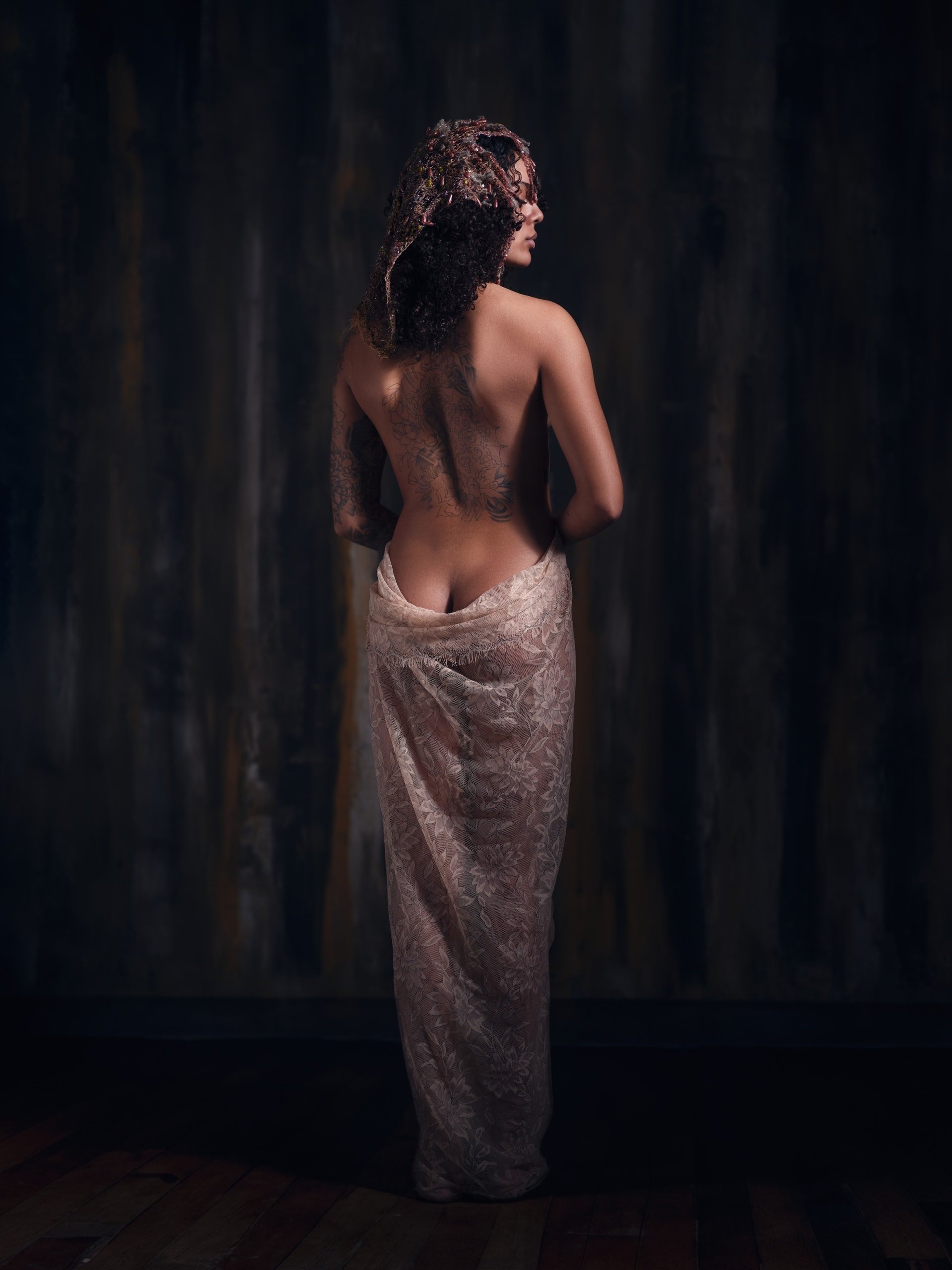
Woman seen from behind in a draped white skirt with a bare back, in a dark room
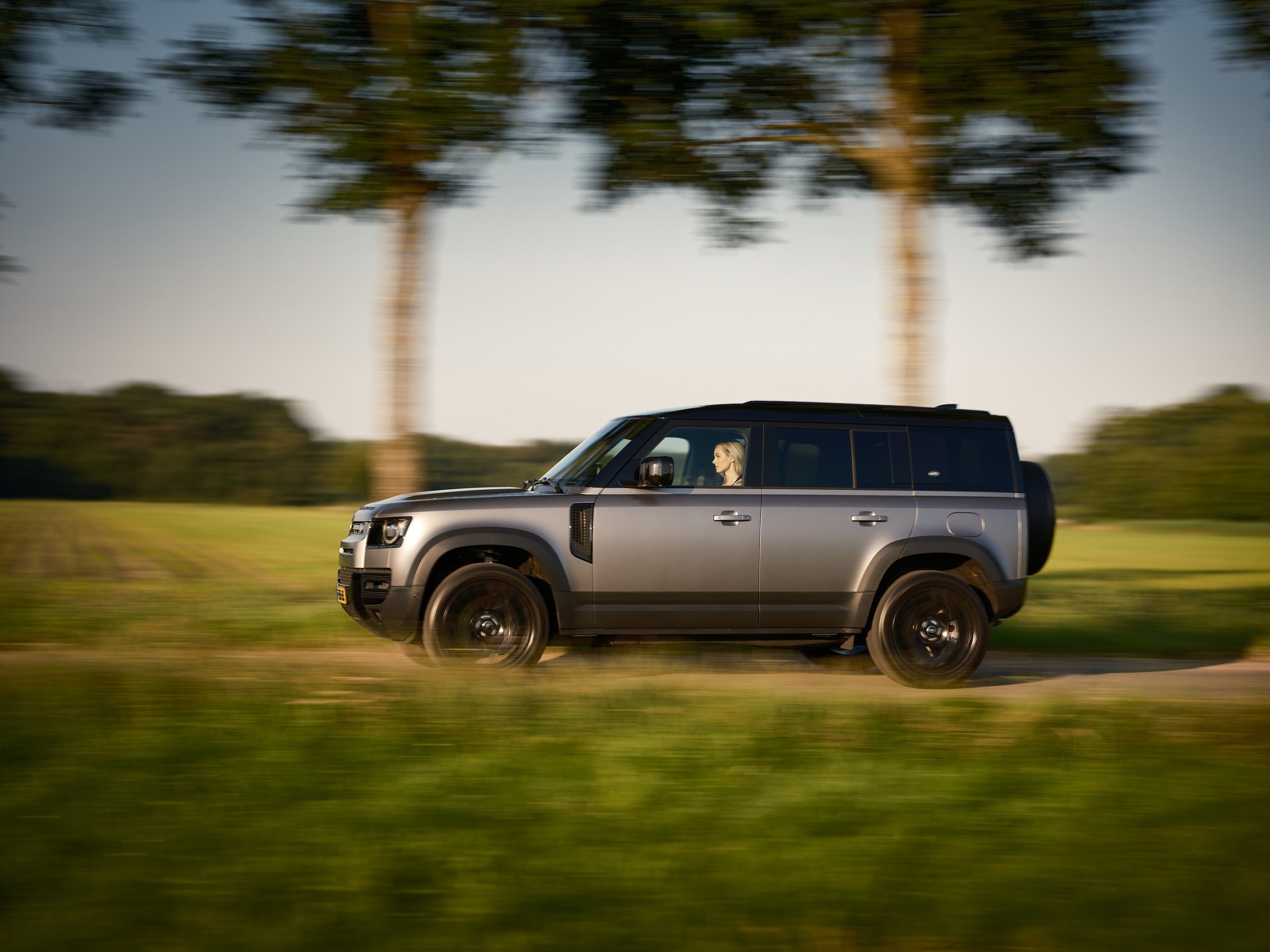
Grey Land Rover Defender driving along a country road with motion-blurred trees

Latest Gear, News and Events with The Photography Insider - Mark Baber

This is the recording of a live broadcast where I chatted with Mark Baber, The Photography Insider and Events Manager at London Camera Exchange, about the latest gear, news and events from within the photography industry. Alongside the gear and news, we talked through the kind of events London Camera Exchange runs, from experience days and hands-on sessions to workshops, and looked ahead to The South West Photography Show and The Photography Show 2025.

links mentioned during the LIVE Episode…

  • London Camera Exchange: ( LINK )

  • LCE Events, Experience Days, Hands-On, Workshops etc … ( LINK )

  • The South West Photography Show - Saturday 24th May 2025: ( LINK )

  • The Photography Show 2025: ( LINK )

The Essential Skills and Attitude for a Successful Photography Business with Pye Jirsa

This is the recording of a live broadcast where I chat with Pye Jirsa, photographer, director, educator and founder of SLR Lounge. Pye's widely known for his captivating wedding photography, but here we talk about his business advice and mentoring: building a solid foundation for a photography business, how to deal with clients, self-worth, dealing with negativity and a whole lot more. If you're running a photography business, or thinking about starting one, there's plenty of practical advice here on both the skills and the attitude it takes.

links mentioned in the video:

Couple embracing on the crest of a sand dune at sunset, the woman's red dress blowing in the wind
Black and white photo of a couple embracing in an arched colonnade as blurred people pass by
Couple embracing at a city crossroads as a blurred bus streaks past between tall buildings
Tiny couple in red and black standing on a vast reflective salt flat with distant mountains
Groom in a gold sherwani and red turban holding a sword in dramatic angled light